
In brief
The Venetian Lagoon is a 550 km² tidal basin enclosing Venice and roughly 50 smaller islands, from Murano and Burano to the agricultural island of Sant'Erasmo and the wooded grounds of San Clemente. It is best explored over several days using the ACTV vaporetto network, allowing at least a half-day per outer island rather than a single rushed circuit.
At a glance
- Location
- Northern Adriatic coast, Veneto, Italy
- Best for
- First-time orientation, multi-day island itineraries
- Time needed
- 3–5 days to see the lagoon beyond central Venice
- Getting around
- ACTV vaporetto (public waterbus); private water taxi for speed
- Access note
- Many island landing stages have step-on/step-off boats only — check accessibility with ACTV before travelling
- Last checked
- August 2026
A city made of water, not built beside it
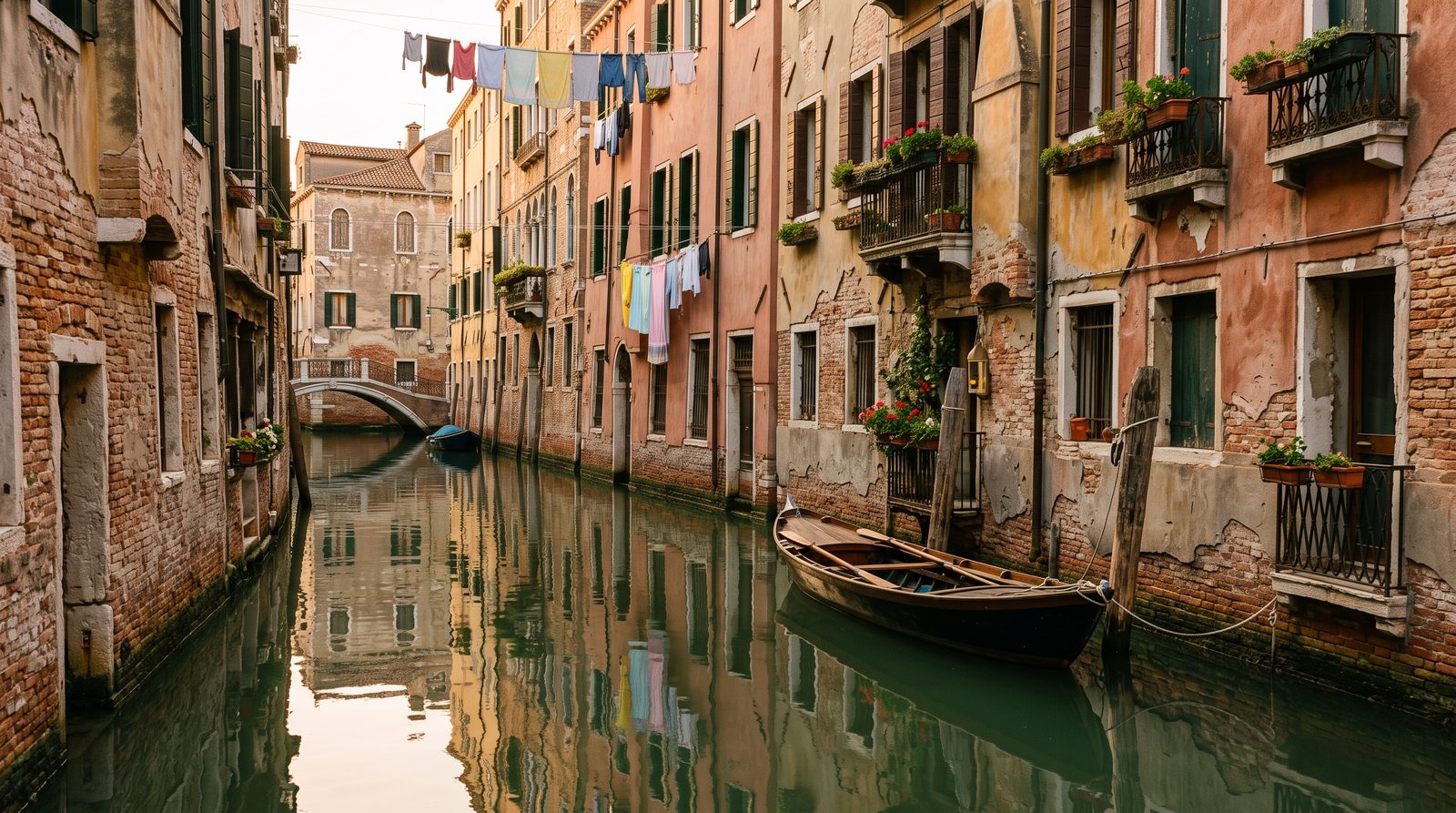
It is easy to think of Venice as a single historic city that happens to sit near water. In fact the reverse is closer to the truth: the lagoon came first, a shallow tidal basin sheltered from the Adriatic by a long chain of barrier islands, and the settlements that became Venice were built inside it, on wooden piles driven into the mud of dozens of separate islets. Understanding the lagoon's shape is the fastest way to understand why the city works the way it does — why there are no cars, why addresses are organised by sestiere rather than street grid, and why so much of daily life still runs on tide tables.
The lagoon stretches roughly 50 kilometres along the coast and up to 15 kilometres inland, enclosed by barrier islands including the Lido and Pellestrina. Three inlets — the Lido, Malamocco and Chioggia openings — let the Adriatic tide in and out twice a day, a rhythm that shapes everything from boat schedules to the acqua alta flooding events of autumn and winter.
The islands worth knowing
Central Venice is itself an archipelago of around 118 islets fused by bridges into six sestieri: San Marco, Cannaregio, Castello, Dorsoduro, San Polo and Santa Croce. Beyond that historic core, the outer lagoon holds a scattered set of islands each with a distinct character.
Murano, a short vaporetto ride north, has been the centre of Venetian glassmaking since furnaces were relocated there by decree in 1291 — officially for fire safety, though it also let the Republic keep closer watch on a valuable trade. Burano, further out, is known for lace-making and a grid of small houses painted in colours that, according to local tradition, once helped fishermen find their way home through fog. Torcello, largely marshland today, was a thriving settlement before Venice itself and holds the lagoon's oldest surviving church, the Basilica di Santa Maria Assunta, founded in 639. Sant'Erasmo remains a working agricultural island, supplying much of the produce sold in Rialto's markets. Giudecca, a short hop from Zattere, mixes former industrial buildings with gardens and quiet residential streets. And San Clemente, a wooded islet in the southern lagoon with a documented monastic history stretching back to the twelfth century, offers one of the most complete views back toward the Venice skyline.
How to move through the lagoon
The ACTV vaporetto network is the lagoon's public transport backbone: numbered routes connect central Venice to Murano, Burano, Torcello, the Lido and beyond, running on a published timetable that is worth checking the same day, since outer-island frequency drops sharply outside peak season. A multi-day ACTV pass is usually better value than single tickets for anyone visiting more than two islands. Private water taxis cost considerably more but cut travel time and run on demand, which matters most for early or late departures when vaporetto frequency thins out.
A common mistake is treating the outer islands as a single half-day loop. Murano, Burano and Torcello sit along different routes and a rushed combined trip usually means arriving everywhere at the busiest hour and leaving with only a photograph, not an impression. Splitting them across two calmer visits — ideally starting early, before the mid-morning tour boats arrive — gives a truer sense of each island's own pace.
Visiting responsibly
The lagoon is a working environment as much as a scenic one: a fishing ground, a source of drinking water management challenges, and home to residents whose daily life is increasingly affected by visitor volume. Staying on marked paths on smaller islands, avoiding peak-hour crowding on Burano's narrow lanes, respecting no-swimming and no-mooring signage, and buying directly from island producers on Sant'Erasmo and Burano are small, concrete ways to visit without adding unnecessary strain to fragile places.
Which lagoon islands should you visit first?
For a first visit, Murano and Burano cover craft and colour in a single accessible day; Torcello rewards travellers willing to spend longer for quiet and history; Giudecca suits anyone wanting lagoon views without leaving city transport links; and San Clemente or Sant'Erasmo suit those with more time who want to see the lagoon's quieter, working edges.
Sources
- Comune di Venezia — Venice municipal tourism and mobility information
- ACTV / Venezia Unica — public transport routes and timetables
- Fondazione Musei Civici di Venezia — Museo del Vetro (Murano glass history)
- Basilica di Torcello — historical documentation, Diocese of Venice
This article was independently researched and produced. No payment, complimentary service or editorial approval was provided by the places mentioned.