
In brief
Genuine Murano glassmaking is hand-formed at a furnace exceeding 1,000°C, using techniques including blowing, lamp-working and murrine (patterned cane) work. A worthwhile demonstration shows a maestro actually shaping a piece with visible tools and technique, not just a finished display; authentic work carries the Vetro Artistico Murano trademark, distinguishing it from imported glass sold nearby under similar branding.
At a glance
- Where
- Murano, a short ACTV vaporetto ride from Fondamente Nove
- History
- Furnaces relocated to Murano by Venetian decree in 1291
- Authenticity mark
- Vetro Artistico Murano trademark, verified by Consorzio Promovetro Murano
- Time needed
- Half a day, including travel and the Museo del Vetro
- Best for
- Visitors interested in craft process, not only finished objects
- Last checked
- July 2026
An industry moved for fire, and for control
Murano's association with glass dates to 1291, when the Venetian Republic ordered the city's glass furnaces relocated to the island, officially to reduce fire risk in a densely built wooden city. That was real and reasonable — furnace fires were a genuine hazard — but it also let the Republic keep its most valuable manufacturing secret, glassmaking technique, more tightly contained on an island the state could watch and control. For centuries afterward, Murano glassmakers held an unusual civic status: permitted to marry into noble families and largely forbidden, under serious penalty, from taking their techniques abroad. That combination of prestige and confinement shaped the trade's culture in ways still visible in how furnace families operate today, often multi-generational and protective of technique passed down rather than formally published.
What a furnace actually does
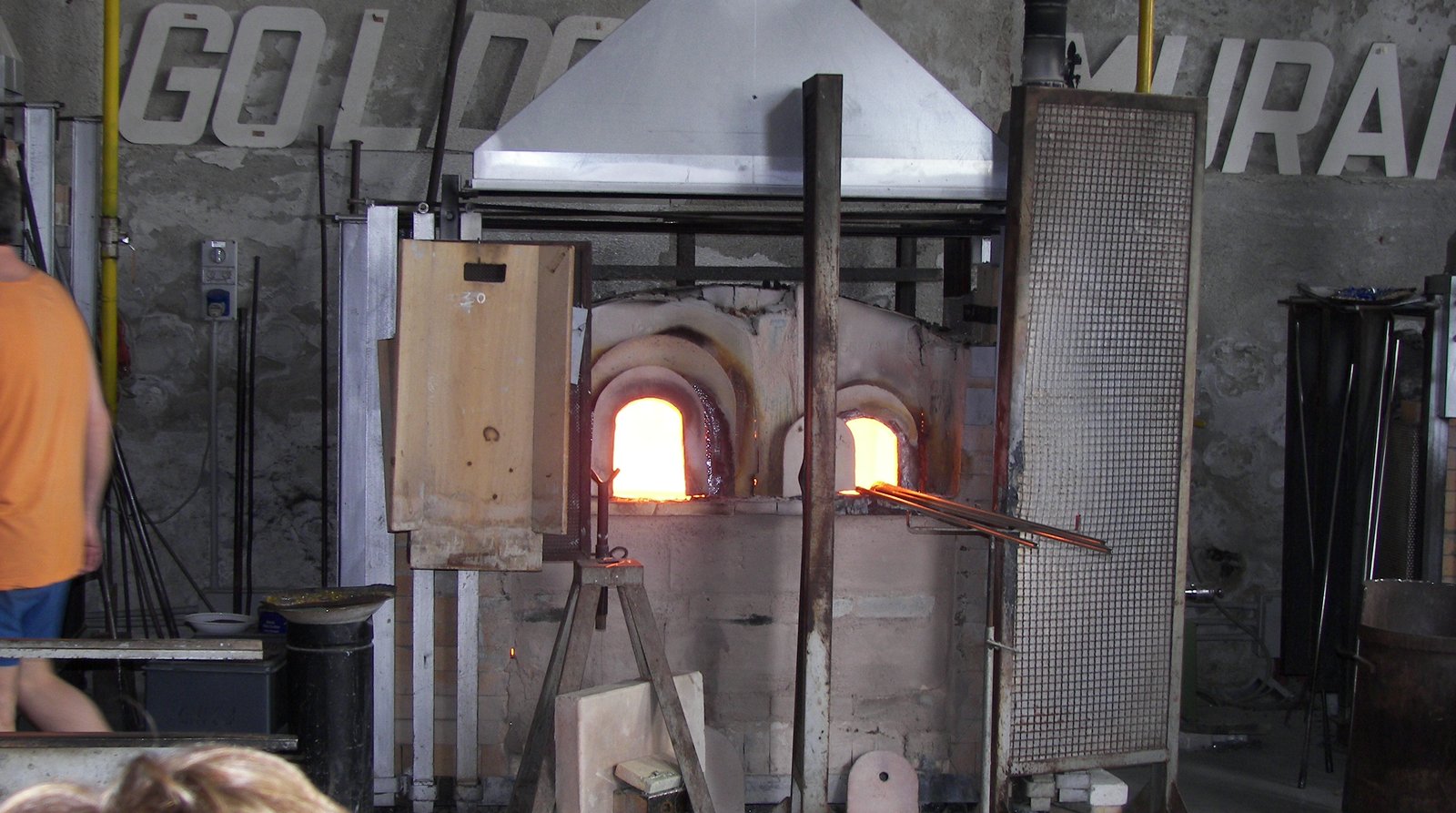
A working furnace runs at temperatures exceeding 1,000°C, keeping a molten glass mixture — silica sand, soda ash and stabilisers, along with mineral additives for colour — in a constantly workable state. A maestro gathers molten glass on the end of a blowpipe or pontil rod, then shapes it through a sequence of blowing, rolling on a marver table, and tooling with shears, paddles and tongs, working fast because the glass cools and stiffens within seconds and must be reheated in the furnace's mouth (the "glory hole") repeatedly through the process. Watching this in person, rather than in a video, is what makes a demonstration worthwhile: the speed, the coordination between maestro and assistant, and the sheer physical heat of the room are impossible to convey any other way.
Beyond blowing: murrine and lamp-work
Blown glass gets most of the attention, but Murano's technical range is wider. Murrine work involves building a patterned glass cane — sometimes with a flower or geometric motif visible in cross-section — then slicing it into discs that are fused onto or into other pieces, a technique requiring extremely precise layering before the cane is even drawn. Lamp-working, done at a smaller torch rather than a furnace, produces finer detail work, including glass beads (the perle e conterie trade, a Venetian export for centuries — see our companion piece on Venetian artisan workshops) and small figures. A demonstration that only shows blowing is showing one slice of a much broader craft.
Telling a real demonstration from a sales routine
Not every glass "demonstration" on Murano is equal. Some are genuine, unhurried looks at a maestro's actual working process, sometimes as part of a scheduled visit to a working furnace; others are brief, heavily choreographed shows timed to end directly at a shop counter, designed to move groups through as quickly as possible. Neither format is inherently dishonest, but it is worth knowing which one you are watching. A useful marker: genuine demonstrations tend to happen at a furnace that is also a working production space, with visible signs of ongoing manufacture — annealing ovens, stacked raw materials, finished and unfinished pieces in process — rather than a space that functions primarily as a retail showroom with a small stage attached.
The authenticity mark worth knowing
A meaningful share of the "Murano glass" sold in and around Venice is not made on Murano at all — cheaper glass, often produced abroad, is sold under Murano-adjacent branding to visitors who have no easy way to verify it. The genuine article carries the Vetro Artistico Murano trademark, a certification mark administered by the Consorzio Promovetro Murano, the trade consortium representing the island's authentic furnaces; pieces bearing it come with documentation tracing them to a specific certified furnace. Asking directly whether a piece carries this mark, before buying rather than after, is the single most useful question a visitor can ask on the island.
Pairing a demonstration with the museum
The Museo del Vetro, part of the Fondazione Musei Civici di Venezia network and housed in the former Palazzo Giustinian on Murano, holds glass spanning from Roman-era pieces through the Republic's golden age to contemporary work, and gives useful context before or after watching a live demonstration — it is far easier to appreciate the speed and control of a maestro's work having first seen, at a slower pace, what centuries of refinement produced. Visiting both in the same half-day trip, rather than only the demonstration, rewards the extra hour.
Is it worth the trip if you won't buy anything?
Yes. The craft itself — heat, coordination, speed, the almost choreographed handoffs between a maestro and an assistant — is worth witnessing independent of any purchase, in much the same way a live music performance has value beyond whether you buy the recording afterward. Treat the shop, where one exists, as optional rather than the point of the visit, and the demonstration reads very differently.
Sources
- Fondazione Musei Civici di Venezia — Museo del Vetro, Murano glass history and collections
- Consorzio Promovetro Murano — Vetro Artistico Murano trademark and authenticity certification
- Comune di Venezia — Murano heritage and craft trade information
This article was independently researched and produced. No payment, complimentary service or editorial approval was provided by the places mentioned.