
In brief
Moeche are lagoon green crabs (Carcinus aestuarii) caught in the brief hours after moulting, while their new shell is still soft enough to eat whole. The main season runs roughly October to December, with a smaller spring moult around March and April. Traditionally soaked in beaten egg and fried whole, moeche fishing is a recognised Slow Food Presidio centred on the lagoon's moecanti fishermen.
At a glance
- What it is
- Lagoon green crabs eaten whole, caught just after moulting their shell
- Season
- Main season roughly October–December; smaller spring moult March–April
- Recognised status
- Slow Food Presidio: Moeca di Venezia
- Traditional method
- Held in tanks until moulting, then soaked in egg and fried whole
- Where associated
- Burano and other northern lagoon fishing communities
- Last checked
- July 2026
A crab caught by timing, not luck
Most crab fisheries work by catching the animal whenever it's abundant. Moeche fishing works the opposite way: the crab in question, the common lagoon green crab, is fished essentially year-round, but it becomes moeca — soft, edible shell and all — only in the few hours after it moults, a natural process it goes through as it grows. Outside that narrow window the same crab is simply granchio, tough-shelled and far less interesting on a plate. The entire tradition is built around identifying which crabs are about to moult and being ready the moment it happens, which makes moeche less a catch than a harvest timed almost to the hour.
The biology behind the ritual
Like all crustaceans, Carcinus aestuarii grows by periodically shedding its exoskeleton and forming a new, larger one underneath — a process that leaves it, for a matter of hours, without a hard shell at all. Lagoon fishermen have learned to read the external signs that a crab is close to moulting, sorting likely candidates into small holding tanks, traditionally woven baskets or wooden crates called vieri, kept submerged in lagoon water. Those tanks are checked by hand, repeatedly, sometimes several times a day during the height of the season, because a crab left in the tank too long after moulting will simply re-harden and lose the quality that makes it valuable.
The moecanti of the northern lagoon
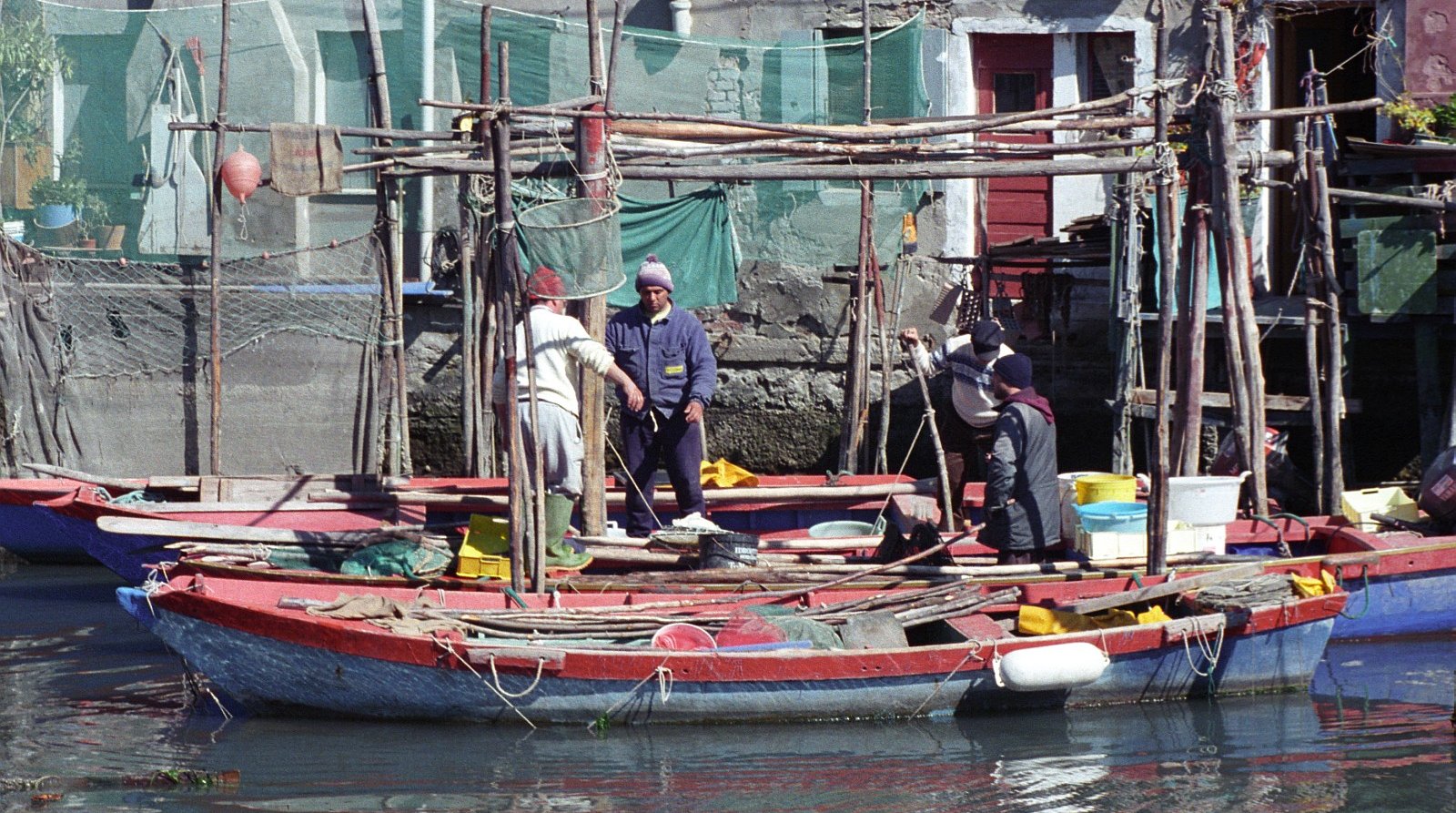
The fishermen who specialise in this work are called moecanti, and the craft is strongly associated with Burano and other small fishing communities scattered across the northern lagoon, where families have passed down both the fishing grounds and the tank-tending routine for generations. It is slow, hands-on, low-yield work — sorting pre-moult crabs (known locally as matte or masenete depending on sex and stage) from the general catch, tending the tanks daily, and pulling out the soft-shelled moeche within a narrow window before they harden again. Slow Food's recognition of the Moeca di Venezia Presidio was explicitly a response to how few people still practise this labour-intensive method, and to the pressure the fishery faces from both an ageing workforce and a changing lagoon ecosystem.
How moeche are eaten
The most traditional preparation is deceptively simple in description and fairly involved in practice: live moeche are submerged in beaten egg, sometimes for a full day, during which they absorb some of the egg before being coated in flour and fried whole in hot oil. The result is eaten entirely — legs, shell and all — with a texture closer to a very delicate soft-shell crab than anything resembling a conventional Italian seafood fritto. It is rich, slightly briny, and served in modest portions given both the cost and the small size of each crab; a plate of moeche is typically an antipasto or a cicchetto-scale portion rather than a main course.
Why the season is so short
The window in which a crab is genuinely soft-shelled lasts only a few hours before the new exoskeleton begins to harden, which is why the tank-checking regime has to be constant during the peak weeks of the season, roughly clustered in autumn with a smaller secondary period in spring. Because the harvest is unpredictable day to day — dependent on how many crabs happen to moult on a given night — supply is genuinely erratic even within season, and prices move accordingly. A bacaro or restaurant advertising moeche in season is making a specific, checkable claim, not a generic seafood boast.
Recognition, and a fishery under pressure
Beyond its culinary appeal, the moeche fishery has become something of a bellwether for the health of the lagoon's traditional small-scale fisheries more broadly. The number of active moecanti has fallen as the work has become harder to sustain economically, and the native green crab population itself faces new competition from the invasive Atlantic blue crab, which has spread through the northern Adriatic in recent years and preys on smaller crustaceans and disrupts the shallow-water habitats moeche depend on — a subject covered in more depth in our guide to sustainable lagoon seafood.
Moeche beyond the fry pan
While the egg-soaked, whole-fried preparation is the dish most associated with moeche, it isn't the only way the lagoon's soft-shell crabs appear on a table. Some kitchens serve them more simply sautéed in butter or oil with a little garlic, letting the crab's own flavour lead rather than the egg coating, and moeche occasionally turn up as a garnish or component within a more composed risotto or pasta dish during the height of the autumn season, when supply briefly allows for more experimentation. None of these variations are as codified as the classic fritte version, and a bacaro or restaurant offering something other than the traditional preparation is worth trying precisely because moeche season gives so few chances to taste it at all.
How to find them in season
The most reliable way to eat moeche honestly is to ask specifically whether they're in season and freshly caught rather than frozen — some restaurants do serve frozen moeche outside the natural window, which is a legitimate product but not the same experience, and should be priced and described accordingly. During the autumn peak, Rialto's Pescaria and a number of lagoon-facing bacari will have them clearly on display or on the daily list; outside that window, their absence is itself the honest answer.
Sources
- Slow Food — Presidio Moeca di Venezia documentation
- ISPRA (Istituto Superiore per la Protezione e la Ricerca Ambientale) — lagoon crustacean fishery data
- Comune di Venezia — traditional lagoon fishing practice records
This article was independently researched and produced. No payment, complimentary service or editorial approval was provided by the places mentioned.