
In brief
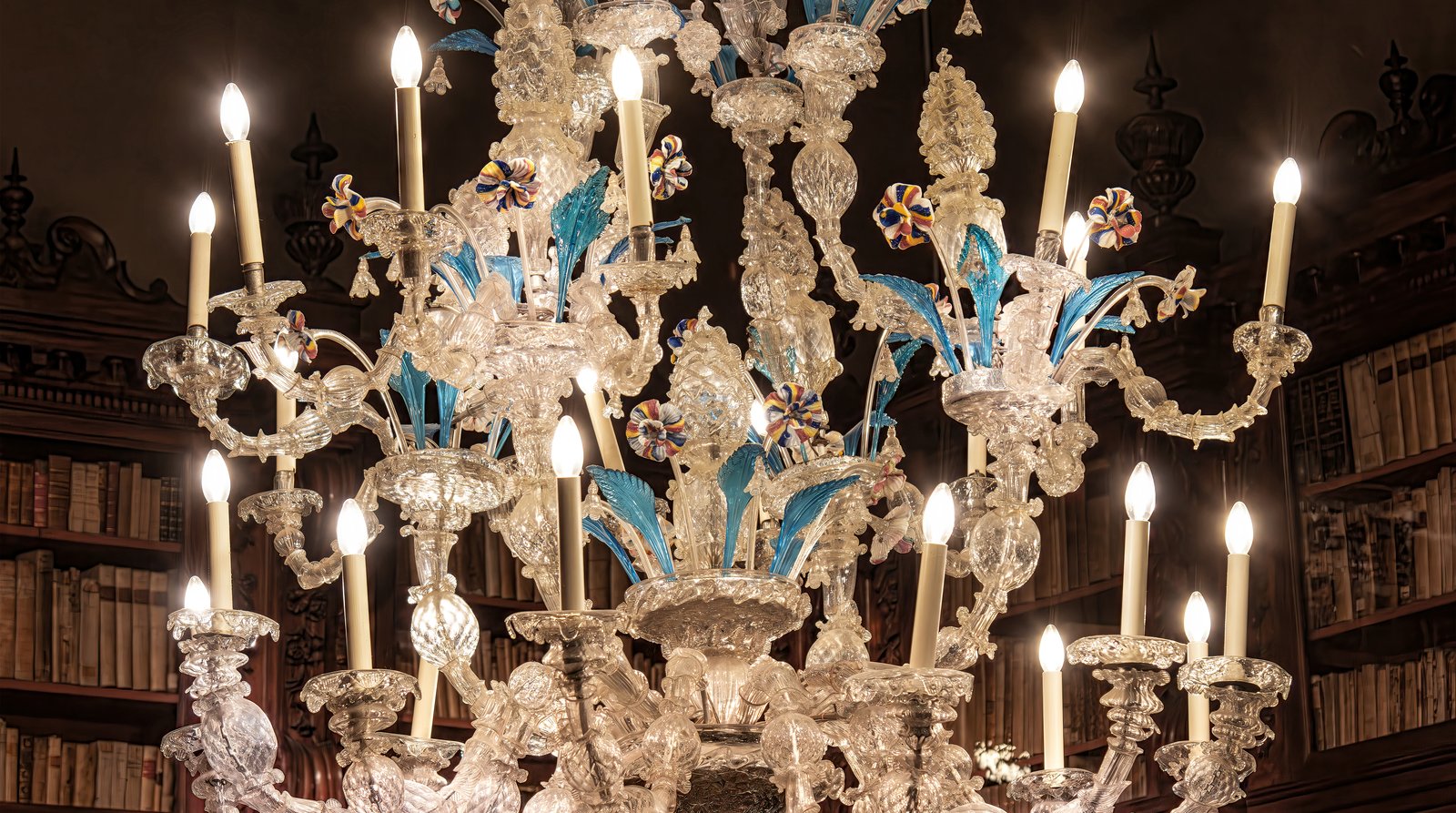
Murano lighting refers to glass chandeliers, sconces and lamps made on the island of Murano, where Venetian glassmaking furnaces were relocated by decree in 1291. The best-known form, the ciocca ("bouquet") chandelier, uses colored glass flowers and leaves rather than crystal drops, and remains hand-blown by a small number of family-run furnaces still working in the traditional way.
At a glance
- Where
- Murano, a short vaporetto ride from central Venice
- Signature form
- Ciocca chandelier — colored glass flowers and leaves on a branching frame
- Origin
- Furnaces relocated to Murano by Venetian decree, 1291
- Where to learn more
- Museo del Vetro, Murano (Fondazione Musei Civici di Venezia)
- Buying note
- Ask for a certificate of authenticity — much "Murano glass" sold nearby is imported
- Last checked
- July 2026
Why the furnaces moved to an island
In 1291, the Venetian Republic ordered the city's glassmaking furnaces relocated to Murano. The official reasoning was fire risk — Venice's densely packed wooden buildings and a furnace running at temperatures capable of melting sand into liquid glass were, understandably, seen as incompatible. The move also had a second, less publicized effect: it concentrated Venetian glassmakers on a single island where trade secrets could be more easily guarded and less easily smuggled to competing cities, a control the Republic maintained for centuries, at times restricting glassmakers' freedom to travel abroad.
Whatever the balance of motives, the result was a sustained, geographically concentrated craft tradition that had few rivals in Europe. By the sixteenth century, Murano furnaces had developed techniques — clear cristallo glass, enameled decoration, filigree threading, and later the colored, sculptural forms most associated with the island today — that made Murano synonymous with luxury glass well beyond Italy.
From tableware to the room itself
Lighting became a defining Murano product for a practical reason as much as an artistic one: glass diffuses candlelight and, later, electric light more gently than metal or plain glass shades, and its transparency let Venetian interiors stay visually open in rooms that were otherwise dark, deep and short on windows. The ciocca chandelier form — a branching frame dense with hand-blown glass flowers, leaves and fruit rather than the faceted crystal drops associated with Bohemian or French chandeliers — emerged as the signature Venetian answer, typically in multiples of a single color (amber, aquamarine, ruby) or in mixed floral tones.
By the eighteenth century, a Murano chandelier in a palazzo's main reception room functioned the way a fresco ceiling or a marble fireplace might elsewhere: it was the room's single most expensive and most conversation-worthy object, sized and positioned specifically to be seen from the canal-facing windows as well as from within.
How it is made, briefly
Traditional Murano glasswork is done by a small team working quickly around a furnace kept near 1,000°C: a maestro gathers molten glass on a blowpipe, shapes it in the air and against wet wooden tools, and assembles a piece like a chandelier element by element while it is still workable, since glass cools and stiffens within seconds. Colour comes from metallic oxides added to the glass batch — cobalt for blue, gold for certain reds and pinks, copper for green — a chemistry refined and closely held over generations. Training a glassmaster traditionally takes many years of apprenticeship inside a furnace, learning by proximity and repetition rather than formal instruction.
Real Murano glass versus the souvenir trade
Murano's fame has long attracted imitation, and the difference between genuine Murano-made glass and imported glass sold under the same name is a real concern for buyers, and for Murano's own furnaces. The Museo del Vetro on Murano, part of the Fondazione Musei Civici di Venezia, documents the island's glassmaking history and displays historic pieces that make the difference in quality legible: irregularity, weight, and the specific clarity of properly annealed glass are hard to fake convincingly. Reputable Murano furnaces issue certificates of authenticity, and a piece bought without one, at a price that seems low for hand-blown glass, is worth treating with scepticism.
Living with Murano glass today
In contemporary Venetian interiors, Murano lighting has moved beyond the historic ciocca form. A newer generation of designers and furnaces — some tracing back to historic names, others newer studios — produce sculptural pendant lights, sconces and table lamps in cleaner, more contemporary shapes while keeping the hand-blown technique and the island's characteristic color chemistry. For residents, a Murano piece is still often bought once and kept for decades; the fragility that makes it feel precious is also, practically, an argument for buying well rather than often.
Some of Murano's family furnaces trace their working history back many generations, a continuity that is unusual even by the standards of European craft industries; several names still active on the island today were already established businesses before the unification of Italy in 1861. That longevity shows up in the work itself — a modern piece from one of these furnaces is often recognisably in dialogue with pieces the same family made a century earlier, using color formulas and shaping techniques that were never fully written down, only passed from maestro to apprentice inside the furnace. This is part of why buyers researching a serious purchase are generally advised to visit a furnace in person rather than order sight-unseen: the differences between workshops, in both technique and price, are real and not always obvious from a shop window.
Scale matters too. A single Murano sconce can transform a small hallway or bathroom the way a full chandelier transforms a reception room, and many contemporary Venetian interiors now mix a single, deliberately chosen Murano piece with otherwise plain, unornamented furnishings — a departure from the maximalist historic room, but one that keeps the material's essential logic: glass as the one object in a room allowed to be extravagant.
How can you tell if Murano glass is authentic?
Look for a certificate of authenticity from the specific furnace, ask directly whether the piece was blown on Murano rather than only "designed" there or finished elsewhere, and examine the glass for the slight irregularity, weight and clarity that mass-produced or imported glass rarely matches. The Museo del Vetro on Murano is a useful reference point for what genuine historic and contemporary Murano work actually looks like up close.
Sources
- Fondazione Musei Civici di Venezia — Museo del Vetro, Murano
- Comune di Venezia — municipal heritage documentation on Murano glassmaking
- Consorzio Promovetro Murano — Murano glass trade association
This article was independently researched and produced. No payment, complimentary service or editorial approval was provided by the places mentioned.