
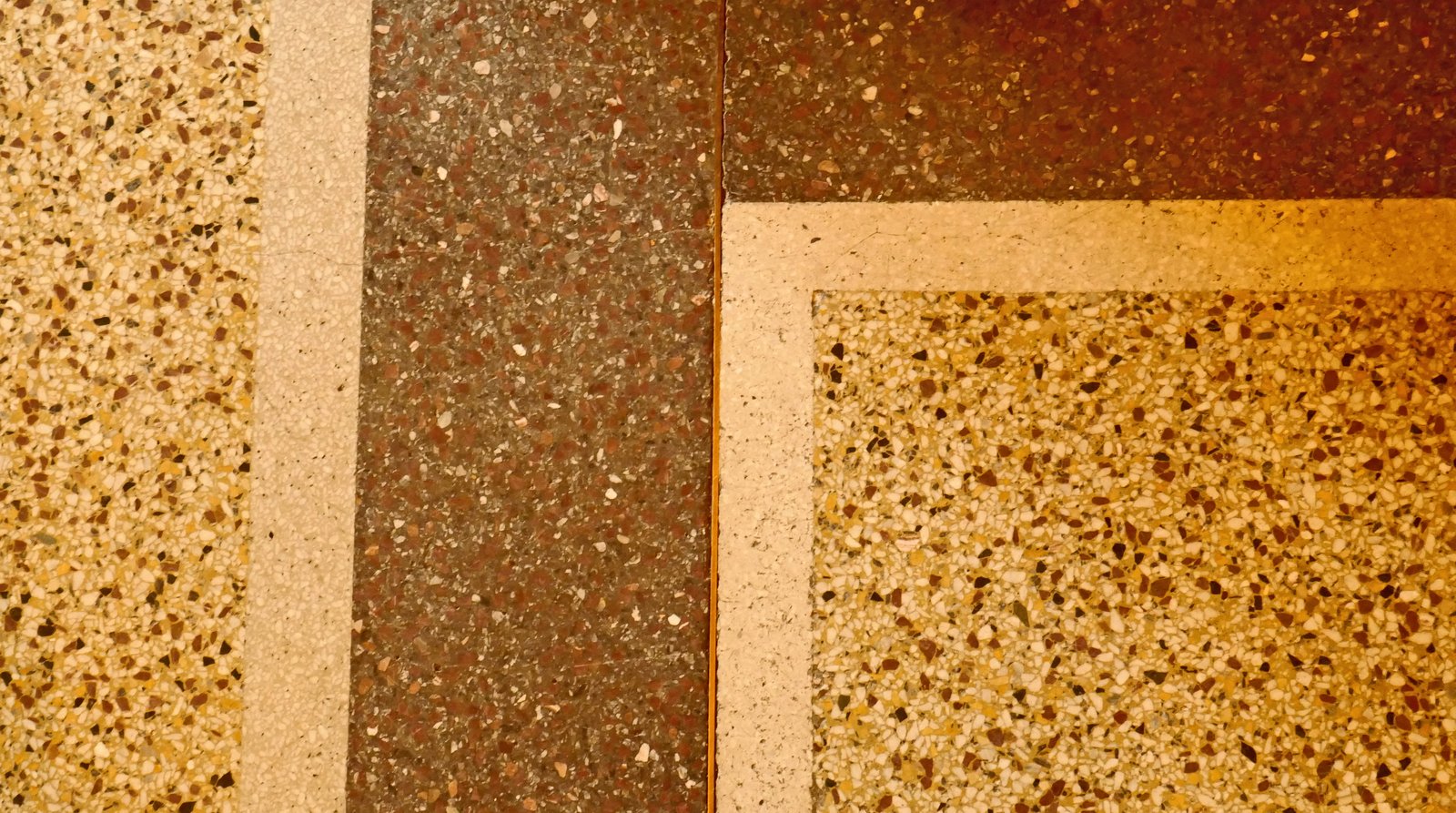
In brief
Terrazzo alla veneziana is a flooring technique of marble and stone chips set in lime or cement binder, then ground and polished smooth. Venetians developed it because it tolerates damp and periodic flooding far better than wood or carpet, and because it could be laid in wide, jointless sheets across a home's main rooms — an early, practical form of the material now fashionable worldwide.
At a glance
- Technique
- Marble and stone chips set in binder, ground flat, polished
- Origin
- Venetian building tradition, developed for damp and flood tolerance
- Where to see it
- Ca' Rezzonico, Palazzo Mocenigo, many ground-floor apartments and hotels
- Modern status
- Still specified by Venetian architects and restorers; also a global design trend
- Care
- Periodic re-waxing or oiling; avoids the need for waterproof membranes underfoot
- Last checked
- July 2026
A floor invented to flood
Most flooring materials fail when wet. Terrazzo, as developed in Venice, was built to survive it. The technique — pastellone or terrazzo alla veneziana, depending on the specific method — layers crushed marble, stone or brick fragments into a lime or later cement binder, then grinds the surface flat over days of increasingly fine abrasives before sealing and polishing it. The result is a jointless, water-resistant surface that can be mopped, occasionally submerged by acqua alta, and dried out again without warping, rotting or staining in the way wood or plaster would.
This made terrazzo the obvious choice for the ground-floor rooms — the androni — that Venetian palazzi have always treated as semi-expendable space, absorbing whatever water the lagoon sends up through the foundations before it can reach the living quarters above. But terrazzo was never confined to utility rooms. Its combination of durability and visual richness — the marble fragments catch light unevenly, giving even a plain grey terrazzo a subtle depth no single-color material can match — made it a preferred finish for grand reception rooms too, from the eighteenth century onward.
How it is actually made
Traditional terrazzo alla veneziana is slow work, historically carried out by specialist tradesmen, the terrazzieri, whose training took years. Stone or marble aggregate — often waste chips from monument and column carving, since Venice imported large quantities of marble for church and palazzo construction and had little use for offcuts — is mixed with a binder and troweled across the floor in a layer several centimetres thick. Once cured, the surface is ground down in stages with abrasive stones, traditionally by hand or foot, later by weighted rotating machines, exposing a flat cross-section of the embedded stone. A final polish with linseed oil or wax brings up the color and seals the surface.
The pattern is never a repeat: because the aggregate is irregular and hand-scattered, no two terrazzo floors are identical, and a skilled terrazziere could vary density, color grouping and fragment size to produce anything from a plain neutral floor to elaborate figurative or geometric designs, sometimes incorporating black Marmo di Verona or red Rosso di Verona alongside white Carrara chips for pattern and contrast.
Where to actually see it
Ca' Rezzonico, on the Grand Canal in Dorsoduro and now home to the Museum of Eighteenth-Century Venice under the Fondazione Musei Civici di Venezia, preserves some of the finest surviving terrazzo alla veneziana in the city, laid across ballroom-scale rooms designed to be seen underfoot as much as overhead. Palazzo Mocenigo, the city's museum of textile and costume history in Santa Croce, has similarly well-preserved period floors. Beyond the museums, terrazzo remains ordinary domestic flooring across much of residential Venice — visible through open doorways at ground level, in the entrance halls of smaller hotels, and underfoot in countless apartments where it has simply never needed replacing.
Real terrazzo versus the modern trend
Terrazzo's international revival over the past decade — as a flooring and surface finish in hotels, bathrooms and kitchens worldwide — has produced a great deal of imitation: printed vinyl, resin-cast tiles with a terrazzo-effect pattern, or thin manufactured slabs that mimic the look without the depth. The giveaway is usually the surface: authentic ground terrazzo has a slightly uneven, matte-to-satin sheen and genuine variation in fragment size and depth, because it was ground by hand or machine rather than printed or moulded. It also ages differently — developing a soft patina rather than simply wearing out — which is part of why centuries-old Venetian terrazzo floors are still in daily use rather than in a museum case.
Restorers working on historic Venetian buildings, including specialists coordinated through the Soprintendenza responsible for the city's protected architecture, generally treat original terrazzo as a fabric to be conserved rather than replaced, re-waxing and selectively repairing rather than tearing out — a conservation approach that has kept a striking amount of centuries-old flooring in ordinary, non-museum use.
Living on terrazzo, in practice
For residents, terrazzo is less a design statement than a fact of daily life: cool underfoot in summer, unforgiving of dropped glassware, and easy to keep clean with just water and a mild soap rather than the specialist products modern engineered floors often require. Furniture is typically fitted with felt pads to avoid scratching the polished surface, and area rugs are used more for warmth and softness than to protect the floor itself, since a well-maintained terrazzo needs little protecting.
Why does Venice use terrazzo floors instead of wood or tile?
Because terrazzo tolerates the damp, occasional flooding and humidity that define ground-floor Venetian life far better than timber, which rots and warps, or ceramic tile, which needs grout lines that trap water. Its jointless, water-resistant surface could be laid across entire palazzo floors and survive centuries of tidal exposure — a practical origin that later became, almost by accident, one of the most recognisable materials in Venetian design.
Sources
- Fondazione Musei Civici di Venezia — Ca' Rezzonico, Museum of 18th-Century Venice
- Museo di Palazzo Mocenigo — Centro Studi di Storia del Tessuto e del Costume
- Soprintendenza Archeologia, Belle Arti e Paesaggio per il Comune di Venezia e Laguna
This article was independently researched and produced. No payment, complimentary service or editorial approval was provided by the places mentioned.