
In brief
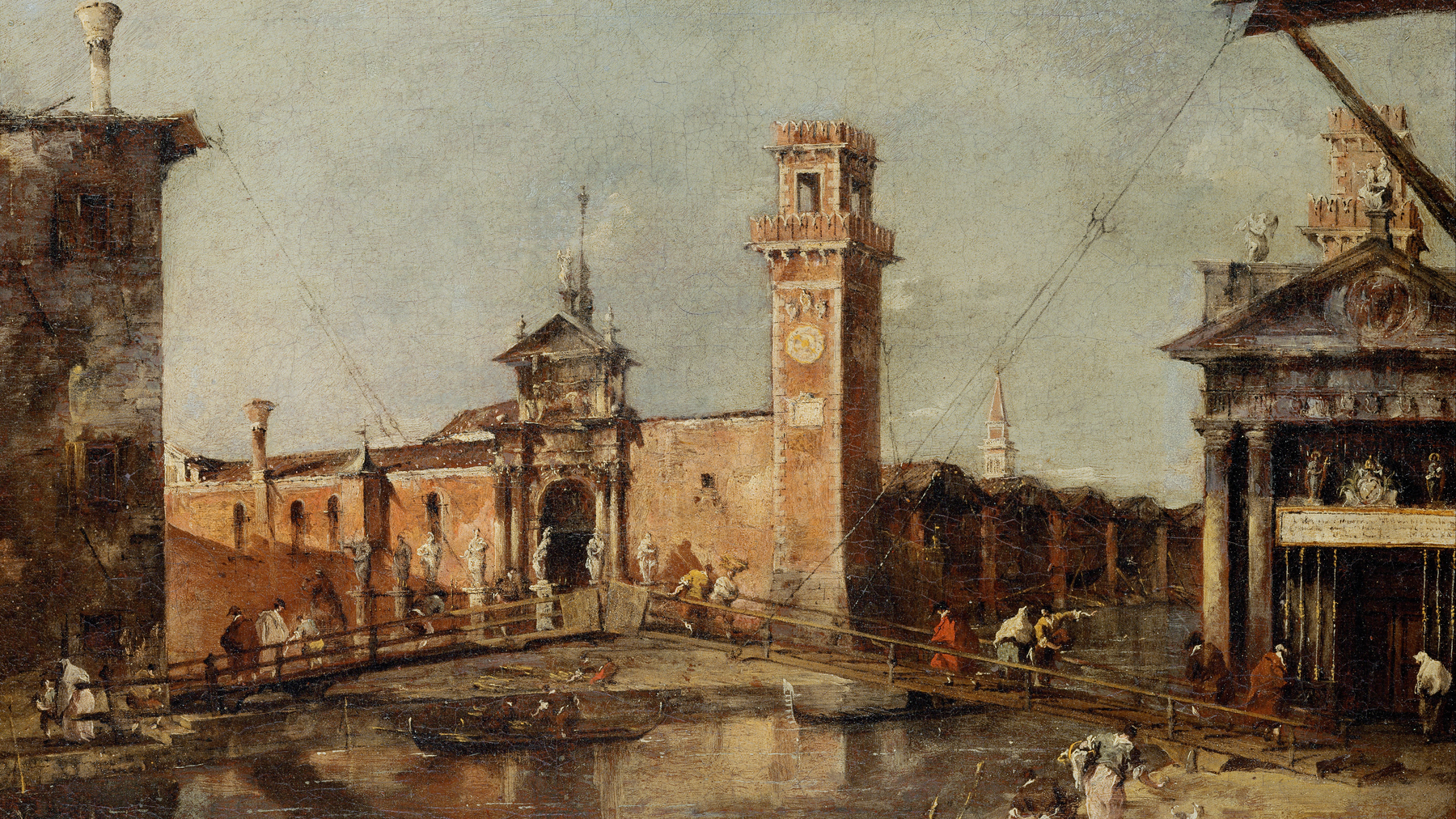
The Venetian Arsenale, the Republic's state shipyard, organised galley construction around a moving line: half-finished hulls were towed past fixed workshops, each staffed by specialists who added rigging, oars, weapons and provisions in sequence. By 1500 it was the largest industrial complex in the world, capable of outfitting a hundred galleys in weeks. Access was restricted, and the workforce operated under an early, and unusually strict, culture of state secrecy.
At a glance
- Where
- The Arsenale, Castello sestiere, eastern Venice, still a working naval and cultural site today
- Founded
- Traditionally dated to the twelfth century, with major expansions in the 1300s and 1400s
- By 1500
- The largest industrial complex in the world, employing thousands of specialist workers known as arsenalotti
- Documented output
- Around 50 galley hulls completed in ten months during 1537 to 1538; about 100 galleys fitted out in roughly fifty days ahead of the 1571 Battle of Lepanto
- Security
- Entry restricted to authorised workers; outside visitors and foreign observers were not permitted inside the working yards
- Why it matters
- An early, state-run example of standardised, sequential, large-scale production, predating industrial factory systems by centuries
The word "arsenal" has entered English as a generic term for a weapons store, which tends to flatten what the original Arsenale in Venice actually was. It was not a warehouse. It was a production system, a walled and gated complex covering a significant share of the city's landmass, where the Republic of Venice built, armed, and maintained the fleet that its entire empire depended on.
What made it remarkable was not simply its size, though that was considerable, but the way work inside it was organised. Two and a half centuries before Henry Ford's Highland Park plant, the Arsenale was moving vessels along fixed routes past stationary teams of specialists, each adding a defined component in a defined order. It is one of the more credible historical claims to an early industrial assembly line, and it grew out of very practical Venetian problems: an empire that needed ships faster than any single yard could otherwise supply them.
A canal as a conveyor belt
The Arsenale's core innovation was spatial. Rather than building each galley from keel to rigging in one location by one crew, as most shipyards of the period did, the Venetians built hulls in one area and then moved them, partly finished, along a channel that ran past a sequence of specialised workshops and storerooms.
As a hull was towed past each station, workers there added exactly what their trade covered: rigging from the ropewalk, oars from the oar-makers, sails from the sailmakers, and munitions, biscuit, and other provisions from dedicated stores, all handed out through windows and doorways in a fixed order as the vessel passed. No single crew needed to master every trade a galley required. Each station needed to master only its own, repeatedly, at volume.
The Castilian traveller Pero Tafur, who visited Venice in 1436, left an account describing galleys being towed along the Arsenale's canal while workers passed out oars, bread, weapons, and other provisions from windows in sequence, an outfitting process he found astonishing enough to describe in detail. Later popular retellings compressed this into claims that the Arsenale could produce a fully armed galley in a single day, a figure modern historians generally treat as exaggerated. The verified, documented output is still striking on its own terms: roughly fifty galley hulls completed in ten months during 1537 and 1538, and around a hundred galleys fitted out in about fifty days ahead of the 1571 Battle of Lepanto, one of the largest naval mobilisations in early modern European history.
Standardisation before the word existed
None of this worked without parts that were interchangeable, or close to it. The Arsenale maintained enormous stores of pre-cut timber, cordage, and fittings built to consistent specifications, so that a workshop along the line could reach for a component without custom-fitting it to the particular hull passing by. The Tana, the Arsenale's vast covered ropewalk, alone stretched over 300 metres and turned out standardised rigging for the entire fleet.
This mattered strategically as much as commercially. Venice's power rested on being able to project and resupply naval force around the eastern Mediterranean faster than its rivals. A galley damaged or lost in a campaign against the Ottoman fleet or Mediterranean rivals could be replaced from a system built for repetition, not from a yard that had to relearn each vessel from scratch. The Arsenale's output was less a product than an outcome of institutional design, refined over centuries by a Republic that treated shipbuilding capacity as a direct extension of state power.
A workforce under oath
The people who made the system run, the arsenalotti, were not ordinary hired labour. They formed a distinct, privileged, and closely watched workforce, drawn largely from families with generations of Arsenale service, organised into guild-like divisions by trade. Their loyalty mattered enough to the Republic that arsenalotti served as the personal bodyguard of the doge on ceremonial occasions, a role no ordinary tradesman in Venice held.
That trust came with restriction. Access to the working yards was closed to outsiders, and foreign visitors, merchants, and even most Venetians without direct business there were kept out of the areas where hulls were built and fitted. Some historical accounts describe workers bound by oaths not to disclose construction methods, and popular tradition holds that revealing Arsenale secrets to a foreign power could be treated as treason. The severity of any specific punishment is harder to verify with a single reliable source than the broader picture of restricted access and institutional secrecy, which is well documented across multiple accounts of how the Arsenale operated. What is not in doubt is the underlying logic: Venice understood its shipbuilding capacity as a strategic asset worth guarding as carefully as any fortress, and treated the knowledge inside the Arsenale's walls accordingly.
What the system reveals about Venice
It is easy to see the Arsenale purely as a curiosity, an early and quaint anticipation of the modern factory. That undersells what it represented at the time. Venice was a small state with no significant land army and few natural resources beyond timber from its mainland territories and salt from its lagoon. Its entire claim to power in the Mediterranean rested on ships, and specifically on being able to build, repair, and replace them faster than any rival.
The Arsenale's moving line, its standardised parts, and its guarded workforce were not separate curiosities. They were three parts of one answer to a single strategic problem: how a republic without an army could still dictate terms across an entire sea. The craft traditions that grew out of it did not vanish with the Republic. Smaller-scale descendants of Arsenale-trained shipbuilding still survive in the city's working squeri, where gondolas are still built by hand, a much smaller and slower echo of the precision the Arsenale once produced at industrial scale.
The state's instinct to protect what it knew was not limited to shipbuilding. Venice extended the same logic of controlled information and closely guarded process to its own government, most visibly in the anonymous denunciation system run by the Council of Ten, a body founded within two centuries of the Arsenale's own expansion and equally concerned with keeping the Republic's secrets inside its walls.
Sources
- “The Venetian Arsenal: World's First Weapons Factory,” HistoryNet. Source link
- “The Venetian Arsenale and the Forgotten Industrial Capacity of Pre-Industrial Europe,” From Poverty to Progress. Source link
- “Arsenale of Venice: from Dante to the Biennale,” When in Venice. Source link
This article was independently researched and produced. The hero image is an editorial illustration and is not presented as documentary photography. No payment, complimentary service or editorial approval was provided by any organisation mentioned.