
In brief
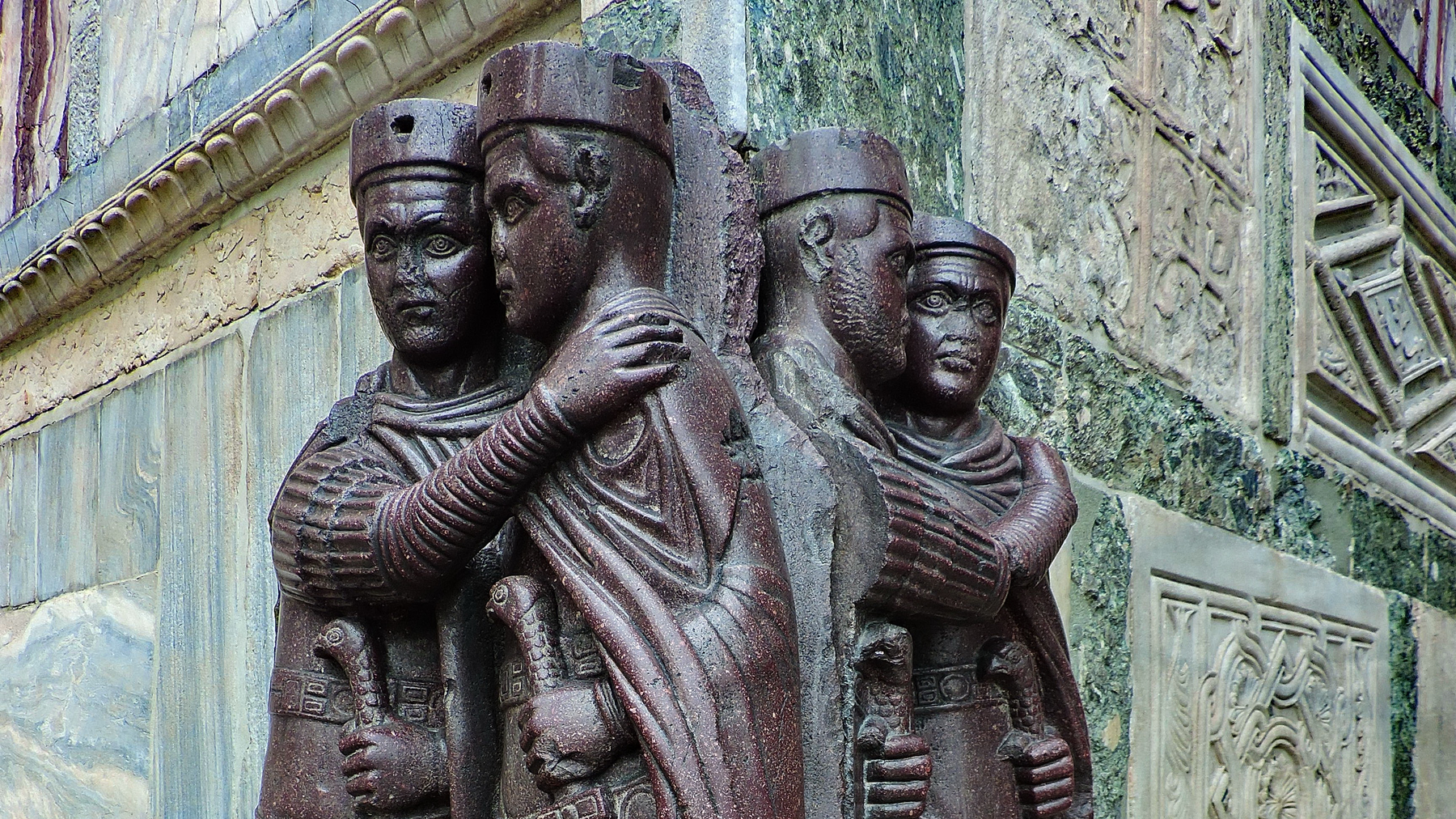
The Four Tetrarchs is a porphyry statue group of about 300 CE, likely carved in Egypt for Constantinople, showing two pairs of Roman co-emperors embracing with hands on their sword hilts. Venetian crusaders looted it from Constantinople in 1204 and set it into the southeast corner of the Basilica di San Marco. One figure's foot broke off in transit; its heel fragment was excavated in Istanbul in the 1960s and remains there, in the Istanbul Archaeology Museums.
At a glance
- Where
- Southeast exterior corner of the Basilica di San Marco, facing the Doge's Palace and the Piazzetta
- Made
- Around 300 CE, likely in Egypt, to commemorate the Tetrarchy established by Emperor Diocletian
- Material
- Porphyry, a hard purple-red Egyptian stone reserved for imperial imagery
- Taken from
- Constantinople, looted during the Fourth Crusade's sack of the city in 1204
- Missing piece
- A carved heel and foot fragment, excavated near the Bodrum Camii site in Istanbul in the 1960s
- Missing piece today
- Held by the Istanbul Archaeology Museums, roughly 1,500 kilometres from the rest of the statue
Most people who photograph the corner of San Marco where the Piazzetta meets the Doge's Palace are photographing the basilica's domes and mosaics, not the squat purple figures wedged into the stonework at eye level. The four embracing men in dark red stone rarely make it into a guidebook's top ten details. They deserve a longer look, because they are one of the more direct pieces of physical evidence in Venice for how the city built its wealth: by taking things.
The group is known as the Four Tetrarchs, and it is, quite literally, broken in two places at once. One statue is missing a foot. That foot is not lost. It is on display in Istanbul, roughly 1,500 kilometres from the rest of the sculpture, and has been since long after archaeologists found it.
Four emperors, carved to look identical
The statues date to around 300 CE and depict the Tetrarchy, the system of shared imperial rule that Emperor Diocletian established in 293 to stabilise a Roman Empire that had grown too large and unstable for one ruler. Under the Tetrarchy, two senior emperors, styled Augusti, each ruled alongside a junior emperor, a Caesar, one pair governing the western provinces and one the eastern.
The sculptors made no attempt to give the four men individual, recognisable faces. They stand in two identical embracing pairs, each figure gripping an eagle-headed sword and resting a hand on a colleague's shoulder. The uniformity is the point. This was propaganda in stone: four rulers presented as interchangeable and undivided, a visual argument for a political system that depended on convincing the empire that shared power would not mean fractured power.
The material reinforced the message. Porphyry, quarried almost exclusively in Egypt's Eastern Desert, was reserved for imperial portraiture because of its rarity, hardness, and imperial purple colour. A porphyry statue was not simply art. It was a claim to legitimate rule, carved into stone that only emperors were permitted to use.
How Constantinople's statue ended up on a Venetian church
The tetrarchs likely stood somewhere in Constantinople for roughly nine centuries after the Tetrarchy itself collapsed into rivalry and civil war within a few years of Diocletian's abdication in 305. Their presence in Venice has a much less ceremonial explanation than their carving does.
In April 1204, the armies of the Fourth Crusade, diverted from their original target and backed by Venetian ships, fleets, and financing under Doge Enrico Dandolo, breached and sacked Constantinople, then the wealthiest city in the Christian world. The sack was one of the most consequential lootings in European history, and Venice was its principal beneficiary. Bronze horses that now stand on the basilica's facade, columns, capitals, reliquaries, and the porphyry tetrarchs all left Constantinople in the same general wave of plunder and arrived in Venice as spoils, not gifts.
The statue group was set into the exterior corner of the Basilica di San Marco nearest the Doge's Palace, at the point where the church's sacred authority and the doge's political authority physically meet. Whether that placement was deliberate symbolism or simple convenience is debated, but the effect has lasted more than eight centuries: a monument to Roman imperial unity, stolen from one empire, mounted on the wall of another power that was, by 1204, actively assembling an empire of its own.
The foot that stayed behind
Somewhere in the process of removal, packing, or transport from Constantinople to Venice, one of the four figures lost part of a foot. For centuries the statue simply stood incomplete, its damage visible but unexplained.
The missing piece resurfaced far from Venice. Archaeological excavations in Istanbul in the 1960s, near the site of the Myrelaion church (known today as the Bodrum Camii), uncovered a carved porphyry heel and foot fragment that scholars identified as the missing piece of the Venetian statue. It had evidently broken off and been left behind, or lost, in Constantinople itself, perhaps at the very moment the rest of the group was being loaded for the journey west.
The fragment is held today in the Istanbul Archaeology Museums. It has never been reunited with the statue in Venice, and there is no current plan for it to be. A single porphyry sculpture, carved as a unified image of four rulers who could not be told apart, now exists as two separated objects in two countries, each holding a fragment the other is missing.
A monument that argues with itself
There is a particular irony in a statue designed to project unbroken unity ending up literally split between two cities, and it is worth sitting with rather than rushing past. The Tetrarchs were carved to declare that Roman power, however divided in practice among four men, remained one thing. Their afterlife has done the opposite: divided the object itself, scattered by a war fought nine centuries after the statue was made, between the empire it once served and the republic that took it.
Visitors who stop at that corner of San Marco are usually moving toward the basilica's main doors, the winged lion, or the view across the Piazzetta toward the water. The tetrarchs ask for a different kind of attention, closer to the ground and slower. They are a reminder that most of what makes Venice's most photographed square remarkable did not originate in Venice at all, and that the city's genius lay less in making such objects than in knowing exactly what to take, and where to put it.
The theft of San Marco's most famous relic followed a similar logic four centuries earlier. The smuggling of St Mark's own body from Alexandria in 828 shows the same instinct at work: Venice building its civic identity out of objects acquired, one way or another, from somewhere else.
For readers curious about other lagoon sites shaped by movement across the sea, the Roman harbour buried beneath the northern lagoon at Altinum tells an earlier chapter of the same maritime story, from a period before Venice itself existed.
Sources
- “Portrait of the Four Tetrarchs,” Wikipedia. Source link
- “The history of one sculpture: from Constantinople to San Marco,” Athens News / RUA.gr. Source link
- “Portrait of the Four Tetrarchs in Venice,” Atlas Obscura. Source link
- Khan Academy, “Byzantine Art and the Fourth Crusade.” Source link
This article was independently researched and produced. The hero image is an editorial illustration and is not presented as documentary photography. No payment, complimentary service or editorial approval was provided by any organisation mentioned.