
In brief
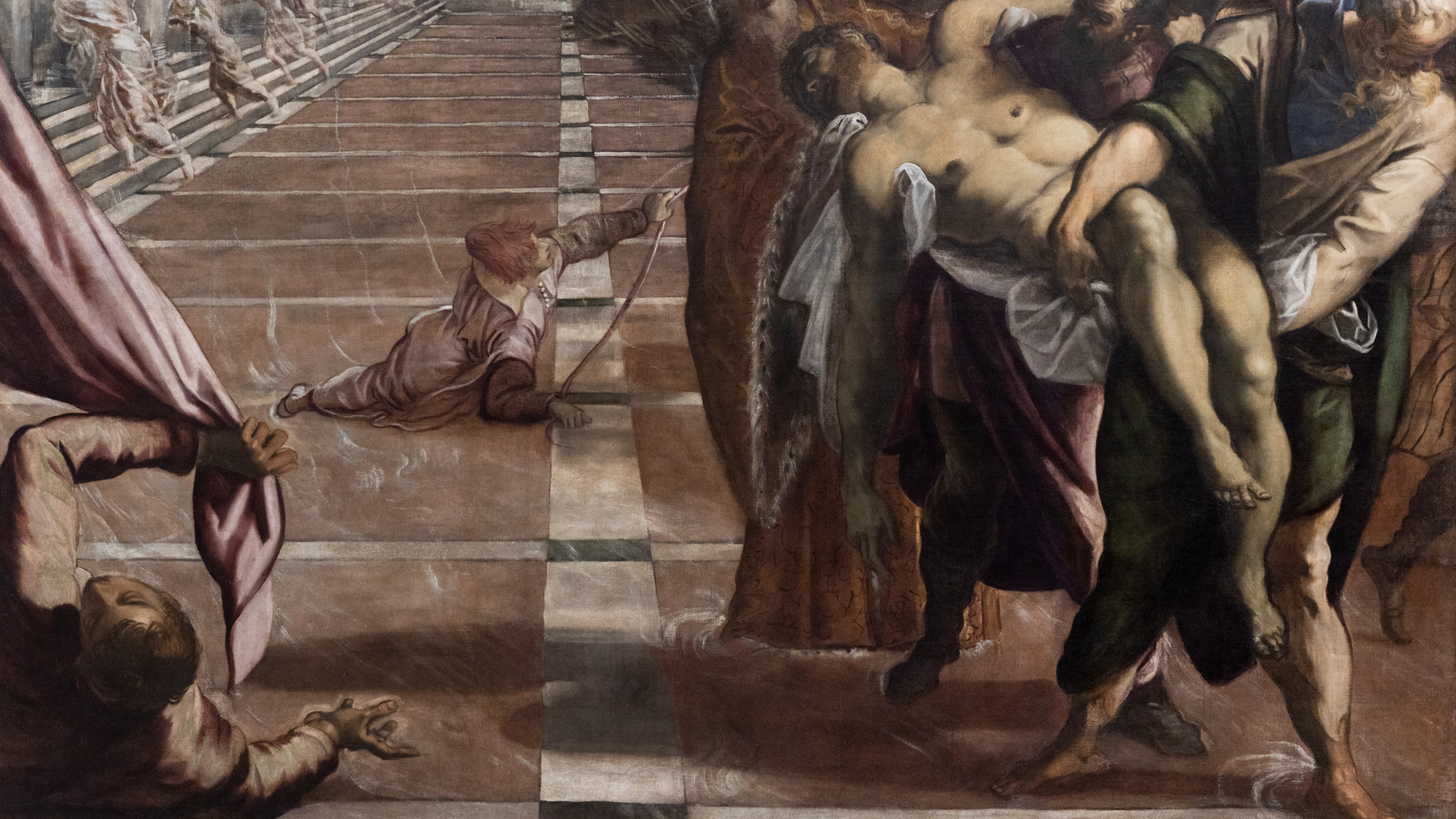
Venice's claim to St Mark rests on a theft. In 828, the Venetian merchants Buono da Malamocco and Rustico da Torcello removed the evangelist's relics from a church in Muslim-ruled Alexandria and hid them beneath a layer of pork and cabbage leaves, knowing customs officers would refuse to search meat forbidden to them. The relics reached Venice and gave the young lagoon republic an apostolic patron of its own.
At a glance
- Event
- The removal of St Mark's relics from Alexandria to Venice, traditionally dated to 828
- Who
- Venetian merchants Buono da Malamocco and Rustico da Torcello, aided by two Alexandrian monks, Staurachios and Theodore
- The method
- The body was reportedly packed beneath layers of pork and cabbage to discourage inspection by customs officials
- Where the relics rest today
- Beneath the high altar of the Basilica di San Marco, Piazza San Marco, Venice
- Earliest written account
- The translatio narrative survives in texts compiled roughly two centuries after the event
- Why it matters
- The relics gave Venice a resident apostolic saint, replacing its earlier patron, St Theodore, and reshaping the city's civic identity
Every guidebook description of the Basilica di San Marco eventually arrives at the same sentence: the body of St Mark was brought to Venice from Alexandria in the ninth century. Few linger on what that sentence is quietly skipping over. The relics did not arrive as a gift, a purchase, or a diplomatic exchange. They were taken, without permission, from a guarded church in a city under Muslim rule, by two Venetian traders who had sailed there to do business and left with something else entirely.
The story of how they did it, and why it mattered so much to Venice that it built one of the most famous buildings in Europe to house the result, says as much about ninth-century Venetian politics as it does about ninth-century piety.
A church, a warning, and an opportunity
According to the account that later Venetian chroniclers preserved, the relics of St Mark had rested since antiquity in a church in Alexandria, then part of the Abbasid Caliphate. By the early ninth century, local authorities were reportedly stripping marble and materials from Christian churches in the city for use elsewhere, including, in one version of the story, for a new palace. Two Alexandrian monks who cared for the church, named in the tradition as Staurachios and Theodore, feared the saint's remains would be disturbed or destroyed.
Two Venetian merchants happened to be in port. Buono, from the lagoon settlement of Malamocco, and Rustico, from Torcello, were traders first, and Venice in this period was a maritime republic that depended entirely on such trade for its survival. Whether the monks approached the merchants or the reverse is not something the sources agree on. What the tradition is consistent about is what happened next: an agreement to remove the relics from Alexandria without the consent of the ruling authorities.
The pork, and why it worked
The mechanics of the smuggling are the part of the story that guidebooks tend to reduce to a single amused sentence, but they reward a closer look. Under Islamic dietary law, pork is forbidden, and observant Muslim officials would not touch it, let alone search through it. According to the traditional account, the merchants packed the saint's remains into a container and covered them with layers of pork and cabbage leaves before presenting the cargo for inspection at the port.
Customs officers reportedly recoiled from the smell and the sight of the meat and waved the shipment through, some accounts adding that they cried out "kanzir, kanzir," the word for pig, as they turned away. It is a small, almost comic detail sitting inside a story about the founding relic of one of the great churches of Christendom, and that contrast is part of why the episode has survived in popular memory even as its finer historical points remain unsettled.
Legend, and how much of it can be trusted
Historians are candid that the translatio, the formal account of the relics' transfer, was not written down until roughly two centuries after the event, and that it carries the hallmarks of a foundation legend as much as a historical record. The medievalist Donald Nicol described the episode as driven "as much by politics as by piety," a judgment later scholarship has largely echoed rather than overturned.
None of this makes the underlying event fiction. Merchant ships moved between Venice and Alexandria in this period, tension over church property under Abbasid rule is documented elsewhere, and the presence of relics at Venice by the mid-ninth century is not seriously disputed. What is uncertain is how much of the pork-and-cabbage detail, and the precise choreography of the theft, reflects what happened at the dock in 828 versus what later generations of Venetians needed the story to say about themselves.
Why Venice needed a saint of its own
That need is the more interesting half of the story. Before 828, Venice's patron was St Theodore, a Greek soldier-saint whose cult tied the young lagoon settlements to Constantinople and the Byzantine world Venice had grown out of, and on which it still nominally depended. A statue of Theodore, standing on a crocodile, still occupies one of the two great columns in the Piazzetta facing the lagoon.
An apostolic evangelist was a different order of patron altogether. Mark was believed to have written one of the four Gospels and to have founded the church in Alexandria itself. A city that possessed his body could claim a direct, unmediated connection to the apostolic age, one that did not run through Byzantine political or religious authority. For a lagoon republic that would spend the following centuries carefully asserting its independence from Constantinople, that was not a minor point of prestige. It was a foundation for the argument that Venice answered to no one.
The winged lion that still marks Venetian flags, gates, and government buildings across the former empire, from the Piazzetta column to fortresses on Crete and Corfu, is Mark's symbol, drawn from the Gospel of Mark's association with a lion in early Christian iconography. Every one of those lions is a small, repeated assertion of the claim that began with a basket of pork in an Alexandrian harbour.
The relics' new home also changed the city's geography. What had been a modest ducal chapel beside the Doge's residence was rebuilt, and rebuilt again after a ninth-century fire, into the basilica that stands today, its Byzantine domes and gilded mosaics deliberately declaring Venice's wealth and standing to every ship that entered the basin. The building most visitors photograph as the picturesque centre of Venice began, in large part, as packaging for a theft.
What the story still explains
Reading the translatio today, it is tempting to treat it purely as colourful medieval anecdote, the kind of detail that makes a walking tour memorable. It deserves a slightly harder look than that. Few founding myths state so plainly what they were built to do: give a small trading republic a claim to spiritual authority equal to its ambitions on the water. The Basilica di San Marco is usually described to visitors as a monument to faith. It is at least as accurate to call it a monument to a very well-timed piece of smuggling, and to the political instinct that turned it into permanent civic identity.
The relics, and the building raised around them, sit at the physical centre of a lagoon full of similar stories about how Venice built itself from improvisation. The submerged monastery and reused ship hulls at San Marco in Boccalama, elsewhere in the lagoon, tell a related story about resourcefulness applied to survival rather than to sanctity. Both sit under the same saint's name, for reasons that were never entirely about religion.
Sources
- “Saint Mark's relics,” Wikipedia, summarising the translatio Sancti Marci tradition and Donald Nicol's assessment. Source link
- The Fitzwilliam Museum, “The Relics of St Mark,” Cambridge. Source link
- “How Did the Remains of St. Mark End Up in Venice?,” TheCollector. Source link
This article was independently researched and produced. The hero image is an editorial illustration and is not presented as documentary photography. No payment, complimentary service or editorial approval was provided by any organisation mentioned.