
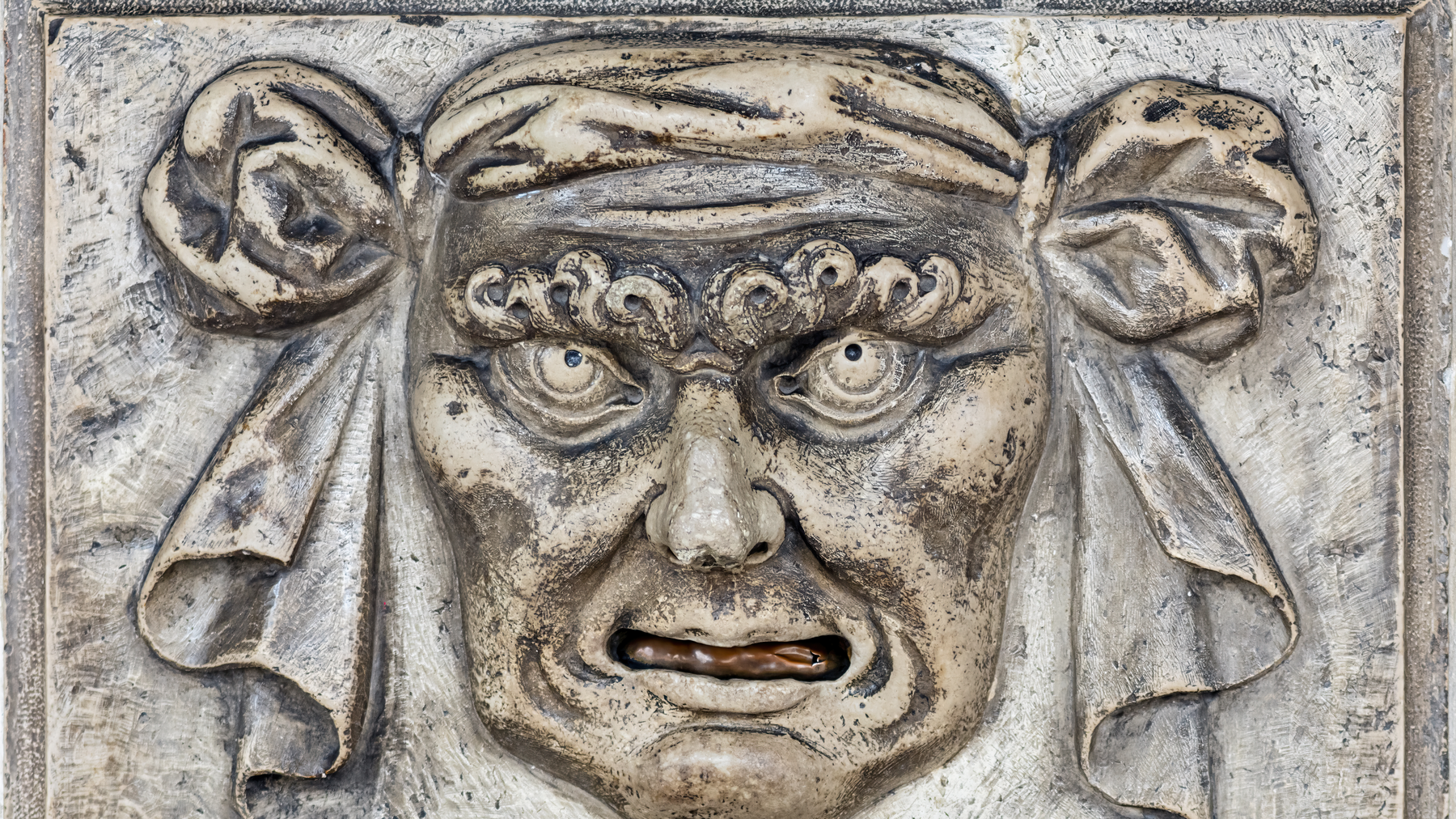
In brief
After a failed 1310 coup attempt, Venice created the Council of Ten, a security tribunal empowered to investigate threats to the state through swift, closed proceedings. Citizens could submit written accusations through stone slots known as bocche di leone, several of which survive today. The same Republic ran one of Europe's earliest organised diplomatic intelligence services, decoding ambassadors' reports in cipher rooms inside the Doge's Palace.
At a glance
- Founded
- 1310, following the failed Tiepolo-Querini conspiracy against the Venetian government
- Formal name
- Consiglio dei Dieci, the Council of Ten
- Method
- Anonymous or signed written denunciations, submitted through carved stone bocche di leone, examined in closed session
- Where to see one
- Surviving bocche di leone remain visible in the Doge's Palace and at other historic sites around Venice
- Related institution
- A cipher office within the Doge's Palace that decoded ambassadors' confidential relazioni reports
- Why it matters
- An early, physically documented example of a state built around organised surveillance and controlled information
Tourists photographing the courtyard walls of the Doge's Palace usually pass a small carved face without registering what it once did. Some of these faces are lions, some are simpler grotesques, but all share a single feature: an open mouth, cut through to a slot behind it, sized for a folded piece of paper. For roughly five centuries, these were Venice's mailboxes for accusing your neighbours.
They are known as bocche di leone, lion's mouths, and they belonged to one of the most consequential institutions the Venetian Republic ever created: the Council of Ten, a security tribunal born out of panic and refined into one of Europe's most methodical systems of state control.
A coup that never quite happened
The Council of Ten's origin lies in a specific, failed act of violence. In June 1310, a group of disaffected Venetian nobles led by Bajamonte Tiepolo and allied with the Querini family attempted to overthrow the government of Doge Pietro Gradenigo, whose policies had alienated segments of the patrician class. The plot collapsed before it achieved much, undone as much by poor coordination as by loyalist resistance, and its leaders were killed, exiled, or stripped of standing.
The Venetian government's response outlasted the crisis that produced it. A temporary emergency council, formed to investigate the conspiracy and prevent a recurrence, was made permanent later the same year. It became the Consiglio dei Dieci, the Council of Ten, a body with sweeping authority to investigate, try, and punish threats to state security, operating with a speed and secrecy the Republic's larger, slower governing councils could not match.
A stone that took written accusations
The mechanism most associated with the Council of Ten in popular memory is the bocca di leone, the carved slot into which citizens could deposit written denunciations. Anyone with a grievance, a suspicion, or a grudge could write out an accusation, in many cases naming witnesses to support the claim, and post it into one of these stone mouths mounted around the Doge's Palace and at other points in the city.
The system was not a free-for-all of anonymous rumour, or at least not by design. Denunciations concerning the most serious matters generally required the accuser to be identifiable to the authorities and, in many procedures, to name corroborating witnesses, a safeguard meant to discourage baseless or malicious accusations. In practice, the system still concentrated an unusual amount of ordinary civic tension into a single, formalised channel: a citizen who suspected a merchant of tax fraud, a neighbour of blasphemy, or an official of taking bribes had an official, sanctioned route for saying so, in writing, directly to the body with the power to act on it.
The Council of Ten reviewed submissions in closed session and could move quickly once it decided a matter warranted action, including arrest, interrogation, and punishment carried out with far less public process than Venice's other courts allowed. That speed and opacity were exactly what the institution had been designed to provide.
The Republic that read its own mail
The Council of Ten's reach extended well beyond denunciation boxes. Venice maintained an extensive network of ambassadors across Europe and the Mediterranean, and those ambassadors were required to send home detailed reports, known as relazioni, describing the politics, economy, and character of the courts where they served.
Because these reports carried sensitive intelligence, the Republic developed a dedicated cipher office, housed in the upper rooms of the Doge's Palace, staffed by secretaries trained to encode outgoing instructions and decode incoming dispatches. Academic studies of Renaissance Venetian intelligence describe a genuinely organised, semi-professional apparatus for gathering and protecting information, arguably among the earliest such systems in Europe to operate with this degree of structure and continuity. The bocca di leone handled Venice's internal suspicions. The cipher office handled its external ones. Together they gave the Council of Ten, and the Republic behind it, a view into both the city's private grievances and its ambassadors' most confidential judgments.
What the stone still says
It is easy to describe this system in the language of a modern surveillance state, and that framing is not entirely wrong, but it flattens something more specific about how Venice actually operated. The Council of Ten did not emerge from an abstract taste for control. It grew directly out of an armed attempt to overthrow the government, and its methods were shaped by a small, wealthy, maritime republic's particular vulnerability: a state with no large standing army, surrounded by water, dependent on internal cohesion and external intelligence simply to survive among larger rivals.
The physical evidence of that anxiety is still mounted in the walls tourists pass every day. A stone face with an open mouth is an unusually direct object: a piece of civic architecture built for the specific purpose of receiving accusations against your fellow citizens. Few surviving structures anywhere in Europe make a state's mechanisms of control quite so visible, or quite so literal.
The Council of Ten's instinct for guarded, controlled information was not unique in Venetian institutions. The Republic applied a comparable logic to its industrial base at the state shipyard of the Arsenale, where access was restricted and workers operated under their own codes of secrecy. And the Council's jurisdiction sat, geographically and politically, at the very heart of the San Marco sestiere, the seat of government the Tiepolo conspiracy had tried, and failed, to seize.
Sources
- “Venice, the Council of Ten, and Speech Control,” Brewminate. Source link
- “The secret service of Renaissance Venice: intelligence organisation in the sixteenth century,” Oxford Brookes University research repository. Source link
- “Relazione,” Wikipedia. Source link
- “Secrets of Venice: A History of Espionage,” Odyssey Traveller. Source link
This article was independently researched and produced. The hero image is an editorial illustration and is not presented as documentary photography. No payment, complimentary service or editorial approval was provided by any organisation mentioned.