
In brief
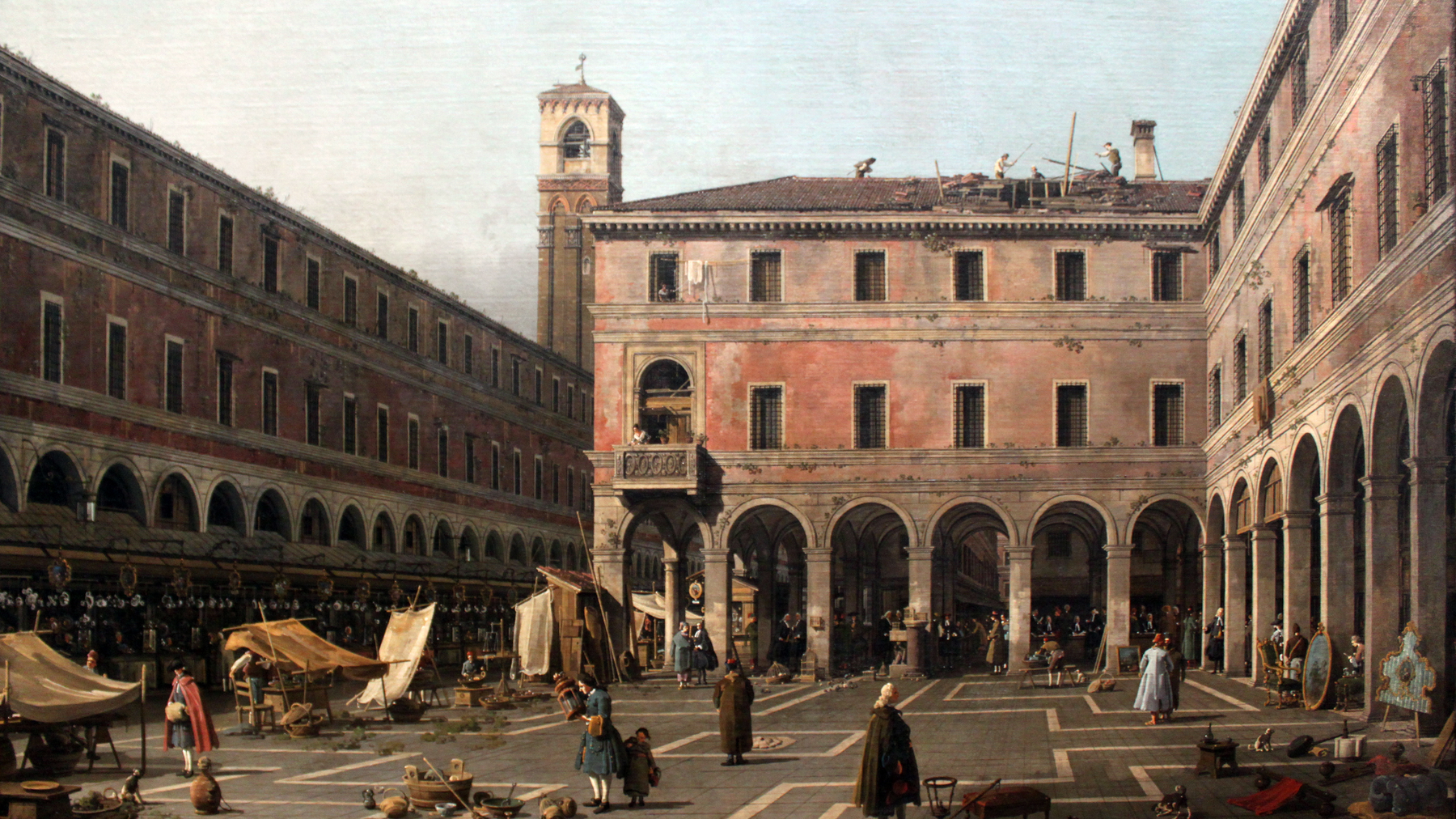
From the thirteenth century, money changers at Rialto worked from wooden benches, or banchi, taking deposits and handling transfers for merchants across the Mediterranean, the origin of the English word bank. When a banker's business failed, tradition held that his bench was broken, banca rotta, the root of bankrupt. After repeated private bank collapses, the Venetian Senate opened the public Banco della Piazza di Rialto in 1587, one of Europe's earliest state banks.
At a glance
- Where
- Rialto, the historic commercial and financial heart of Venice, beside the Grand Canal
- Name origin
- Rialto derives from the Latin Rivus Altus, the high bank of the canal
- Money changers
- Known as campsores, operating from wooden benches, or banchi, from the 1200s onward
- Word origins
- Bank from banca or banco, the trading bench; bankrupt from banca rotta, a broken bench
- Public bank founded
- Banco della Piazza di Rialto, established by Senate decree on 11 April 1587
- Growth
- Deposits at the public bank reached roughly 1.7 million ducats by 1618
Most visitors who cross the Rialto Bridge are heading toward the fish market, the produce stalls, or a bacaro for a glass of wine and a plate of cicchetti. That is a reasonable instinct. Rialto has been a food market for centuries. It is a much older, and today far less visible, identity that gave English two words still used every day, in every country, without anyone thinking twice about where they came from.
The words are bank and bankrupt, and both trace back to a specific piece of furniture that once sat in this same small stretch of Venice: a wooden bench, used by a money changer, that could be taken away from him if his business collapsed.
A high bank on a working canal
The name Rialto itself points to the area's original function. It comes from the Latin Rivus Altus, meaning high bank or deep stream, describing the raised, relatively stable ground beside the Grand Canal where some of Venice's earliest permanent settlement and commerce took root, well before the city's political centre consolidated around San Marco.
By the thirteenth century, Rialto had become Venice's principal commercial district, drawing merchants, goods, and currency from across the Mediterranean and beyond. A trading city built on maritime commerce needed somewhere to convert currencies, settle accounts, and move money between merchants who might not meet again for months, and Rialto became that place.
The bench that became the bank
The specialists who did this work were known as campsores, money changers, and they conducted business from simple wooden tables or benches set up in the open commercial area, referred to in Venetian dialect as banca or banco. A merchant could deposit funds with a trusted campsore and draw on that deposit later, or arrange for payment to a third party without physically moving coin, an early and informal form of the deposit and transfer banking that would later be formalised across Europe.
The furniture gave the trade its name, and the trade's name outlived the furniture by centuries. Modern English, along with most European languages, still calls the institution a bank because the earliest recognisable version of it in cities like Venice and Florence was, quite literally, a piece of bench-height furniture set up in a market square.
The same word carried a harsher second meaning when things went wrong. When a money changer's business failed, whether through bad debts, fraud, or simple insolvency, the common account holds that his bench was broken, either symbolically or in practice, marking him publicly as finished in the trade. The Italian phrase for this, banca rotta, a broken bench, passed into English almost unchanged as bankrupt, one of the more direct and traceable etymologies in the language.
When private banking kept failing
Private banking at Rialto was not a stable system. Individual campsori operated with limited oversight and limited capital reserves relative to the deposits they held, and Venice experienced repeated waves of bank failures across the fourteenth, fifteenth, and sixteenth centuries, each one disrupting merchants who had trusted a now-broken bench with their funds.
The Republic tried, more than once, to establish a public alternative. Proposals for a state-run bank surfaced as early as 1356 and again in 1374, but neither produced a lasting institution. It took a further round of serious private bank collapses in the later sixteenth century, a period when confidence in Rialto's private bankers had worn thin, to finally push the Senate to act decisively rather than debate the idea again.
The public bank the collapses finally produced
On 11 April 1587, the Venetian Senate established the Banco della Piazza di Rialto, a public bank intended to offer merchants a more secure alternative to private money changers. It accepted deposits, handled transfers between merchant accounts, and operated under direct state oversight rather than the individual judgment and solvency of a single campsore.
The bank grew steadily rather than spectacularly. By 1618, deposits held at the Banco della Piazza reached approximately 1.7 million ducats, a substantial sum that reflected genuine merchant confidence in an institution backed by the Republic rather than by one man's bench and reputation. It stands among the earliest public banks in Europe, predating better-known later institutions by decades, and it grew directly out of Rialto's long, messy history of private financial failure.
What the market still remembers
Rialto today sells fish, vegetables, wine, and souvenirs, and almost nothing in its current market atmosphere hints at its earlier identity as one of the origin points of Western banking. That gap is worth noticing rather than smoothing over. The market's noise, its produce stalls, its crowded footbridge, sit directly above ground where merchants once settled international debts across a wooden bench, and where a failed banker's ruin was, briefly, a piece of furniture broken in public view.
A short walk from those same benches stands the Fondaco dei Tedeschi, the merchants' warehouse that anchored German trade at Rialto for centuries, another building whose commercial history has been almost entirely obscured by its present-day function. Together, the two sites suggest how much of Rialto's real significance sits beneath what a modern visitor sees at street level. For a look at what the market actually sells today, and how to shop it properly, the Rialto market guide covers the produce and fish stalls that occupy the same ground the campsori once worked.
Sources
- “Banco della Piazza di Rialto,” Wikipedia. Source link
- Fernand Braudel, The Mediterranean and the Mediterranean World in the Age of Philip II, on early Mediterranean banking and exchange practice.
- Oxford English Dictionary, etymology entries for “bank” and “bankrupt,” tracing both to Italian banca and banca rotta.
This article was independently researched and produced. The hero image is an editorial illustration and is not presented as documentary photography. No payment, complimentary service or editorial approval was provided by any organisation mentioned.