
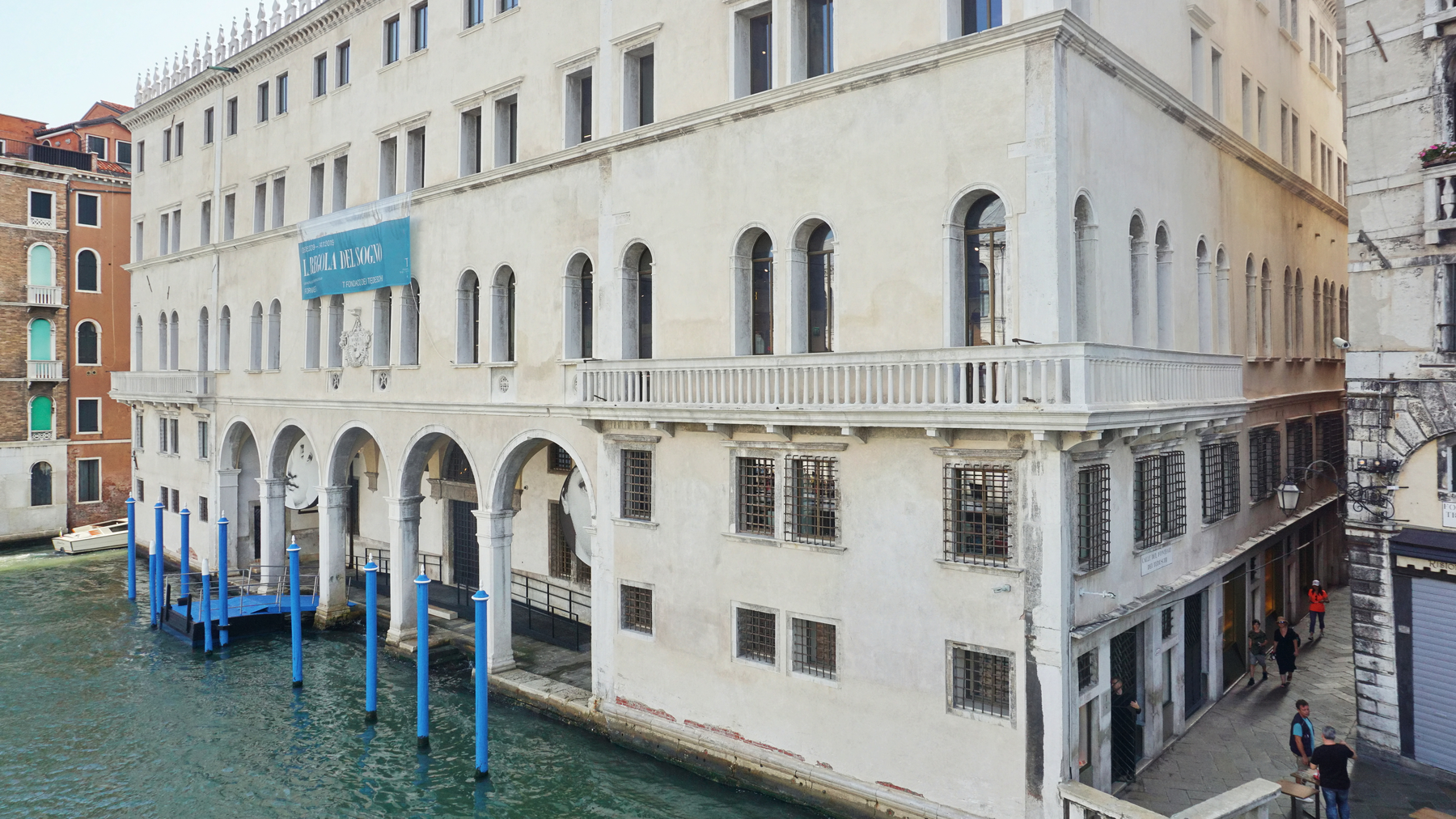
In brief
The Fondaco dei Tedeschi, beside the Rialto Bridge, was founded in 1228 as a strictly regulated warehouse and lodging house for German merchants, rebuilt after a 1505 fire, and later served in turn as a Napoleonic-era customs house and, for roughly seventy years, Venice's central post office. A 2016 renovation by OMA turned it into a luxury DFS department store, which closed in May 2025, leaving the building's next role undecided.
At a glance
- Where
- Riva del Vin side of the Grand Canal, immediately beside the Rialto Bridge, San Marco sestiere
- Founded
- 1228, as a fondaco, a regulated trading house and lodging for German merchants
- Rebuilt
- 1505 to 1508, after a fire destroyed the original building
- Later uses
- Customs house under Napoleonic administration; Venice's main post office for roughly seventy years
- 2016 renovation
- Converted into a luxury DFS department store, designed by OMA under Rem Koolhaas
- 2025
- DFS announced the closure of the store; it closed its doors in May 2025
Step off the Rialto Bridge on the San Marco side and the building on your immediate left has been receiving goods, money, and travellers for very nearly eight hundred years. It has never stood empty for long, and it has never done the same job for more than a few centuries at a stretch. Warehouse, customs post, government office, luxury store: the Fondaco dei Tedeschi has been rebuilt in purpose almost as often as Venice itself has changed hands.
Its most recent chapter closed in 2025, and as of this writing the building's next use has not been announced, which makes now an unusually apt moment to look at what it has already been.
A warehouse with rules attached
The word fondaco, borrowed from the Arabic funduq, describes a specific medieval institution common in Mediterranean trading cities: part warehouse, part lodging house, part regulatory checkpoint, reserved for a particular foreign merchant community and closely supervised by the host city's authorities. Venice's Fondaco dei Tedeschi, established in 1228, served merchants from German-speaking trading cities, Nuremberg and Augsburg prominent among them, who came to Venice to buy and sell goods moving between northern Europe and the Mediterranean.
The arrangement was not a casual hospitality gesture. German merchants were required to lodge and conduct business through the Fondaco, their goods inspected and taxed on the way in, and direct sales to buyers outside official Venetian channels were restricted. The building's location, immediately beside the Rialto Bridge and directly on the Grand Canal, put visiting merchants close to Venice's commercial heart while keeping their activity easy for the Republic to monitor. Convenience and control sat side by side in the same address, a pattern that recurs across much of Venetian mercantile regulation in this period.
Rebuilt after fire, decorated by two of the greatest painters in Venice
A fire in 1505 destroyed the original Fondaco, and the Venetian state rebuilt it within a few years, completing the new structure by 1508. The rebuilt facade received frescoes from Giorgione and, in one of the more remarkable footnotes in Venetian art history, the young Titian, working alongside or shortly after him. Exposure to weather and canal humidity took a heavy toll on the frescoes over the following centuries, and only fragments survive, now preserved and displayed at the Ca' d'Oro gallery rather than on the building itself. The Fondaco most visitors see today carries only a faint memory of what was, briefly, an outdoor gallery by two of the defining painters of the Venetian Renaissance.
From merchants' house to government office
The Fondaco's identity as a German merchants' house lasted, in some form, for close to five and a half centuries, ending only with the fall of the Venetian Republic itself in 1797. Under the administrations that followed, Napoleonic and later Austrian, the building was repurposed as a customs house, a function that made practical sense given its position directly on the Grand Canal's main commercial artery.
Its most enduring twentieth-century role came under Italian national administration, when the building became Venice's central post office. For roughly seventy years, the Fondaco dei Tedeschi processed the city's mail rather than its merchants, a use so long-running that generations of Venetians knew the building primarily as the post office rather than by its medieval name or its earlier trading history.
A department store, and then an empty question
The building's most recent transformation began in 2008, when the Benetton Group acquired a long-term lease, and took full shape between 2014 and 2016, when the Dutch architecture firm OMA, under Rem Koolhaas, renovated the interior into a luxury department store operated by DFS Group. The renovation preserved the historic courtyard and facades while inserting a dramatic, open, multi-level retail atrium beneath a new glass roof, along with a rooftop terrace that became one of the most sought-after free viewpoints over the Rialto Bridge and Grand Canal.
The store operated for close to a decade before economic pressures caught up with it. DFS Group announced in late 2024 that it planned to close the Fondaco dei Tedeschi location, and the store closed its doors in May 2025, ending the building's shortest chapter of use to date after roughly nine years of operation. What replaces it has not been settled. The building's owners and the city's tourism economy are, as of this writing, still working out what an 800-year-old trading house does next, in a city where retail footfall, rents, and tourist behaviour have all shifted considerably since the store's 2016 opening.
A building that keeps answering the same question differently
What makes the Fondaco dei Tedeschi worth more than a passing photograph from the rooftop terrace, when it is open, is the pattern underneath its individual chapters. Every one of its identities, merchant warehouse, customs post, post office, luxury retailer, has been an answer to the same underlying question: what does a city do with its most valuable piece of real estate, sitting directly on its main commercial waterway, beside its busiest bridge? Medieval Venice answered with regulated trade. Napoleonic administrators answered with customs revenue. The Italian state answered with mail. A global luxury retailer answered with tourism spending. Each answer worked for a while, and then stopped working, and the building outlasted all of them.
The Fondaco's history sits directly above the same commercial ground explored in the story of Rialto's money changers and the origins of the word bank, a few steps away along the same stretch of canal. Both buildings, and the market between them, make the case that Rialto's real identity has always been commercial reinvention rather than any single fixed use, food market included. For a look at what still happens at street level around the bridge today, the Rialto market morning piece follows the produce and fish trade the Fondaco has watched from across the water for centuries.
Sources
- “Fondaco dei Tedeschi,” Wikipedia. Source link
- “DFS to close its iconic department store in Venice,” Premium Beauty News. Source link
- “OMA-designed Fondaco dei Tedeschi store in Venice closes its doors,” Designboom. Source link
- “DFS Group announces plan to close Fondaco dei Tedeschi in Venice,” DFNI Online. Source link
This article was independently researched and produced. The hero image is an editorial illustration and is not presented as documentary photography. No payment, complimentary service or editorial approval was provided by any organisation mentioned.