
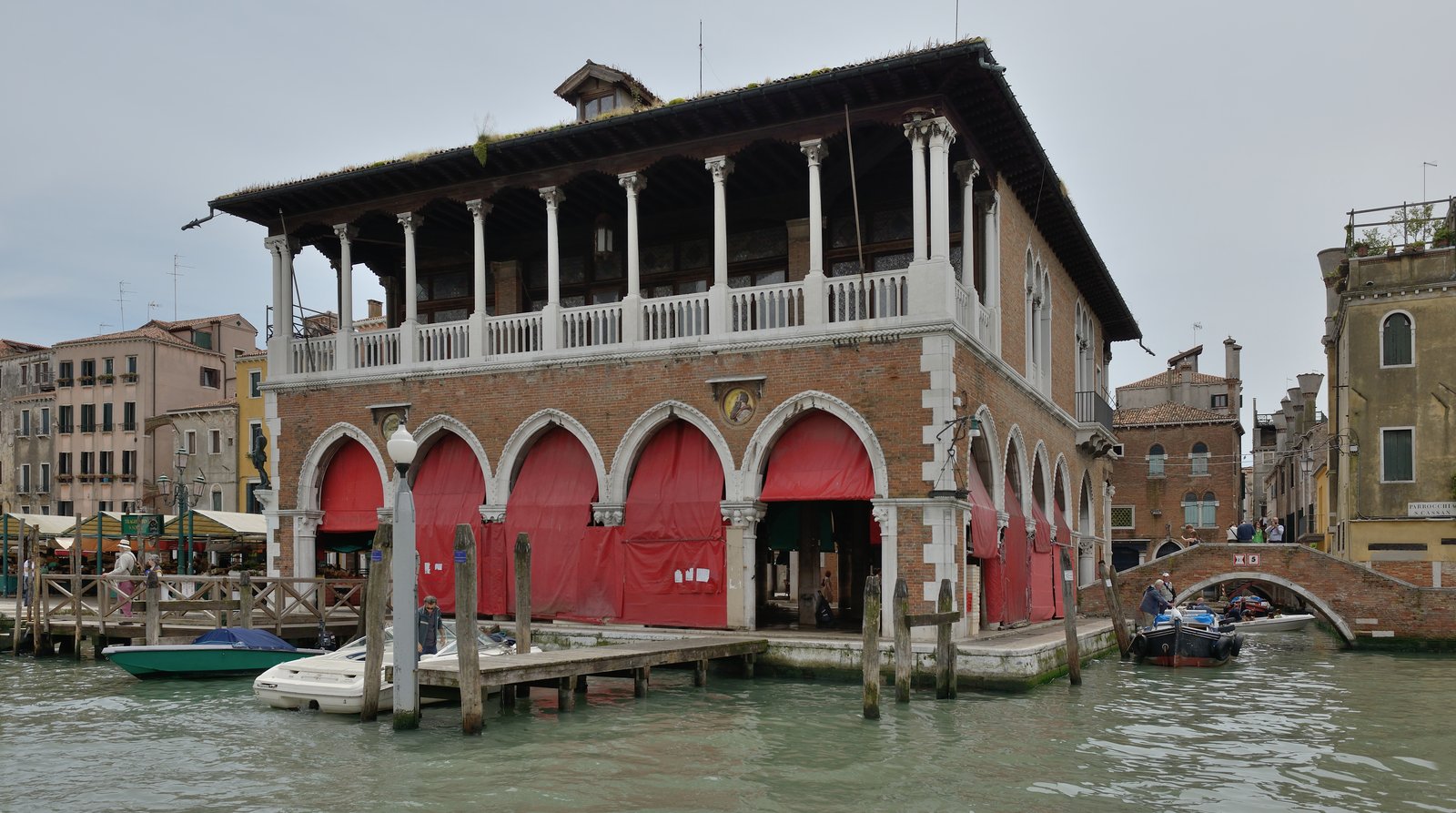
In brief
The Rialto Market, comprising the Pescaria (fish market) and the adjoining Erbaria produce stalls, has operated on the same site beside the Grand Canal since at least the 11th century, though the current fish-market pavilion dates to 1907. Vendors open around 7am, with deliveries arriving earlier by boat, and the market largely winds down by early afternoon; it is closed Sundays, and the Pescaria is also closed Mondays.
At a glance
- Location
- San Polo, beside the Grand Canal, near the Rialto Bridge
- Hours
- Roughly 7am–1pm; closed Sunday, fish market also closed Monday
- Best time to visit
- Before 9am, ahead of day-trip crowds
- History
- Trading site since the 11th century; current Pescaria pavilion built 1907
- Supply
- Mix of Adriatic and lagoon fish, and Sant'Erasmo-grown produce
- Last checked
- July 2026
The oldest working address in Venice
The Rialto has functioned as Venice's principal commercial hub since before the Republic reached its full power — the area's name derives from rivo alto, "high bank," reflecting its status as one of the earliest solidly settled parts of the lagoon. Trading activity here is documented back to at least the 11th century, and the market's basic layout — fish and seafood closest to the water, fruit and vegetables in the open arcades of the Erbaria just behind — has proven durable enough to survive rebuilding after fires, changes of political system, and the wholesale shift of the surrounding city's economy toward tourism. The fish market's current covered pavilion, with its distinctive neo-Gothic arcades, was completed in 1907, replacing older structures, but the trading pattern beneath the new roof continued largely unbroken.
Before the bridge fills with people
The working day begins long before the market technically opens to browsers. Fish arrives mostly by boat and van from the wholesale fish market at Tronchetto, itself supplied by Chioggia's fishing fleet and other Adriatic ports, with crates unloaded onto handcarts and wheeled the short distance to stalls starting well before dawn in season. A vendor setting up at 6am is arranging a display that has to look genuinely fresh by 8am and still hold its quality through a morning of handling — a discipline that has nothing to do with performance for visitors and everything to do with a trade where reputation is built stall by stall, customer by customer, over years, often across more than one generation within the same family concession.
What is sold reflects the lagoon's own calendar as much as the Adriatic's: soft-shell crabs, known locally as moeche, appear at specific short windows in spring and autumn when local crabs moult; canoce, or mantis shrimp, and schie, the small grey lagoon shrimp used in classic Venetian dishes, are sold by vendors who can generally tell a regular customer exactly which boat brought that morning's catch in. This is not a market performing authenticity for an audience; the specificity is simply how the trade has always worked, because a Venetian cook buying dinner wants to know precisely that.
The Erbaria and the Sant'Erasmo connection
Just behind the fish stalls, the Erbaria's produce vendors draw heavily on Sant'Erasmo, the lagoon's largest agricultural island, along with mainland growers from the Veneto's market-garden belt. The island's violetto di Sant'Erasmo artichoke has its own short, keenly anticipated season each spring, and Erbaria stallholders who deal directly with island growers rather than intermediaries are able to offer produce that reached the market by boat that same morning — a supply chain measured in hours rather than days, unusual for a city of Venice's size and density.
A market under pressure
The number of working stalls at Rialto has declined over recent decades, a trend documented by the Comune di Venezia and by trade associations representing market vendors, driven by the same broader forces reshaping the historic centre: rising commercial rents, a shrinking resident population who form the market's actual customer base, and competition from supermarkets on the mainland and in Mestre that offer lower prices, if not comparable freshness or specificity. Some remaining vendors have adapted by leaning into the market's appeal to visitors — offering smaller portions, ready-to-eat packaging, or multilingual signage — while trying to preserve the wholesale, resident-facing trade that is the market's actual economic foundation.
The sounds and rules of the trade
Even the vocabulary of the market has its own texture. Vendors call out weights and prices in a mix of standard Italian and Venetian dialect terms that have stayed largely unchanged for generations — asking for un etto of schie, or half a chilo of moeche when they're running, is understood immediately without translation, and regular customers often speak to vendors almost entirely in dialect. Prices are chalked on small boards rather than printed, adjusted through the morning as supply comes in or runs low, and haggling in the conventional tourist-market sense is not really the custom here; the relationship between a regular customer and a vendor is closer to a long-running professional understanding than a negotiation. Watching that exchange happen, even without buying anything, gives a far better sense of the market's actual economy than photographing the fish on ice ever could.
Visiting well
For a visitor, the most respectful way to experience Rialto Market is also the most rewarding one: arrive early, before the mid-morning tour groups pass through as a photo stop rather than a shopping destination, and treat the stalls as a working food market rather than a sight to be viewed. Buying something — a handful of schie, a bag of Sant'Erasmo produce in season, a piece of fruit — is a small but genuine way to support a trade that has occupied this exact stretch of the Grand Canal for the better part of a thousand years and is, in real and measurable ways, still shrinking.
Sources
- Comune di Venezia — Rialto Market history, hours and vendor data
- Fondazione Musei Civici di Venezia — Rialto district historical documentation
- Mercato Ittico di Venezia (Tronchetto wholesale fish market) — supply chain information
This article was independently researched and produced. No payment, complimentary service or editorial approval was provided by the places mentioned.