
In brief
Practical lagoon knowledge — reading tides, mending nets, maintaining flat-bottomed boats, growing vegetables on reclaimed mudflats — has historically passed within island families through daily apprenticeship rather than formal schooling. On Burano, Pellestrina and Sant'Erasmo, that transmission continues today, though population decline and depopulation of the historic islands mean fewer young residents are present to receive it.
At a glance
- Where
- Burano, Pellestrina, Sant'Erasmo — outer lagoon islands
- Subject
- Intergenerational transmission of fishing, boat and craft knowledge
- Best context
- Understood alongside Venice's shrinking resident population
- Related institutions
- Local fishing cooperatives, Confartigianato Venezia, parish schools
- Access note
- These are working communities, not open-air exhibits — visit with restraint
- Last checked
- July 2026
Knowledge that lives in the hands
Venice's historic centre has lost roughly two-thirds of its resident population since the 1950s, a decline documented for decades by the Comune di Venezia's own statistics office. The outer islands — Burano, Pellestrina, Sant'Erasmo, Mazzorbo — have shrunk too, but more slowly, and what remains in each is a peculiar density of specific, hard-won knowledge: how to tell from the colour of the water where the sandbanks shift after a storm, which knot holds a mooring line against a scirocco wind, when the lagoon's brackish soil is ready to take artichoke seedlings. None of this is written down in any complete form. It survives because someone still stands next to someone younger while doing it.
Fishing families on Pellestrina, the long barrier island south of the Lido, have worked the same shallow-water grounds for generations, developing an intimate map of channels, moli and fishing rights that shift subtly with the tide calendar. A teenager here who spends summers on a family boat absorbs a working vocabulary — the local names for wind directions, the specific behaviour of local fish species around the different bocche di porto, or inlets, that connect the lagoon to the Adriatic — that no classroom teaches. It is knowledge built entirely from repetition: watching a parent's hands set a net, then doing it badly, then doing it less badly, over years.
Burano: lace, boats and a school that floats
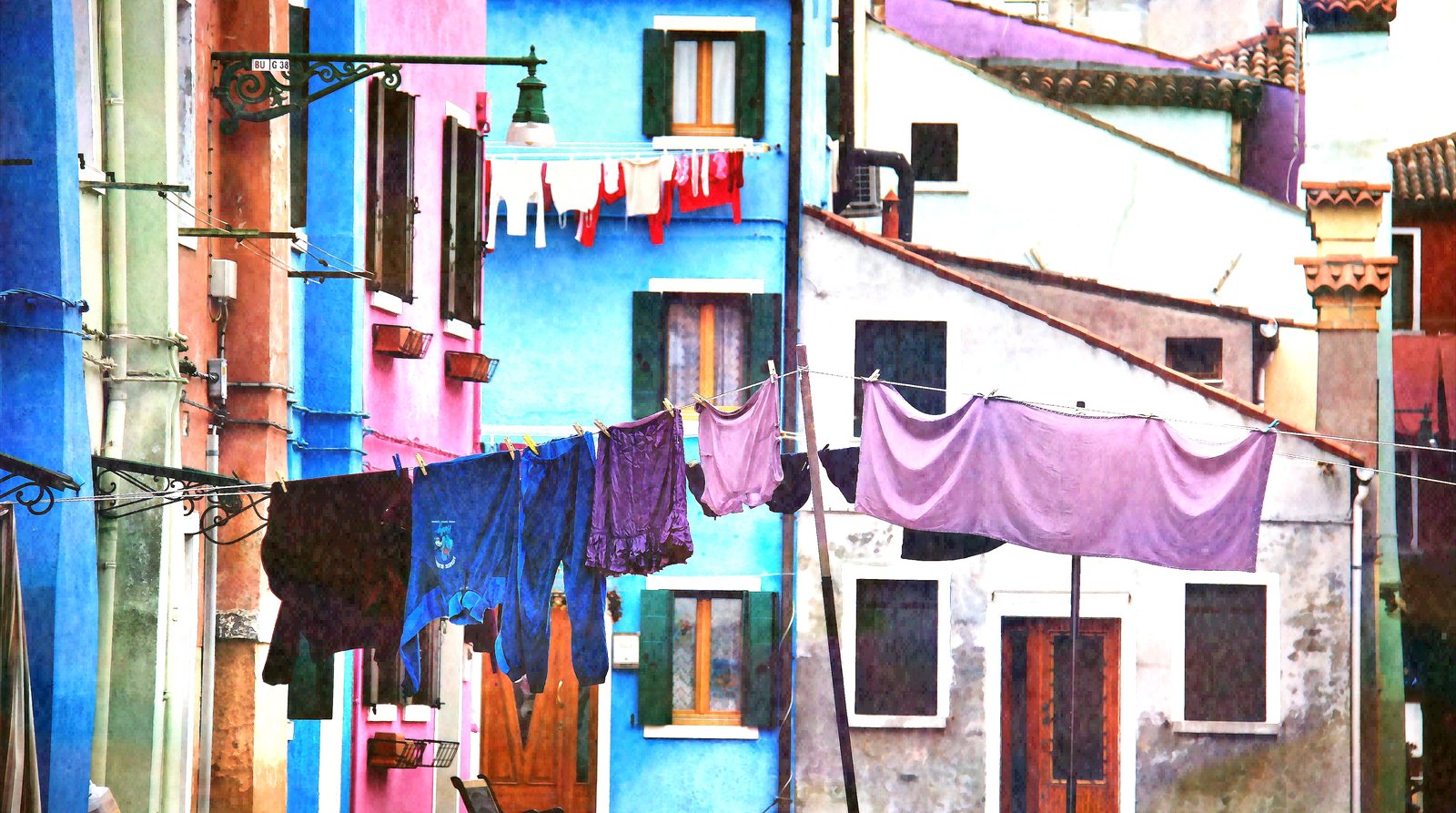
On Burano, the transmission runs through two very different crafts at once. Lace-making, historically a way for fishermen's wives to earn income while husbands were at sea, was formalised by a lace school founded on the island in 1872 and is now sustained in smaller part by the Museo del Merletto, part of the Fondazione Musei Civici di Venezia's network. Genuine burano needle lace — as distinct from the machine-made lace sold in many souvenir shops along the island's canals — takes years to learn properly, and the number of people who can produce it at a professional level is now small enough that local craft associations have flagged the skill as at risk.
Meanwhile Burano's children, along with those from Torcello and Mazzorbo, have long reached school on the mainland-facing islands by dedicated school boats run under arrangements with ACTV and the local school authority — a detail that says something concrete about what it means to grow up here: the commute itself is water, weather-dependent, and impossible to replicate by any other means. A delayed vaporetto because of fog or an exceptionally low tide is not an inconvenience abstractly comparable to a missed bus; it can mean a missed exam. Children raised this way develop a working relationship with tide tables before they can properly explain algebra.
Sant'Erasmo: knowledge measured in centimetres of soil
Sant'Erasmo, the lagoon's largest island after Venice itself and still substantially agricultural, holds a different kind of inherited expertise: how to farm reclaimed, salt-adjacent land that floods periodically and where irrigation, drainage and crop timing all have to account for a water table that moves with the tide. The island is known particularly for the violetto di Sant'Erasmo artichoke, and growers here describe soil and planting decisions in terms that would be unfamiliar on the mainland — decisions shaped by exposure to acqua alta, by which fields flood first, by which varieties tolerate brief salt intrusion and which do not. This is not knowledge available in general agricultural manuals; it is site-specific, built up over decades of a single family working the same few hectares.
Why the chain is thinning
The pressures are well documented and not mysterious: housing costs in the historic centre and even on some outer islands have risen as short-term rental and second-home ownership have expanded, pushing working-age families toward Mestre and the mainland; fishing and small-scale agriculture offer uncertain income compared with tourism-adjacent work; and younger residents who do stay increasingly work in hospitality rather than in the trades their parents or grandparents practised. Every skill described above depends on a young person being physically present, repeatedly, over years — and presence is precisely what is becoming harder to guarantee.
None of this is presented here as nostalgia for its own sake. It is a practical account of what is actually at stake when a lagoon community loses population: not only postcard views, but a body of functional, non-transferable knowledge about how to live safely and productively in a tidal environment that has no real equivalent taught anywhere else.
What keeps the knowledge alive today
Some of it survives through formal channels — craft guild apprenticeship programmes supported by Confartigianato Venezia, museum-linked lace and glass schools, cooperative fishing licences that are still often passed within families. Some of it survives more informally, through summers spent on a relative's boat or in a relative's vegetable rows, with no institutional structure at all. Visitors who want to support this continuity in a concrete way can do so simply: buying lace or produce directly from island makers and growers rather than from resellers, and treating these islands as inhabited places with working rhythms rather than as day-trip scenery.
Sources
- Comune di Venezia — resident population statistics, historic centre and lagoon islands
- Fondazione Musei Civici di Venezia — Museo del Merletto, Burano lace history
- Confartigianato Venezia — craft trades and apprenticeship data
- ACTV — school transport routes serving Burano, Mazzorbo and Torcello
This article was independently researched and produced. No payment, complimentary service or editorial approval was provided by the places mentioned.