
In brief
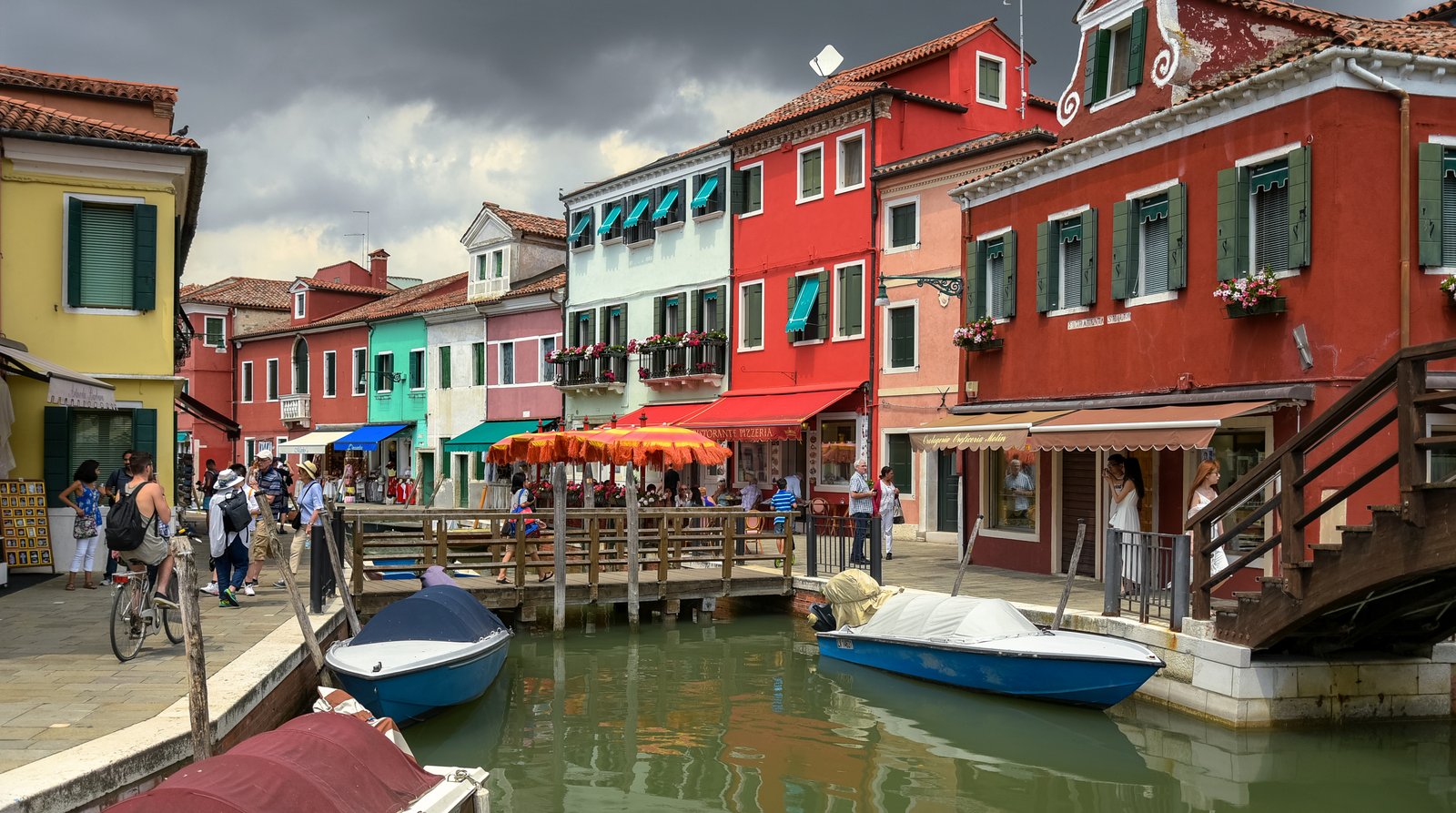
Burano is a small fishing island in the northern Venetian Lagoon, home to roughly 2,500 residents, known for brightly painted houses and needle lace. Children here typically attend the island's own primary school before commuting by boat to secondary schools elsewhere in the lagoon, and the island's population — like much of the lagoon — has declined for decades as young families move to the mainland.
At a glance
- Location
- Northern lagoon, roughly 40 minutes by vaporetto from central Venice
- Population
- Roughly 2,500 residents, down from a considerably larger historic figure
- Known for
- Painted houses, needle lace, fishing
- Schooling
- Island primary school; secondary students commute by boat
- Related institution
- Museo del Merletto (Lace Museum), Fondazione Musei Civici di Venezia
- Last checked
- July 2026
A colour scheme with a practical origin
Burano's houses are painted in a dense patchwork of blues, reds, yellows and greens, and the popular explanation — that the colours helped fishermen returning through fog identify their own homes — is widely repeated locally and plausible enough to have become part of how residents describe the island to outsiders, even if it is difficult to verify as documented civic policy versus accumulated tradition. What is well documented is that repainting a house on Burano has long required approval matching an assigned palette for each property, administered locally, which keeps the pattern consistent rather than allowing arbitrary colour choices to dilute it. For a child growing up here, the colours are not a backdrop performed for cameras; they are simply which house is whose, learned the way children anywhere learn their own street.
An island commute measured in tides
Burano has its own primary school, but from secondary level onward, island children commute to schools elsewhere in the lagoon or in Venice proper, a journey that runs on the ACTV vaporetto network rather than roads. This detail shapes daily rhythm in ways that would be unusual almost anywhere else: an exceptionally low or high tide, a period of dense lagoon fog, or a mechanical issue with a single boat can genuinely disrupt a school day for the whole island's children at once, since there is no alternative route. Families here plan mornings around a published boat timetable the way mainland families plan around a bus or train — except that a missed connection cannot be solved by a short walk or a lift from a neighbour with a car, because there are no cars.
This produces a particular, early fluency: island children tend to develop a working, largely unconscious understanding of tide behaviour and lagoon weather well before adolescence, simply because their ability to get to school and back depends on it. It is a form of environmental literacy that has no real equivalent in a landlocked town.
Lace, inherited unevenly
Burano's needle lace tradition, formalised by a lace-making school founded on the island in 1872 to support the trade during a period of economic hardship, was historically something many island girls learned as children, often taught by mothers, aunts and grandmothers within the household as much as through formal instruction. That pattern has weakened considerably. Genuine hand-made burano lace takes years of practice to produce at a professional standard, and it competes today, often confusingly for shoppers, with machine-made lace imported and sold as if it were the genuine local product — an issue island lace-makers and local trade bodies have raised publicly for years. The Museo del Merletto, part of the Fondazione Musei Civici di Venezia network and housed in the former lace school's building, now plays a significant role in keeping the craft documented and visible even as the number of children learning it informally at home has fallen.
A shrinking, aging island
Burano's population has declined over recent decades, following the broader pattern across the historic lagoon: young adults leaving for housing, education or employment on the mainland, and a resident population skewing progressively older. This is not unique to Burano, but it is felt acutely on a small island where community institutions — the school, the parish, the fishing cooperative, the lace school's living tradition — all depend on a critical mass of young residents to function as more than historical artefacts. Local associations and the Comune di Venezia have both, at various points, flagged the sustainability of small-island communities like Burano as a genuine long-term concern, distinct from and often overshadowed by discussion of Venice's historic centre.
What childhood here actually looks like
Strip away the postcard version, and what remains is a small, close, water-bound community where children know the tide schedule before they know a bus schedule, where a house's colour is a street address rather than a photo opportunity, and where a genuinely difficult, beautiful craft survives on a smaller and more fragile base than its worldwide reputation would suggest. Visitors who spend an hour past the main lace-shop street — walking the quieter canals toward the island's northern edge, or visiting the Lace Museum rather than only photographing the houses — get a fuller, fairer sense of the place children here actually grow up in.
Sources
- Comune di Venezia — Burano population and municipal services data
- Fondazione Musei Civici di Venezia — Museo del Merletto, Burano lace history
- ACTV — vaporetto routes and timetables serving Burano
This article was independently researched and produced. No payment, complimentary service or editorial approval was provided by the places mentioned.