
In brief
The Rialto market, beside the Rialto Bridge in San Polo, has operated on roughly the same site since the eleventh century and splits into the Erbaria, for fruit and vegetables, and the Pescaria, for fish, under its distinctive early-twentieth-century loggia. It runs Tuesday to Saturday mornings, is busiest and freshest before around 9am, and the Pescaria closes on Sundays and Monday mornings.
At a glance
- Location
- Beside the Rialto Bridge, San Polo, on the Grand Canal
- Best for
- Seeing the ingredients behind Venetian cooking firsthand
- Hours
- Roughly Tuesday–Saturday, early morning to early afternoon
- Best time to visit
- 7:30–9:00am for full stalls and a working atmosphere
- Closed
- Sundays; Monday mornings for the fish market
- Last checked
- July 2026
A market older than most of the buildings around it
Rialto takes its name from Rivoalto, "high bank," one of the earliest solid patches of ground in the lagoon settlement and, from around the eleventh century onward, the commercial and financial heart of the Republic — banking houses, warehouses and the Fondaco dei Tedeschi trading house for German merchants all clustered here alongside the market stalls, long before Venice's political centre fully consolidated around San Marco. Trading records referencing a market at Rialto date back close to a thousand years, which makes it one of the longest continuously operating markets in Europe, surviving fires, plague closures and the general reshaping of the surrounding buildings across the centuries while staying, more or less, on the same patch of ground beside the bridge.
Erbaria and Pescaria: two markets, one site
The market divides into two distinct sections that most visitors experience as one continuous stretch of stalls but that have separate identities. The Erbaria, closer to the bridge and largely open-air, handles fruit and vegetables, arranged under awnings and portable stalls that are set up and struck down daily. The Pescaria, a short walk further along, sits under a covered neo-Gothic loggia built in 1907 to replace an earlier structure, its arcades opening directly onto the Grand Canal so that fish could once be — and to some extent still is — landed almost at the counter. The Pescaria's stone floor, sloped and channelled for drainage, and its distinctive open-sided arches are themselves worth a look independent of what's for sale.
What's actually sold, stall by stall
The Erbaria's produce draws heavily on the lagoon's own agricultural islands, particularly Sant'Erasmo, alongside vegetables and fruit trucked in daily from farms across the Veneto mainland; a handwritten sign reading nostrano or the name of a specific island is worth more attention than a generic display. The Pescaria's counters mix genuinely local lagoon species — seppie, schie, go, canoce, depending on the season — with Adriatic and imported fish, and EU labelling rules require stalls to post catch method and origin, information that's usually visible if you look for the small printed cards rather than the fish itself.
Beyond fish and vegetables
The stretch of streets around the Erbaria and Pescaria has grown a supporting layer of shops that aren't strictly part of the market proper but are shaped by it: small cheese counters selling Veneto and Alpine-region cheeses, spice and dried-goods merchants whose stock still nods to Venice's centuries as a trading hub between Europe and the eastern Mediterranean, and bakeries turning out bread specifically timed to the market's early hours. None of these carry the same strict provenance rules as the fresh produce and fish stalls, but together they round out what a working Venetian kitchen would actually shop for on a normal morning, beyond the headline vegetables and seafood.
Reading the stalls like a local
A market morning rewards attention to a few small signals. Stalls with handwritten, specific labelling — an island name, a catch zone, a variety name rather than just "carciofi" or "pesce" — are generally the ones a local shopper would trust first. Prices that move sharply week to week for a given item are usually a sign of genuine seasonal or catch variability, whereas suspiciously flat prices across months point toward a more industrial, imported supply chain. And absence is informative too: a good stall simply won't have certain items out of season, rather than quietly filling the gap with something imported and unlabelled.
The rhythm of a market morning
The working day at Rialto starts well before the public arrives — wholesale trading and unloading begins in the very early morning, with restaurant buyers and market regulars moving through while stalls are still being set up. By roughly 7:30 to 8am the market is fully open and at its best: full stalls, brisk trade, the fish counters still glistening with the morning's catch. Activity tapers through the late morning and the market largely closes by early afternoon, with little reason to visit after lunchtime beyond seeing the empty stone architecture.
Beyond the stalls: the neighbourhood
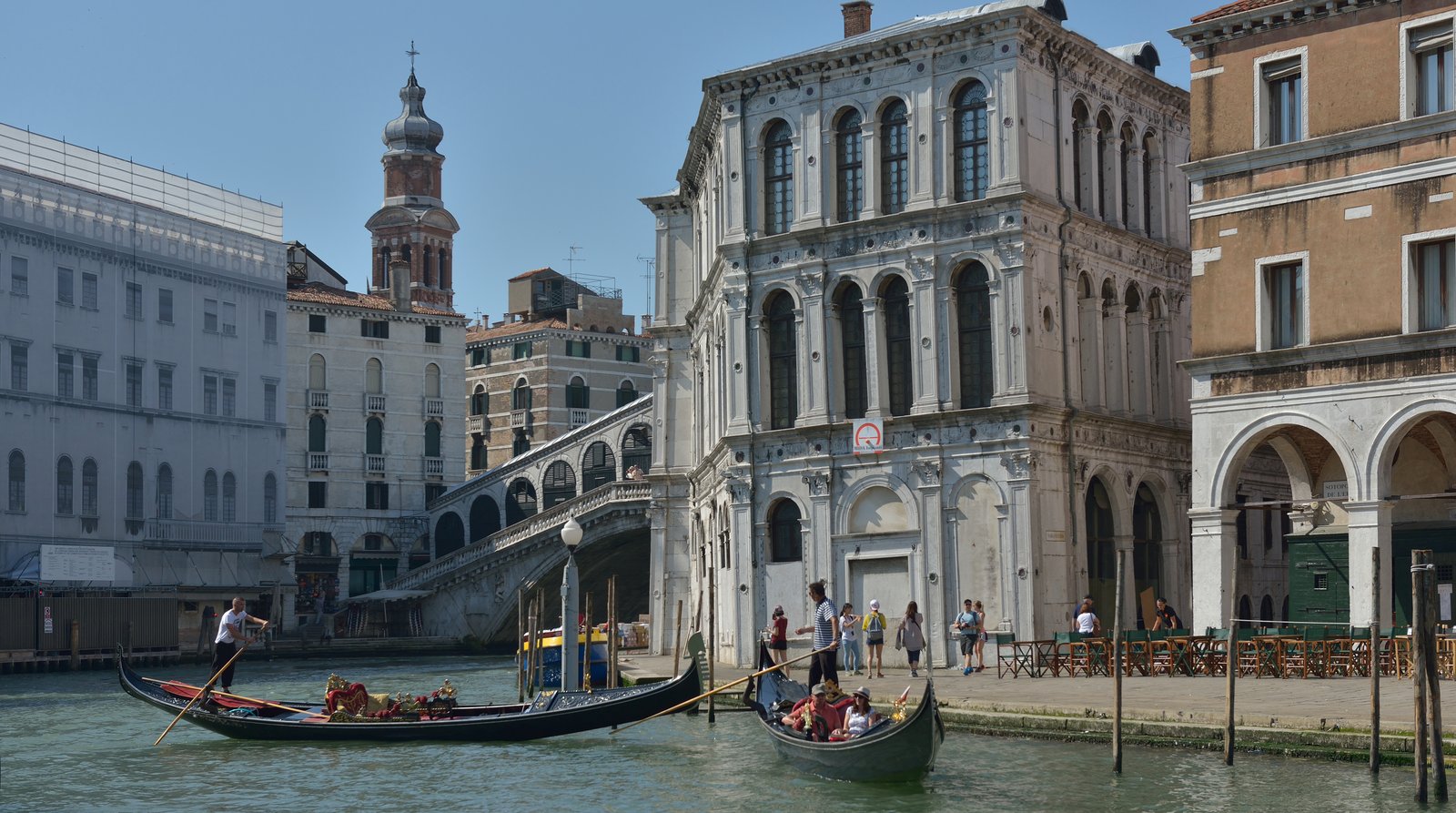
The market sits inside a small but dense historic quarter worth exploring on its own terms. San Giacomo di Rialto, a small church at the edge of the Erbaria with a prominent clock face, is traditionally held to be among the oldest churches in Venice, though the current structure has been much rebuilt. The Palazzo dei Camerlenghi, a Renaissance building that once housed Venetian treasury officials, sits nearby along the Grand Canal. It's also the historic epicentre of Venice's bacaro culture: a dense cluster of small wine bars around the market fills mid-morning with market workers and shoppers taking a quick ombra between errands, a pattern that predates and outlasts any tourist schedule.
A market that survives despite itself
Rialto has weathered more than the ordinary pressures of time: fires that swept through the wooden structures of earlier centuries, the general shift of the Republic's commercial power away from Venice after its fall in 1797, and, more recently, a marked decline in the number of resident shoppers as Venice's population has fallen and property has shifted toward short-term visitor accommodation. That the market still opens most mornings with a working, largely local clientele — rather than folding entirely into a tourist-facing food court — is itself worth noting, and part of why supporting it by buying something, however small, matters more here than it might at a market with a more secure customer base.
Visiting without getting in the way
Rialto remains a working market, not a staged attraction, and treating it that way improves the visit for everyone. Come early rather than at midday, when narrow aisles get genuinely congested; avoid photographing vendors and their goods without a quick acknowledgement first; and if you stop to ask a vendor questions or hold up their line, buying something small is the reasonable exchange. Large rolling luggage is a particular hazard in the tighter stretches near the Pescaria — best left at accommodation before a market visit.
Sources
- Comune di Venezia — Mercato di Rialto operating hours and market regulations
- Fondazione Musei Civici di Venezia — Rialto architectural and historical records
- Slow Food Venezia — market produce and species documentation
This article was independently researched and produced. No payment, complimentary service or editorial approval was provided by the places mentioned.