
In brief
Sant'Erasmo, the largest island in the Venetian Lagoon after Venice itself, is a working agricultural island whose sandy, salt-tinted soil produces the Carciofo Violetto di Sant'Erasmo, a Slow Food Presidio. Its most prized harvest is the castraura, a small first-cut bud picked by hand in April and May, followed by a longer main crop that supplies Rialto's Erbaria through June.
At a glance
- Location
- Sant'Erasmo, northern lagoon, reached by ACTV line 13 from Fondamente Nove
- Best for
- Understanding where Rialto's produce actually comes from
- Season
- Castraure roughly late April–May; main artichoke crop into June
- Recognised status
- Slow Food Presidio: Carciofo Violetto di Sant'Erasmo
- Getting there
- Vaporetto to the Chiesa or Capannone stop, roughly 30–40 minutes from central Venice
- Last checked
- July 2026
The island most visitors never see
Sant'Erasmo sits in the northern lagoon, a short but easily overlooked vaporetto ride from Fondamente Nove, and it is easy to miss entirely if your itinerary runs Murano–Burano–Torcello and back. There is no glassmaking here, no lace, no basilica drawing coach parties. What there is instead is roughly three kilometres of flat, sandy farmland, a scattering of farmhouses, a fort built by the Austrians in the nineteenth century, and somewhere around a few hundred permanent residents — many of them farmers whose families have worked the same plots for generations. It is, in effect, Venice's kitchen garden, and it has been supplying the city's markets since at least the medieval period, when religious orders and the Republic itself held agricultural interests on the lagoon's outer islands.
Why this soil grows a different artichoke
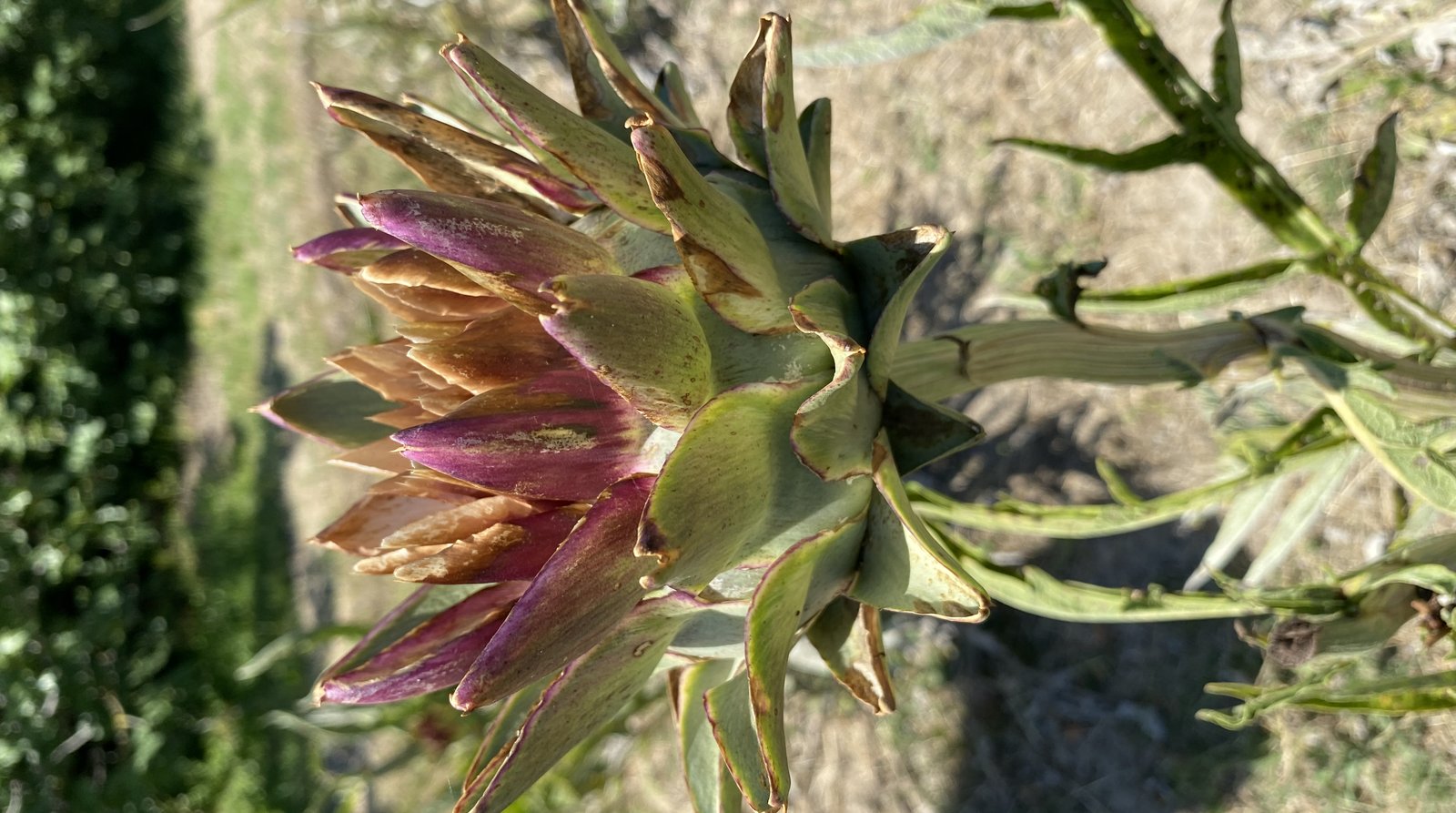
What makes Sant'Erasmo's produce distinct is not romantic conjecture — it is a specific combination of sandy, well-drained soil, low elevation just above the tide line, and near-constant exposure to salt-laden air blowing in off the Adriatic through the lagoon's inlets. That salinity stresses the plants in a way that, for artichokes in particular, concentrates flavour and produces a variety — the Carciofo Violetto di Sant'Erasmo — that differs from the more familiar globe artichokes sold across Italy. It is a local heirloom cultivar: violet-green, nearly thornless, with tightly closed leaves and a tenderness that allows the whole bud, not just the heart, to be eaten raw when young. Slow Food recognised it as a Presidio, a designation reserved for small-scale traditional products at risk of disappearing, in acknowledgement of both its distinctiveness and the shrinking number of families still farming it commercially.
Castraura: the cut that matters most
Each artichoke plant sends up one central bud first, and it is this bud — the castraura — that farmers cut early, by hand, typically over a narrow window from late April into May. Removing the central bud is a deliberate act of restraint: cutting it off redirects the plant's energy into the smaller side buds that follow, which become the main summer crop. The castraura itself is small, intensely tender and prized precisely because the harvest window is so short and the yield so low relative to labour — a single plant produces only one. It is traditionally eaten raw, sliced paper-thin with good olive oil, a little lemon and shavings of aged cheese, a preparation that would be pointless with a tougher, later-season artichoke.
From castraura to the main crop
Once the castraure are cut, the plant's remaining buds mature through May and into June, larger and slightly less delicate than the first cut but still markedly more tender than most globe artichokes sold elsewhere. These go into the dishes most visitors will actually recognise: artichoke bottoms trimmed and braised in olive oil and parsley, folded into risotto, or fried whole as fritto. Restaurants across Venice build spring menus around this window, and it is one of the more reliable seasonal markers of the Venetian calendar — when castraure appear at Rialto, spring has properly arrived, in a way the weather alone doesn't always confirm.
A landscape shaped by farming, not tourism
Sant'Erasmo has almost none of the infrastructure built around Venice's other outer islands. There is no glass showroom circuit, no lace market, only a handful of small trattorie and a scatter of working farms, many still family-run on modest plots. The island is largely flat and easy to explore on foot or, more practically, by rented bicycle, past the Torre Massimiliana — a nineteenth-century Austrian coastal fort now used for occasional exhibitions — and along quiet lagoon-edge paths where the working nature of the place is obvious: irrigation channels, greenhouse tunnels, stacked wooden crates rather than souvenir stalls.
How the harvest reaches the city
Produce grown on Sant'Erasmo has historically travelled to central Venice by boat, and much of it still does, landing at the Erbaria — the vegetable and fruit section of the Rialto market, distinct from the adjoining Pescaria for fish — where it is sold directly by growers or their agents in the early morning hours before the market opens to browsers. Some Sant'Erasmo farmers also sell directly from stands on the island itself, and a modest but growing number supply restaurants and bacari directly, cutting out the market stage of the chain altogether. Either way, the distance an artichoke travels from Sant'Erasmo's fields to a Venetian plate is measured in a single lagoon crossing, not in refrigerated trucks.
Not just artichokes
The castraura is Sant'Erasmo's best-known crop, but the island's sandy, salt-touched soil produces other specialities worth knowing about. The asparago violetto di Sant'Erasmo, a purple-tinged local asparagus variety, is harvested in the same general spring window as the castraure and shares the same prized tenderness, though it draws far less attention outside the island. Later in the year, the same fields turn over to squash, beans and other vegetables that supply Rialto through summer and autumn — a reminder that Sant'Erasmo functions as a working farm on a full annual cycle, not a single-crop curiosity that happens to peak in spring.
Visiting without disrupting a working island
Sant'Erasmo rewards a slower visit than most lagoon day-trip itineraries allow. Buying produce directly from a farm stand, eating at one of the island's small family-run trattorie, and keeping to marked paths around cultivated fields are simple ways to support an agricultural economy that receives a fraction of the visitor spending that flows to Murano or Burano, despite supplying much of what ends up on Venetian tables. It is not, and does not aim to be, a tourist attraction — which is precisely what makes it worth the crossing.
Sources
- Slow Food — Presidio Carciofo Violetto di Sant'Erasmo documentation
- Comune di Venezia — island agriculture and Rialto market records
- Veneto Agricoltura — regional agricultural heritage documentation
This article was independently researched and produced. No payment, complimentary service or editorial approval was provided by the places mentioned.