
In brief
Traditional Venetian wells collected rain from roofs and paved surfaces, channelled it into sand-filled underground cisterns sealed with clay, and allowed filtered water to gather in a central permeable shaft. The wellhead provided access, but the water came principally from rain—not a natural spring.
At a glance
- Venetian term
- Pozzo; the system is often called a pozzo alla veneziana
- Water source
- Rainfall, supplemented at times by water brought from the mainland
- Core components
- Collection drains, clay-lined cistern, filtering sand, permeable central shaft and stone wellhead
- Public works
- The Great Council ordered 50 new public cisterns in 1322 and 30 more in 1424
- End of dependence
- A modern aqueduct reached Venice in the late nineteenth century
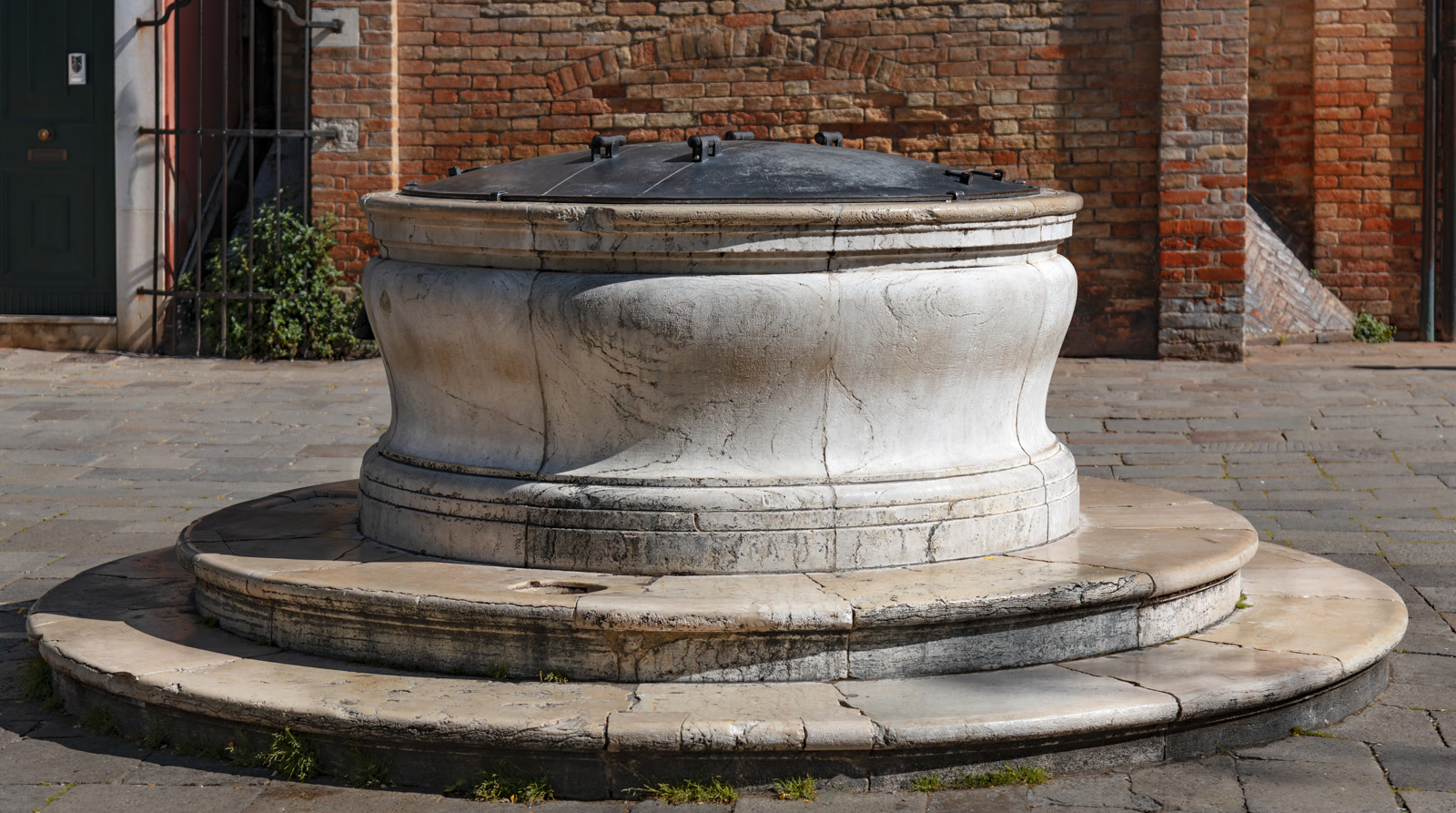
At the centre of many Venetian courtyards and campi stands a carved stone cylinder. It looks like the mouth of a conventional well, and Venetians still call it a pozzo. But drill down beneath one and you would not find a natural freshwater table. You would find a carefully constructed basin of impermeable clay, filled with filtering sand and fed by rainwater from the paving around it. Venice’s wells were, in other words, cisterns disguised by familiar language. Their success depended on making a small artificial aquifer inside a city surrounded by brackish water. For centuries this quiet infrastructure supplied households, convents, palaces and public squares. It made urban life possible while remaining mostly invisible underfoot.
Fresh water in a salt-water city
Venice’s most obvious resource was also its problem. The lagoon protected and connected the city, but its water could not sustain a dense population. Rivers had been kept away or diverted to control silting. Shallow groundwater was vulnerable to salinity and contamination. Drinking water therefore had to be captured, protected or imported.
The solution transformed the city’s surfaces into a collection device. Rain falling on roofs and paved squares ran toward stone drains. From there it entered the subterranean reservoir, passing slowly through sand. The sand removed much suspended matter; the clay lining prevented the stored freshwater from leaking away and helped keep brackish groundwater out.
At the centre stood the canna, a shaft made from special porous bricks and permeable mortar. Filtered water migrated into it and could be drawn through the decorative wellhead above. The arrangement imitated a natural water table on a small, controlled scale.
Reading a campo as a machine
Once the system is understood, a Venetian square looks different. Its slopes are functional. Its drains are part of a hydrological design. The wellhead is not an isolated ornament but the visible control point of a reservoir extending below the paving.
Construction demanded both materials and discipline. According to historian David Gentilcore’s study of the early modern cistern system, the floor and walls could be wrapped in roughly half a metre of impermeable clay. Clean sand filled the basin around the central shaft. The catchment surface had to remain serviceable, and polluted runoff had to be managed.
The design could be scaled. A small private courtyard might serve a household. Larger systems supported communities and institutions. Palaces and convents sometimes possessed more than one. Public cisterns distributed water through neighbourhood space, turning the campo into a shared reserve.
Water as law and daily ritual
Engineering alone did not keep the system working. Water collection was a matter of governance from at least the medieval period. Gentilcore notes that Venetian law addressed rainwater capture in the eleventh and twelfth centuries. In 1322 the Maggior Consiglio ordered 50 new public cisterns; in 1424 it ordered another 30 in different parts of the city.
Numbers varied over time and historical inventories do not always count in the same way. What is clear is the scale: thousands of cisterns eventually existed across Venice, including public and private examples. They formed a distributed network rather than a single monumental waterwork.
Access could be regulated, particularly during scarcity. Wellheads might be locked. Officials and parish structures helped supervise public supplies. Water carriers also brought freshwater by boat from mainland rivers, adding an external stream to the rain-fed system. The cistern network was resilient precisely because it combined local capture, storage, rules and imported supply.
For residents, this infrastructure appeared as routine. Drawing water, opening and closing a well, cleaning catchments and waiting for rain were domestic and civic rhythms. Drought was not an abstraction; it altered the level beneath the square.
The beauty above, the labour below
Many surviving vere da pozzo—the stone rings around the opening—carry coats of arms, foliage, religious symbols or inscriptions. They are collected visually as pieces of sculpture. Yet their decoration can obscure the physical labour beneath them.
Clay had to be transported and packed. Sand had to be selected and periodically renewed. Drains and paving required maintenance. A contaminated cistern could threaten health; a damaged lining could allow precious water to escape or saline water to enter. The elegant stone rim was only the public face of a demanding system.
That contrast is deeply Venetian. The city often turns necessity into form without erasing the necessity. A bridge is an answer to a canal and also a piece of civic theatre. A cistern is a response to thirst and also the compositional centre of a campo.
Not pure by modern standards
It is tempting to describe the sand as producing perfectly pure water. Historical caution is needed. Filtration improved clarity and quality, but these systems operated before modern microbiology and water treatment. Catchments could be contaminated by animals, waste or dirty surfaces. Epidemics and ordinary waterborne illness belonged to urban life.
Venetian authorities understood cleanliness in practical terms even when the mechanisms of disease were debated. Protecting collection surfaces, controlling access and maintaining the cistern mattered. Water brought from the mainland also varied in quality. The system was ingenious, not infallible.
This distinction makes the achievement more credible. The cisterns were not magical wells. They were engineered compromises that worked well enough, at vast scale, for a city with few easy options.
The aqueduct and the afterlife of the wells
By the nineteenth century Venice’s population and expectations had outgrown dependence on rainwater capture and boat-borne supply. The modern aqueduct changed the city’s relationship with fresh water. Many cisterns fell out of use or were sealed. Their wellheads remained as markers in stone.
Today they are easy to photograph and easy to misunderstand. Tourists rest bags on them; children circle them; high water can temporarily surround them. Their original purpose survives most clearly when rain runs across a campo toward the old inlets.
The wells reveal Venice not as a city floating free of material limits but as one built through intimate knowledge of them. Every shower was an asset. Every paved surface had a second function. Below the grand façades lay reservoirs of sand and clay.
That is the most compelling lesson of the Venetian pozzo: the city’s endurance was produced not only by ships, merchants and palaces, but by the patient capture of weather.
A small field guide to the surviving clues
The system can still be read without opening the ground. Look first at the paving around a wellhead: the broad stone surface is the former catchment, not merely a decorative setting. Small openings or drains indicate where rain entered the filter bed. The carved ring marks the central shaft, while changes in pavement level can suggest the reservoir's footprint. Not every surviving element is complete, and many squares have been repaved, so visual interpretation should remain tentative. Even so, these clues restore a hidden dimension to an ordinary walk. The city below one's shoes was as carefully composed as the façades above.
The system also offers a useful warning against treating historical sustainability as effortless. Rainwater harvesting demanded land, clean surfaces, regular maintenance and collective rules. It succeeded because Venice invested labour and authority in it. The lesson is not that an old technology can simply be copied, but that resilient infrastructure is usually social as well as technical.
Sources
- David Gentilcore, “The cistern-system of early modern Venice,” Water History (2021), open PDF via Ca’ Foscari: https://iris.unive.it/retrieve/handle/10278/3743728/251969/Gentilcore2021_Article_TheCistern-systemOfEarlyModern.pdf
- David Gentilcore, “The Waterwheels of Lizzafusina: Technological Innovation, Patenting, and Practical Necessity in Sixteenth-Century Venice,” Technology and Culture (2025): https://iris.unive.it/retrieve/e1c456ec-6c26-4d92-bae6-1d0be4379ab2/Gentilcore_The%20Water%20Wheels%20of%20Lizzafusina_Technology%20and%20Culture_Jan%202025.pdf
This article was independently researched and produced. No payment, complimentary service or editorial approval was provided by the places mentioned.