
In brief
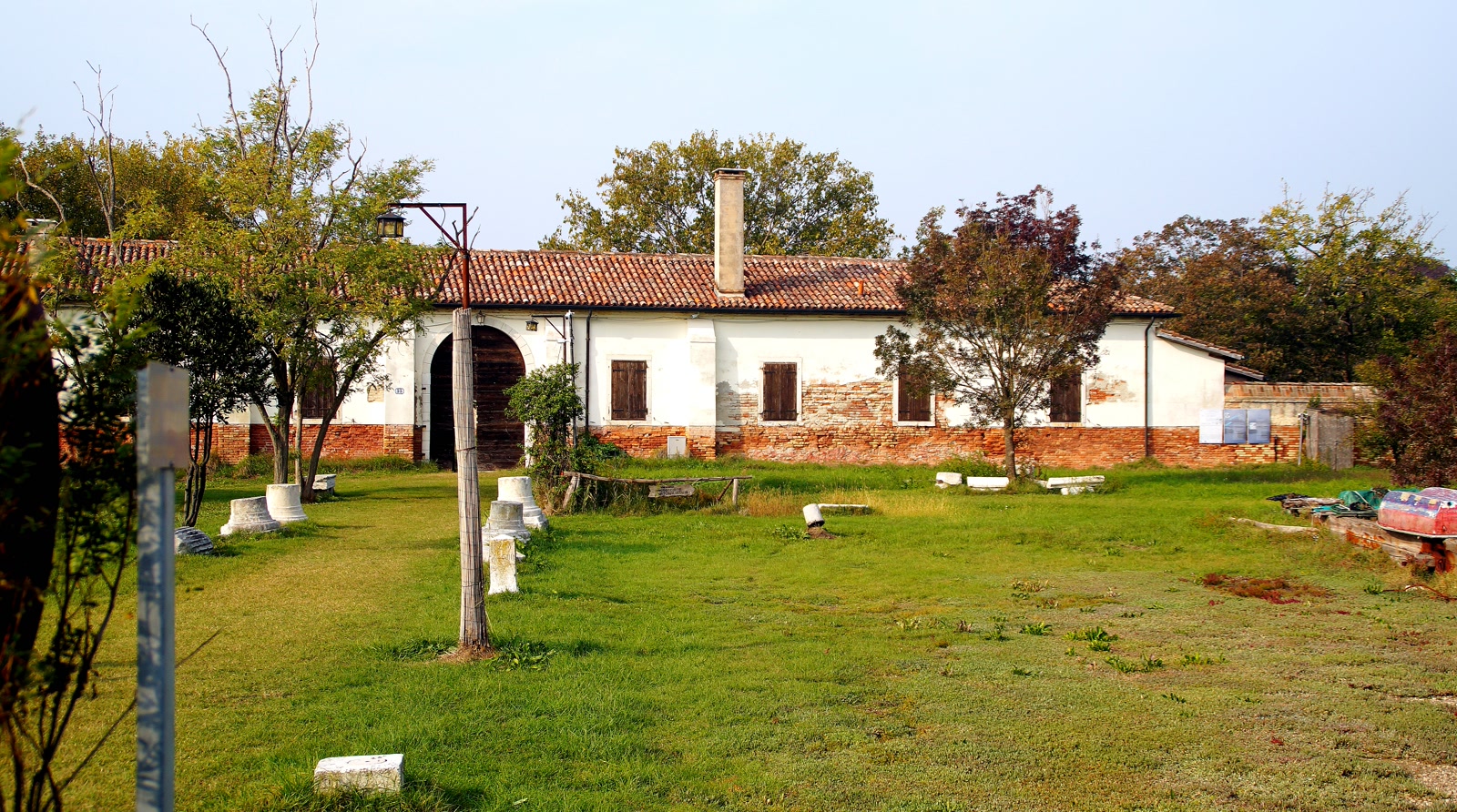
Established by the Venetian Republic in 1468, Lazzaretto Nuovo operated as a quarantine threshold for ships, travellers and merchandise suspected of carrying plague. Its warehouse walls preserve work-related writings, while its cemetery contains the remains of people connected to centuries of epidemic control.
At a glance
- Where
- Near the entrance to the Sant’Erasmo channel, northern lagoon
- Established
- 1468 by the Republic of Venice
- Main building
- Tezon Grande, a warehouse over 100 metres long
- Wall evidence
- Graffiti and painted records dating mainly from the late 1500s and early 1600s
- Cemetery
- Archaeologists estimate that the walled burial area may contain at least 2,500 individuals; only part has been investigated
Lazzaretto Nuovo sits where the lagoon begins to open toward the sea, close to the channel of Sant’Erasmo. This position was its purpose. A vessel arriving from another Mediterranean port could be near Venice without entering it. People and cargo could be observed, aired and held at a controlled distance. Inside the island’s Tezon Grande, a long warehouse more than 100 metres in length, the walls still carry writing and painted signs from the late sixteenth and early seventeenth centuries. Merchants, guards and the bastazi—porters employed by the health magistracy—left dates, symbols and working notes. Outside, archaeological research in the walled cemetery has investigated the people who died within this system. Lazzaretto Nuovo is often introduced as the birthplace of quarantine. The history is more precise: Venice developed several health institutions and regulations over time, and this island became a major station for the preventive isolation of ships, people and goods. Its power lies not in a slogan but in the surviving evidence of administration becoming daily life.
A threshold, not an exile at the edge of nowhere
The island’s geography expressed a public-health idea. Venice’s prosperity depended on exchange with distant ports, but the same connections could carry epidemic disease. Closing the city completely would damage the commerce that sustained it. Allowing every vessel immediate access created obvious danger. Quarantine made delay into policy.
Lazzaretto Nuovo complemented Lazzaretto Vecchio, the older institution associated more directly with the sick. At the “new” lazaret, potentially contaminated goods and people could be separated before admission to the city. The arrangement changed across three centuries, and practices were not uniform in every emergency. Still, the basic spatial logic remained: intercept movement at the lagoon’s edge.
The modern word quarantine is associated with forty days, from the Italian quaranta. Historical isolation periods varied, however, and the institution cannot be reduced to a single number. Documents, health certificates, inspections and judgments about ports of origin all shaped what happened to an arriving ship.
The Tezon Grande as an archive
The Tezon Grande is not an archive in the quiet institutional sense. It was a place of bales, ropes, smells and repeated handling. Goods were unloaded and arranged to be ventilated or treated according to the health rules of the period. Porters performed the heavy work under supervision.
Its walls preserve marks created by people inside that process. Some identify ships or merchants; others record dates, cargo or operations. Religious and protective signs share space with administrative notation. Together they show how bureaucratic decisions were translated into physical routines.
The writing also disrupts the idea that quarantine was only imposed from above. Magistrates issued rules, but guards and labourers made the institution function. A porter moving textiles, a clerk tracking a consignment and a merchant waiting for release each experienced a different version of the same health regime.
Municipal descriptions date the most important wall evidence from the end of the sixteenth to the beginning of the seventeenth century. These are not spontaneous modern visitor scratches. They are historical testimony tied to the island’s operations, and their preservation allows language and gesture to survive beside architecture.
Merchandise under suspicion
Early modern plague theory did not match modern germ theory. Authorities nevertheless developed detailed empirical practices around contact, origin and material risk. Textiles and other porous goods were treated with particular caution because they were thought capable of retaining contagion. Cargo could be opened, spaced and aired. Movement was documented.
The system sought to convert uncertainty into manageable categories. A ship came from a place judged healthy, suspect or infected. Papers might be accepted or challenged. People could appear well while remaining dangerous in the official imagination. Waiting created time for symptoms to emerge and for goods to undergo prescribed handling.
There was no clean separation between science, commerce and power. Quarantine protected lives, but it also controlled bodies and trade. It imposed costs unevenly. Travellers and crews lost time; merchants faced delay; labourers accepted exposure. The institution deserves neither romantic celebration nor simple dismissal. It was a sophisticated response built with the knowledge and inequalities of its age.
The cemetery behind the system
The walled cemetery gives the island’s administrative history a human weight. Archaeological and anthropological campaigns have investigated only a limited area. In 2019, the City of Venice reported the researchers’ view that at least 2,500 individuals might be buried within the structure. That is an estimate, not a completed count.
Basic osteological analysis can suggest age, sex and aspects of physical condition. Isotope and DNA research may add evidence about geographic origins, diet, disease and relationships, though results require careful interpretation. Venice was cosmopolitan, and the island received people moving through broad Mediterranean networks. The cemetery may therefore illuminate both local residents and travellers, but individual identities are rarely simple to recover.
The remains should not be turned into scenery. They belong to people who encountered quarantine not as an abstract policy but as confinement, illness, labour or death. Responsible storytelling keeps that fact in view.
From health station to powder magazine
The island did not retain one purpose forever. Under Austrian military administration in the nineteenth century, it became part of a defensive system and served as a powder magazine. A path of old mulberry trees, planted during that period, now leads visitors through a landscape where military and health histories overlap.
Later abandonment threatened the site. Volunteer groups, archaeologists and public institutions worked over decades to safeguard it and interpret its buildings and environment. The island today combines museum displays, archaeology and a nature route through the barene.
This layered afterlife matters because preservation can otherwise freeze a place at its most dramatic moment. Lazzaretto Nuovo is not solely “the plague island.” It is a lagoon island repeatedly reassigned by changing states and changing ideas of security.
What the walls still say
Standing before the Tezon Grande’s inscriptions, one encounters an unusual distance. The marks are legible enough to feel immediate but specialised enough to resist easy interpretation. A date may be clear while the work behind it remains obscure. A ship symbol summons a voyage whose crew list is lost.
Their incompleteness is part of their value. Public health often survives in decrees and institutional records, written in the voice of authority. Here the walls keep traces of intermediate hands: the people who counted, carried, watched and waited.
Venice is frequently described through unrestricted movement—boats crossing water, merchants reaching distant markets, strangers arriving from everywhere. Lazzaretto Nuovo reveals the counter-system that made such openness politically sustainable. The republic moved goods by learning when to stop them.
Visiting with the right expectations
Lazzaretto Nuovo should be approached as an archaeological landscape, not as a theatrical ruin. Access conditions and guided-visit schedules can change, and some areas may be restricted while research or conservation is underway. The value of a guided visit is interpretive: many wall marks that appear slight become meaningful only when connected to cargo handling, health administration and the people who made them.
The surrounding barene are part of that understanding. They show why the island could function as both barrier and gateway. Channels controlled approach; open water created distance; proximity to the inlet allowed authorities to intercept maritime traffic before it reached the dense city. The institution's architecture cannot be separated from this lagoon geography.
Sources
- City of Venice, “Lazzaretto Nuovo: la Giunta autorizza il prosieguo della campagna di scavi,” with description of the Tezon Grande and wall evidence: https://live.comune.venezia.it/it/2025/04/lazzaretto-nuovo-la-giunta-autorizza-il-prosieguo-della-campagna-di-scavi-allarcheoclub
- City of Venice, “Lazzaretto nuovo 2019 — Lo scavo di antropologia nel Campo Santo,” including institutional history and the cemetery estimate: https://live.comune.venezia.it/it/node/127741
- City of Venice, “Itinerari della Laguna Nord: dall’isola di Sant’Erasmo al Lazzaretto Nuovo”: https://live.comune.venezia.it/it/node/137335
- City of Venice, “Urbs Scripta 2025,” on specialist interpretation of Lazzaretto Nuovo’s wall writings: https://www.comune.venezia.it/it/content/urbs-scripta-2025-17-maggio
This article was independently researched and produced. No payment, complimentary service or editorial approval was provided by the places mentioned.