
In brief
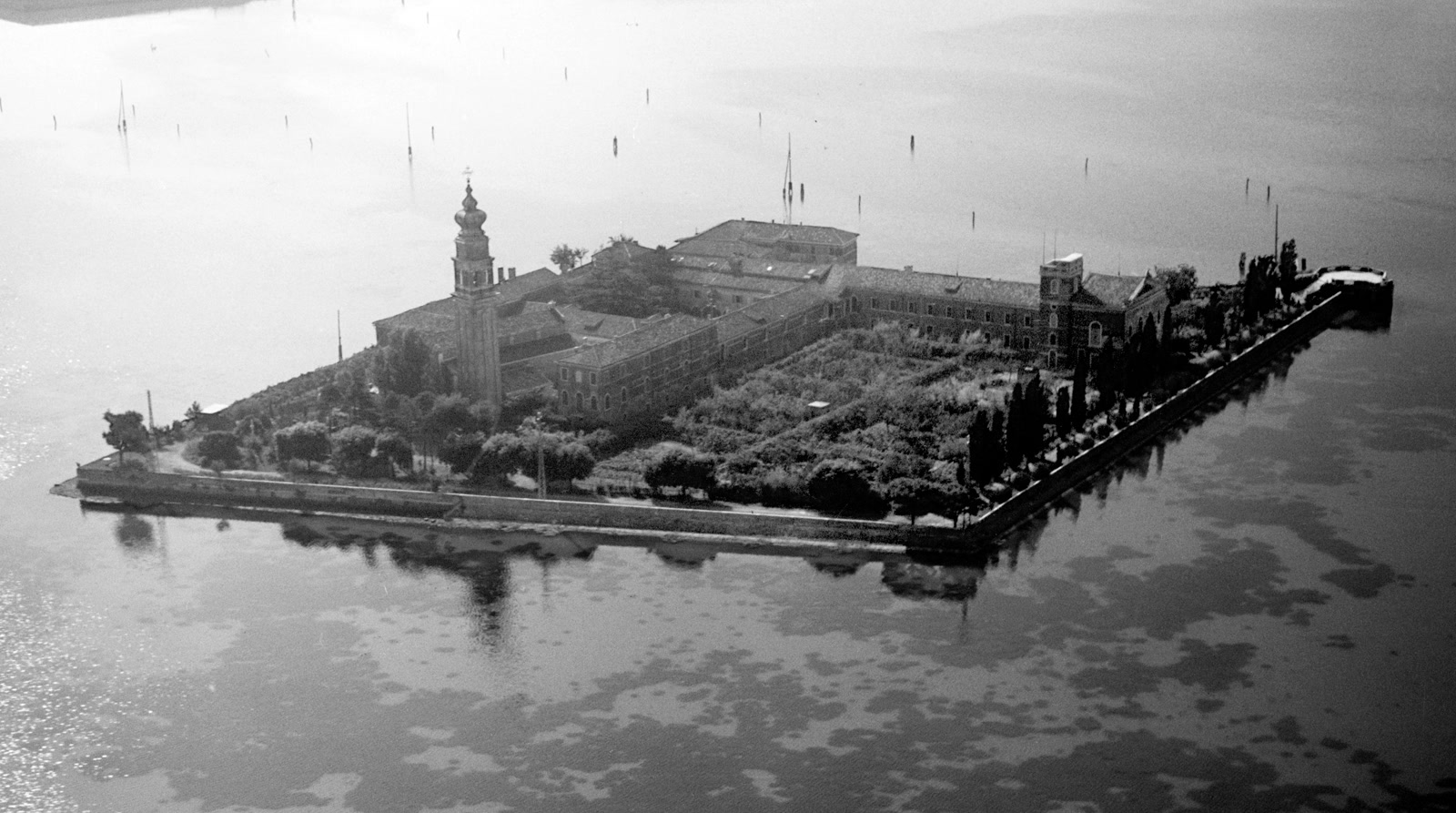
The Mekhitarist monks established their community on San Lazzaro in 1717 and developed a major centre for Armenian scholarship and printing. Through grammars, dictionaries, translations, editions and correspondence, the island linked Armenian culture to Venice and to far-reaching diaspora networks.
At a glance
- Island
- San Lazzaro degli Armeni, in the Venetian lagoon
- Community founded there
- 1717, under Mekhitar of Sebaste
- Earlier Venetian milestone
- The first printed Armenian book was produced in Venice in 1512
- Principal work
- Armenian-language publishing, translation, lexicography and manuscript scholarship
- International recognition
- Napoleon’s administration recognised the monastery as the Academia Armena Sancti Lazari
San Lazzaro degli Armeni is close enough to Venice for the campanili to remain visible, yet the short boat journey changes the scale of the world. Behind the island wall, Armenian manuscripts, dictionaries, maps, scientific works and printed books tell a story that reaches from the lagoon to Constantinople, the Caucasus, India and the communities of a global diaspora. The island’s press did more than reproduce texts. It helped standardise, teach and circulate languages. It connected monks, merchants, scholars and readers. By the nineteenth century, the Mekhitarist institution had become one of the most consequential centres of Armenian learning outside Armenia, while also printing works in other languages. Claims that the press worked in exactly “36 languages” circulate widely, but totals vary according to period and what is counted as a distinct language or script. The stronger story is not a number. It is the sustained multilingual practice visible in the books themselves.
Armenia was already present in Venice
San Lazzaro did not begin Armenian–Venetian relations. A documented Armenian presence in the city reaches back centuries. Ca’ Foscari scholar Sona Haroutyunian notes the establishment of Europe’s first Casa Armena in Venice in 1245, diplomatic links between the Venetian Republic and Armenian kingdoms, and the importance of Armenian merchants, including those from Julfa.
Printing created another bond. In 1512 Hakob Meghapart produced the first known printed Armenian book in Venice, the Urbatagirk. This occurred long before the Mekhitarists settled on San Lazzaro. Venice’s presses, type founders, trade routes and relative openness made it a place where a dispersed reading community could address itself through print.
The island monastery eventually concentrated and expanded that relationship. It gave Armenian scholarship a durable home with a library, press and disciplined community of translators and editors.
Mekhitar’s island
Mekhitar of Sebaste founded a Catholic Armenian congregation committed to religious and intellectual renewal. After displacement and negotiation, the community received San Lazzaro from the Venetian authorities in 1717. The island had earlier associations with a leper hospital and was small; the monks gradually enlarged and built upon it.
Their project joined spiritual life to philology. Preserving Armenian Christian tradition required reliable texts. Teaching required grammars and dictionaries. Communicating with European scholarship required translation in more than one direction.
This was not antiquarianism sealed away from the present. Language work served communities spread across different empires and commercial worlds. A printed book from the lagoon might travel farther than most residents of Venice ever would.
A press as a network
A press is often imagined as a machine in a room. At San Lazzaro it is better understood as the centre of a network. Manuscripts had to be found or copied. Editors compared versions. Type had to be designed and cast. Paper, ink and skilled labour had to be secured. Books then required agents, patrons and routes to readers.
Armenian presented practical typographic challenges, including its distinctive alphabet and a learned tradition with multiple textual registers. The Mekhitarists invested in clarity and precision. Their editions, grammars and dictionaries contributed to the development of modern Armenian intellectual life, though language standardisation was a broader, contested process involving many communities.
Translation widened the circuit. European works entered Armenian; Armenian history and literature became more accessible to European scholars. The monks worked across Italian, Latin and other languages as scholarship demanded. Some publications used unexpected language-script combinations, reminders that spoken language, religious identity and writing system do not always align neatly.
The useful problem of “36 languages”
San Lazzaro is frequently described as having printed in 36 languages. The number is attractive because it compresses cosmopolitanism into a memorable fact. It should be used with context.
Press output changed over decades. Catalogues may distinguish languages, dialects and scripts differently. A work translated from one language, printed bilingually or written in another language using Armenian characters complicates the count. The existence of multilingual production is not in doubt; the exact total needs a specified catalogue and date range.
This uncertainty does not weaken the achievement. It makes the archive more interesting. The press reveals language as practice: compositors setting unfamiliar characters, scholars choosing equivalents, readers crossing alphabets. Multilingualism was daily work, not a decorative ideal.
Byron and the seductive visitor story
Lord Byron’s study of Armenian with the Mekhitarists in 1816 is the island’s most famous visitor episode. It offers an accessible way into the story, but it can distort the proportions. San Lazzaro was not significant because a British poet noticed it. Byron came to an institution whose scholarship and networks already possessed their own momentum.
His presence nevertheless demonstrates the island’s role as an encounter point. The lagoon offered seclusion without isolation. Scholars could work in a monastic setting while remaining connected to one of Europe’s great port cities.
Napoleon’s recognition of the community as an academy offers another revealing episode. Religious houses across Venetian territories faced suppression, but San Lazzaro’s scholarly character helped distinguish it. The title Academia Armena Sancti Lazari expressed what the monks had built: an institution whose cultural function exceeded the conventional boundaries of a monastery.
Books as portable territory
For a dispersed people, a library and press can act like geography. They gather texts from lost or distant places; they send a shared language outward; they permit debate across borders. San Lazzaro became a kind of portable Armenia without pretending to replace the country itself.
The island’s collections preserve manuscripts and objects, but its deepest importance lies in circulation. Books printed there entered schools, churches, private libraries and scholarly collections. Dictionaries gave readers tools for crossing linguistic borders. Historical editions constructed narratives of collective memory.
This work was never politically neutral. Choices about classical and vernacular Armenian, canon and translation shaped identity. Yet the press’s endurance allowed those choices to be argued through print rather than lost to dispersal.
The lagoon as intellectual infrastructure
San Lazzaro also changes how we understand Venetian geography. Islands are often presented as picturesque fragments—the glass island, the cemetery island, the monastic island. But the lagoon functioned as an intellectual infrastructure. Water provided separation, while Venice provided trade, diplomatic access, craftspeople and postal routes.
The Mekhitarists used both conditions. The island offered continuity and concentration. The city offered connection. From this balance came an institution at once Armenian, Venetian and international.
When a boat leaves San Lazzaro, the island quickly becomes a line of trees and masonry. Its printed output moved in the opposite direction, expanding rather than disappearing with distance. The most accurate image of the monastery may therefore be neither its dome nor its cloister, but a page: letters fixed in ink, made on a small island and intended to travel.
How to read the collection
The most revealing objects are not always the most ornate. A grammar carries evidence of teaching; a dictionary records negotiations between concepts; a bilingual edition identifies the readers an editor hoped to reach. Marginal notes and revised impressions can show scholarship in motion. Seen together, these works make the monastery less a treasury of isolated masterpieces than a workshop with long-running intellectual projects.
Visitors should also distinguish the history of Armenian printing in Venice from the history of the island press. The landmark of 1512 belongs to the city's earlier Armenian print culture, while the Mekhitarist establishment on San Lazzaro dates from the eighteenth century. Linking the two is illuminating; collapsing them into one event is not. The interval itself demonstrates how durable the Armenian connection to Venice became.
Sources
- Sona Haroutyunian, “From Academia Armena Sancti Lazari to the Establishment of Armenian Studies at Ca’ Foscari,” Edizioni Ca’ Foscari, 2018: https://edizionicafoscari.unive.it/en/edizioni4/libri/978-88-6969-253-6/from-academia-armena-sancti-lazari-to-the-establis/
- Haroutyunian chapter DOI and open-access publication record: https://doi.org/10.30687/978-88-6969-252-9/003
- Annali di Ca’ Foscari. Serie orientale, supplementary volume containing research on multilingual and Armenian-script publishing: https://edizionicafoscari.unive.it/media/pdf/article/annali-di-ca-foscari-serie-orientale/2018/54supplemento/art-10.14277-AnnOr-2385-3042-2018-01-028_1bddG3S.pdf
This article was independently researched and produced. No payment, complimentary service or editorial approval was provided by the places mentioned.