
In brief
Murano, Burano and Torcello are three northern lagoon islands reachable by ACTV vaporetto from Venice in roughly 25 to 50 minutes. Murano is the historic glassmaking island, Burano is known for lace and brightly painted houses, and Torcello is a largely empty former settlement holding the lagoon's oldest church. Visiting all three well needs at least a full day, ideally two.
At a glance
- Location
- Northern Venetian Lagoon, ACTV lines 3, 4.1, 4.2, 12 and 9
- Best for
- Craft history, colour, and lagoon landscape away from central Venice
- Time needed
- A full day for all three; two calmer half-days is better
- Getting around
- ACTV vaporetto from Fondamente Nove or Murano; line 9 shuttles Burano–Torcello
- Access note
- Torcello's landing stage involves a short walk with no wheelchair-adapted path in places — check current accessibility with ACTV
- Last checked
- August 2026
Three islands, three different lagoons
Murano, Burano and Torcello sit within a few kilometres of each other in the northern lagoon, and it is tempting to fold them into a single half-day loop. Most guided tours do exactly that, herding groups through all three between late morning and mid-afternoon — precisely the hours each island is at its most crowded and least itself. Each island has a genuinely distinct identity, shaped by a different trade and a different relationship to the lagoon, and each rewards a visit that isn't rushed.
Murano: glass, fire and eight centuries of guild history
Murano has been the centre of Venetian glassmaking since 1291, when the Republic ordered furnaces moved there from central Venice — officially a fire-safety measure, though it also let the state monitor a trade whose techniques were treated as state secrets, with emigrating glassmakers historically at risk of prosecution. The Museo del Vetro, run by Fondazione Musei Civici di Venezia, traces this history in a Gothic palazzo that once belonged to the Bishops of Torcello. Beyond the showrooms along the Fondamenta dei Vetrai, smaller workshops still operate furnaces that can be watched from the street, and it is worth distinguishing genuine Murano-made pieces, usually marked and sold with documentation, from the imported glass that fills souvenir stalls closer to the vaporetto stop.
Burano: lace, colour and a working fishing island
Burano's houses are painted in a dense patchwork of colours that, according to local tradition, once helped fishermen navigate home through fog — a story repeated so often it has become part of the island's identity even where its historical accuracy is debated. The tradition is maintained today under a system requiring residents to request approval for house colours from local authorities before repainting, which keeps the palette distinct rather than arbitrary. Burano is also the historic home of a fine needle-lace tradition; the Museo del Merletto documents its near-disappearance and revival, and it is worth seeking out the handful of workshops where lace is still made by hand rather than machine-imported and resold as local craft. The island remains home to a working fishing fleet, visible along the Via Baldassarre Galuppi canal in the early morning before day-trip boats arrive.
Torcello: the lagoon's oldest settlement, now nearly empty
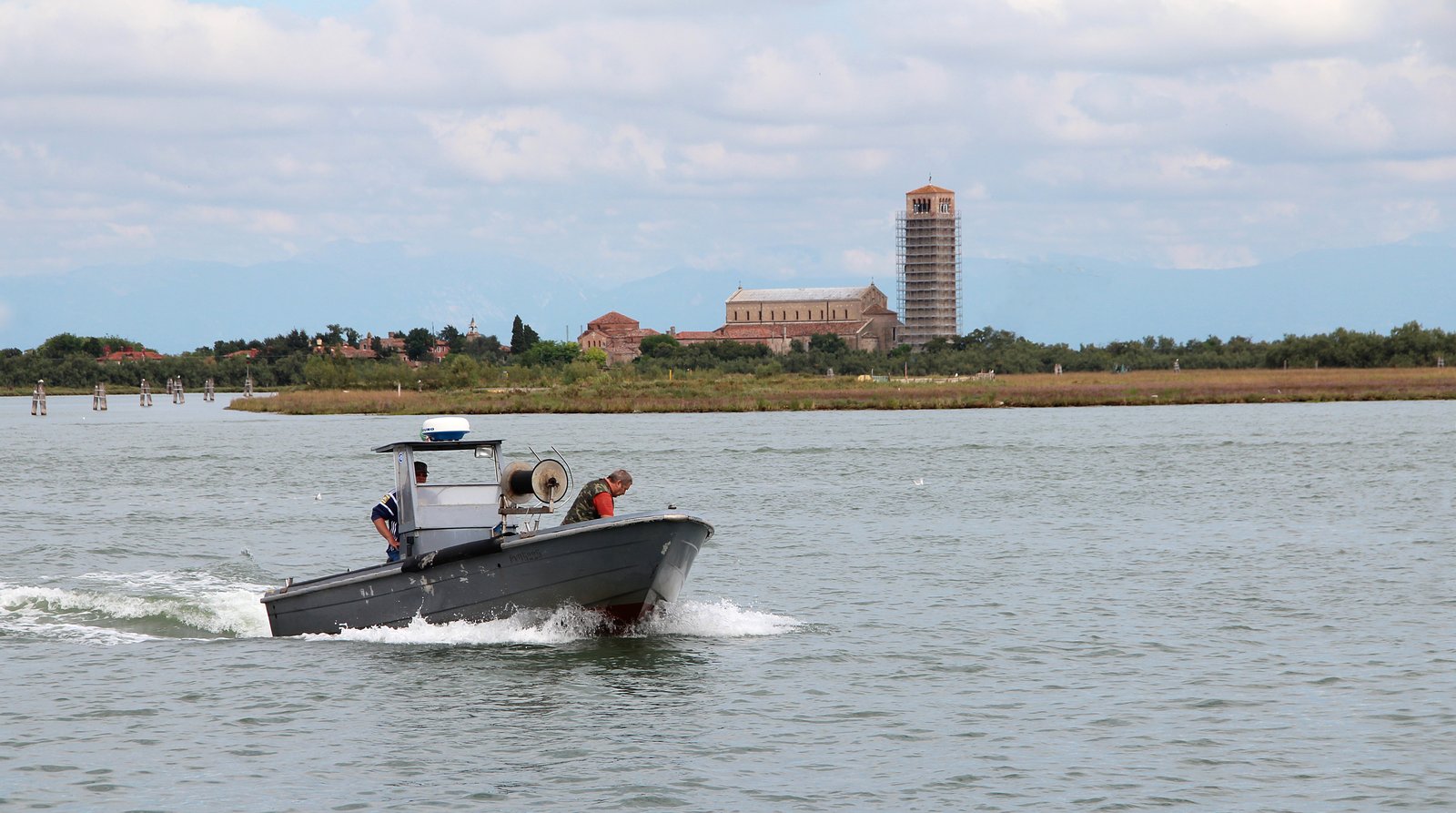
It is difficult to overstate how quiet Torcello is compared with Murano and Burano. Settled before Venice itself and once home to a population in the thousands, Torcello's fortunes declined as its channels silted and malaria spread through the marshland from the late medieval period onward; today it has only a handful of year-round residents. What remains is the Basilica di Santa Maria Assunta, founded in 639 and rebuilt in its current form in the eleventh century, holding some of the lagoon's oldest surviving Byzantine mosaics, including a striking Last Judgement on the west wall. The short walk from the vaporetto stop, along a stone path beside marshland and past the so-called Attila's Throne, gives a rare sense of what the lagoon looked like before Venice concentrated settlement onto the main islands.
What tour groups usually miss
The standard combined tour itinerary tends to stop at a single glass showroom on Murano (often one paying the tour operator a referral commission rather than the one making the finest work), spend perhaps forty minutes on Burano's main thoroughfare, and allow barely twenty minutes on Torcello before the return boat. Travelling independently by ACTV removes that structure entirely. On Murano, it is worth walking past the Fondamenta dei Vetrai's main strip to the Museo del Vetro and the quieter Sacca Serenella district, where several working furnaces operate away from the principal tourist route. On Burano, the streets running perpendicular to the main canal — away from Via Baldassarre Galuppi — hold small workshops and quieter corners of the same colour-block housing, with far fewer people photographing them.
Getting the order and timing right
ACTV lines 4.1 and 4.2 connect Fondamente Nove to Murano in around 10 minutes; line 12 continues from Murano to Burano in roughly 30 to 40 minutes, and a short shuttle (line 9) links Burano to Torcello in about five. Arriving at Burano and Torcello before 10am, ahead of the mid-morning tour groups, makes the single biggest difference to how each island feels. A Venezia Unica multi-day transport pass is generally better value than single tickets for this route, since it also covers the return legs and any detours back through Murano.
Eating on each island
Food follows trade on all three islands. Murano's restaurants lean toward seafood served with a degree of polish aimed at day-trippers with money to spend between glass showrooms, though smaller trattorie away from the main fondamenta serve simpler, better-value plates to a more local clientele. Burano's kitchens draw on the island's own fishing fleet, and risotto de gò — made with goby, a small lagoon fish rarely found on menus outside the immediate area — is considered a genuine local specialty rather than a tourist-menu invention. Torcello has almost no dining options at all beyond a couple of long-established restaurants near the basilica, a reflection of how few people actually live there rather than any deliberate scarcity.
Which island is worth prioritising on a short visit?
Travellers with only half a day should choose Murano for craft and museum depth, or Burano for colour, lace and a working island atmosphere. Torcello suits those with a full day to spare and a genuine interest in early lagoon history and quiet — it offers very little in the way of shops or restaurants, and that is largely the point.
Sources
- Fondazione Musei Civici di Venezia — Museo del Vetro and Museo del Merletto
- ACTV / Venezia Unica — public transport routes and timetables
- Diocese of Venice — Basilica di Torcello historical documentation
- Comune di Venezia — municipal heritage and island records
This article was independently researched and produced. No payment, complimentary service or editorial approval was provided by the places mentioned.