
In brief
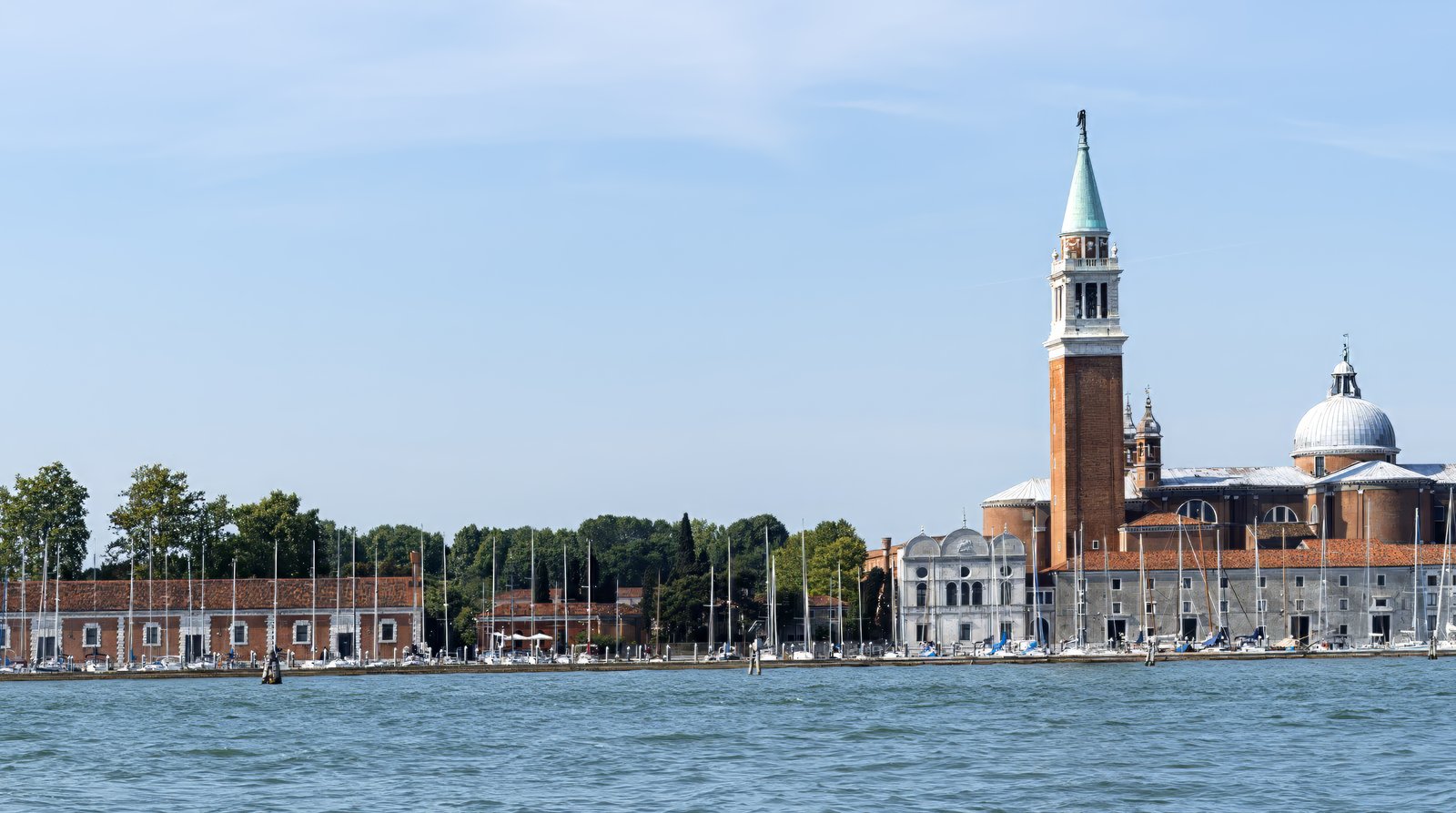
San Giorgio Maggiore is a small island directly across the Bacino di San Marco from the Doge's Palace, reachable by ACTV vaporetto line 2 in about four minutes. It is dominated by Andrea Palladio's church of the same name, built from 1566 on the site of a Benedictine monastery founded in the tenth century, and its campanile offers what many consider Venice's best panoramic view.
At a glance
- Location
- Facing San Marco across the Bacino di San Marco
- Best for
- Architecture, panoramic views, a short and calm excursion
- Time needed
- 1.5–2 hours including the campanile
- Getting around
- ACTV vaporetto line 2 from San Zaccaria, roughly every 10–20 minutes
- Access note
- The campanile is accessed by lift; church entry is free, lift ascent has a small fee
- Last checked
- August 2026
A monastery that predates the church by six centuries
San Giorgio Maggiore's religious history goes back further than its famous facade suggests. A Benedictine monastery was founded on the island in 982, and by the Republic's later centuries it had become one of Venice's wealthiest religious institutions, accumulating land, art commissions and political influence. The church visitors see today replaced an earlier structure damaged by earthquake, with construction beginning in 1566 to a design by Andrea Palladio — one of the most influential architects in Western history, whose classical, mathematically proportioned facades reshaped church and villa design across the Veneto and, eventually, well beyond Italy.
Palladio's white facade and what it changed
Palladio's design for San Giorgio Maggiore, completed after his death in 1580 by his collaborator Vincenzo Scamozzi, solved a problem that had troubled Renaissance architects for generations: how to apply a classical temple facade to a tall church with a lower-roofed nave and side aisles. His solution — overlapping two temple fronts of different heights and widths on the same facade — became one of the most copied architectural devices in European church design. Inside, the church holds two major late Tintoretto paintings, "The Last Supper" and "The Fall of Manna," commissioned for the monks' choir and among the artist's final major works.
The view the campanile is known for
The island's bell tower, rebuilt in the eighteenth century after an earlier collapse, is reached by lift rather than stairs, which makes it one of the more accessible viewpoints in the lagoon. From the top, the view runs directly across to the Doge's Palace, the Piazza San Marco campanile and the domes of the Basilica — a genuinely different vantage point from the more commonly climbed St Mark's Campanile itself, since it looks back at the postcard skyline rather than standing inside it. On clear days the view extends past Giudecca to the barrier islands and, in the other direction, toward Murano.
From Napoleonic barracks to a cultural foundation
The monastery's fortunes changed sharply after the fall of the Venetian Republic in 1797: Napoleonic suppression of religious orders and subsequent military use left much of the complex neglected or repurposed as barracks and storage through the nineteenth and early twentieth centuries. Its recovery began in 1951, when Italian industrialist and philanthropist Vittorio Cini established the Fondazione Giorgio Cini in memory of his son, restoring the monastic buildings, cloisters and library and turning the island into a centre for cultural and academic activity that continues today, including exhibitions, concerts and the Vatican Chapels project shown during the 2018 Venice Architecture Biennale.
The cloisters and the library
Beyond the church itself, the Fondazione Cini's restoration work uncovered and reopened two cloisters designed by different architects across the monastery's long building history: one attributed to the sixteenth-century architect Andrea Buora, the other to Palladio himself, completed after his work on the church. The monastic library, the Biblioteca del Longhena — named for Baldassare Longhena, the Baroque architect also responsible for Santa Maria della Salute across the water — holds a significant collection of manuscripts and rare books assembled over the monastery's centuries of scholarly activity, and can be visited as part of scheduled tours arranged through the foundation, offering access to a part of the complex most day visitors to the church never see.
A working cultural institution, not a museum piece
What distinguishes San Giorgio Maggiore from many restored monastic complexes in Italy is that the Fondazione Cini treats the site as an active cultural venue rather than a preserved relic. Its calendar regularly includes contemporary art exhibitions, academic conferences, concerts in the former monastic spaces, and collateral events tied to the Venice Biennale and Film Festival calendars. This active use means the island's atmosphere shifts noticeably depending on when it is visited — a quiet Tuesday morning bears little resemblance to a Biennale opening weekend, when the cloisters and gardens fill with an entirely different, art-world crowd than the church's usual visitors.
Visiting without the crowds
Because San Giorgio Maggiore is a short, self-contained crossing rather than a destination requiring a full day, it tends to avoid the sustained crowding of Murano or Burano even in high season — though the campanile queue can build in the late morning. An early or late-afternoon visit, timed for softer light on the return crossing toward San Marco, is generally the most rewarding approach.
Comparing San Giorgio Maggiore with the Redentore
Visitors interested in Palladio's Venetian churches often ask which of his two major lagoon commissions to prioritise if time allows for only one: San Giorgio Maggiore or Giudecca's Redentore, a short distance further west. The two share obvious architectural DNA — the layered classical facade, the luminous white interior — but differ in purpose and setting. The Redentore was built as a votive offering following a devastating plague and remains tied to an annual civic festival; San Giorgio Maggiore grew from an established monastic community and functions today as much as a cultural institution as a place of worship. Seeing both on the same day, connected by a short vaporetto hop, gives a clearer sense of how consistently Palladio solved the same architectural problem across two very different commissions.
Is San Giorgio Maggiore worth the short crossing?
Yes — at under five minutes each way by vaporetto, it is one of the lowest-effort, highest-return excursions in the lagoon, combining major Renaissance architecture, two significant Tintoretto paintings and what many visitors and Venetians alike consider the single best view of the city.
Sources
- Fondazione Giorgio Cini — monastery and cultural centre history
- Diocese of Venice — Basilica di San Giorgio Maggiore records
- Fondazione Musei Civici di Venezia — Palladian architecture documentation
- ACTV / Venezia Unica — vaporetto routes and timetables
This article was independently researched and produced. No payment, complimentary service or editorial approval was provided by the places mentioned.