
In brief
The Lido di Venezia is an 11-kilometre barrier island separating the Venetian Lagoon from the Adriatic, reachable by ACTV vaporetto in about 15 minutes from San Marco. Unlike central Venice, it permits cars and bicycles, and combines a sandy public beach with Belle Époque architecture, the Venice Film Festival each September, and a slower, more residential pace.
At a glance
- Location
- Barrier island between the lagoon and the Adriatic Sea
- Best for
- Beach time, cycling, film festival season, a change of pace
- Time needed
- Half a day for a walk and beach visit; longer for cycling the island's length
- Getting around
- ACTV vaporetto lines 1, 5.1, 5.2, 6; buses and bicycles once on the island; cars permitted (unusual for the lagoon)
- Access note
- Most named beach areas are attached to paid stabilimenti (beach clubs); a smaller public stretch exists near San Nicolò
- Last checked
- August 2026
The island where Venice's rules don't apply
Nearly everything that makes central Venice distinctive — no cars, no bicycles, footbridges instead of roads — is absent on the Lido. It is the one part of the historic lagoon municipality with a genuine road network, bus routes and private cars, a difference that dates to the island's development as a resort from the mid-nineteenth century onward, when it was laid out with wider streets and villa plots rather than a medieval calli network. For visitors coming from Venice's dense centre, the shift is immediate: wider pavements, front gardens, and a noticeably slower pace of daily life.
Belle Époque bathing culture and the Film Festival
The Lido's identity as a resort took shape in the late nineteenth and early twentieth centuries, when grand hotels including the Hotel Excelsior and the Grand Hôtel des Bains (the setting for Thomas Mann's "Death in Venice") were built to draw European aristocracy for sea bathing. That era's Art Nouveau and eclectic architecture is still visible along the Gran Viale Santa Maria Elisabetta, the island's main pedestrian thoroughfare linking the vaporetto stop to the beachfront. The Venice Film Festival, founded in 1932 as the world's oldest film festival, is held each early September at the Palazzo del Cinema, and for those two weeks the Lido's usually quiet pace shifts dramatically, with red-carpet arrivals drawing crowds to an island that spends most of the year in relative calm.
The beach, and how it actually works
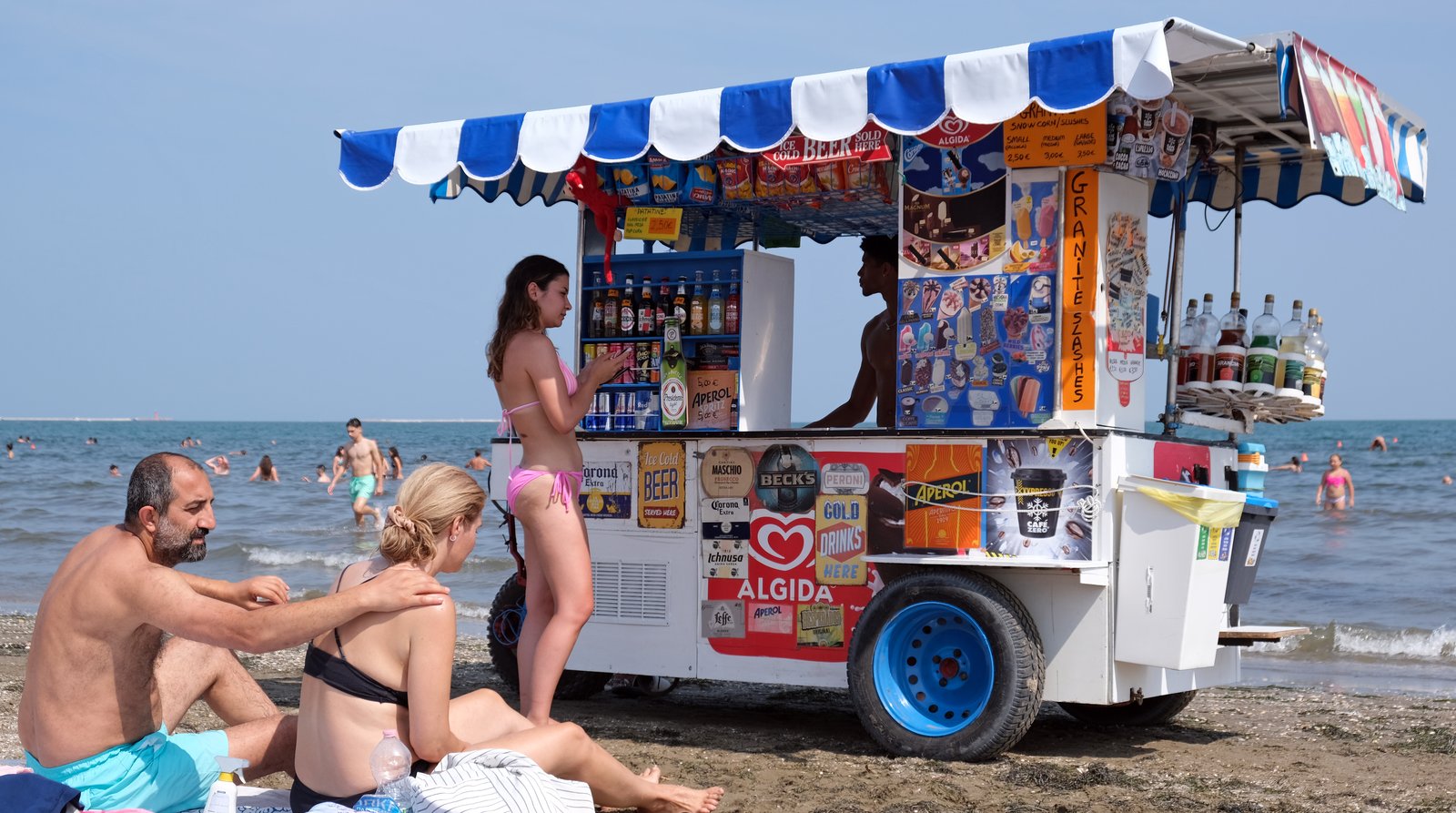
Much of the Lido's shoreline is divided into stabilimenti balneari — private beach clubs charging for umbrella and lounger hire, a long-standing Italian seaside convention rather than a Venice-specific one. Free public beach access exists but is more limited and less signposted, generally found toward the northern end near San Nicolò and the southern end toward Alberoni; asking locally or checking Comune di Venezia beach zoning maps before visiting saves a frustrating walk. The sand itself, fine and pale, faces open Adriatic water rather than the lagoon, giving the Lido a genuinely different sea character from the sheltered, often murky water elsewhere in the lagoon.
Cycling the island's length
Because it permits wheeled transport, the Lido is one of the only places in the Venice municipality where cycling is a practical way to get around, and several rental points near the main vaporetto stop make it easy. The island stretches roughly 11 kilometres from the Porto di Lido in the north to Malamocco, a small fishing settlement in the island's centre that predates the Lido's resort development and retains a distinctly different, older character, with the ride continuing south toward Alberoni and the connection to Pellestrina.
The Jewish cemetery and a longer memory
Near the Lido's northern end, the Antico Cimitero Ebraico is one of the oldest Jewish cemeteries in Europe, established in the early sixteenth century not long after the Republic formalised the Ghetto in Cannaregio, when Venice's Jewish community was granted land here for burial outside the city's dense centre. Weathered, tilting headstones, some dating to the 1500s, sit among trees and low scrub in a quiet corner of the island rarely visited outside organised heritage tours, offering a very different register of history from the Lido's Belle Époque hotels a short walk away.
Malamocco: the island's older, quieter half
Before the Lido became a resort, Malamocco was briefly the seat of the lagoon's ducal government in the eighth century, prior to power shifting to Rialto. The settlement visible today, with its small canal, church and fishing boats, was largely rebuilt after the original was lost to coastal erosion and storm damage centuries ago, but it retains an unhurried, working character that contrasts sharply with the Lido's northern resort strip.
Eating away from the beachfront
The Lido's restaurant scene splits fairly cleanly between beachfront establishments catering to stabilimento clientele and a quieter set of trattorie further inland, around the Gran Viale and the streets near Malamocco, that serve a more residential and, in the evenings, noticeably local crowd. Fish restaurants here draw on the same lagoon and Adriatic supply chains as central Venice, but with less tourist-driven pricing pressure, since the island's dining economy still depends heavily on residents and repeat summer visitors with houses on the Lido rather than one-time day-trippers.
The Lido across the seasons
Because the Lido's identity is so tied to summer bathing culture, it is easy to assume the island has little to offer outside the warmer months, but its character in autumn and winter is arguably more distinctive rather than less. Stabilimenti close, the beachfront empties, and the island's residential streets — quiet even in high season by Venetian standards — take on an almost provincial calm, closer in feel to a small Adriatic town than to anything associated with central Venice. Storms rolling in off the open sea give the seafront a different, wilder character in these months, visible from the Murazzi-adjacent stretches toward Malamocco, and cyclists willing to brave cooler weather have the island's roads almost entirely to themselves.
Getting to the Lido and back without losing the day
Because the Lido sits at a junction of several ACTV lines, it is easy to combine with other parts of the lagoon rather than treating it as an isolated destination. Line 1, the slower vaporetto that stops along the full length of the Grand Canal, connects directly to the Lido and makes a pleasant, if unhurried, way to arrive; lines 5.1 and 5.2 offer a faster circular route via Murano on one side and San Marco on the other, useful for anyone planning to combine a Lido morning with an afternoon back in the historic centre or an onward trip toward the northern islands.
Is the Lido worth visiting outside festival season?
Yes — outside the film festival's two weeks, the Lido is one of the calmest, least crowded parts of the lagoon, better suited to cycling, a beach afternoon or a walk through Malamocco than to sightseeing in the conventional sense, and it makes a natural link to Pellestrina for travellers heading further south.
Sources
- Comune di Venezia — Lido zoning, beach access and municipal records
- La Biennale di Venezia — Venice Film Festival history
- ACTV / Venezia Unica — vaporetto and bus routes
This article was independently researched and produced. No payment, complimentary service or editorial approval was provided by the places mentioned.