
In brief
Venice was the printing capital of Renaissance Europe, home to Aldus Manutius and the invention of italic type and the modern pocket-sized book around 1501. That legacy continues today in a small number of working letterpress and hand-bookbinding studios, mainly in Cannaregio and Dorsoduro, producing marbled paper, hand-set type and sewn-signature books using largely pre-industrial methods.
At a glance
- Historic peak
- Venice was Europe's leading print centre through the 15th–16th centuries
- Key historic figure
- Aldus Manutius, founder of the Aldine Press, active from 1494
- Surviving craft today
- Hand letterpress printing, marbled (carta marmorizzata) paper-making, hand bookbinding
- Where to find workshops
- Small ateliers in Cannaregio and Dorsoduro
- Where to see historic material
- Biblioteca Nazionale Marciana, Museo Correr
- Last checked
- July 2026
The city that printed Europe's books
It is easy to associate Renaissance printing with Germany, where Gutenberg's movable type began, but by the early sixteenth century Venice had become the industry's real centre of gravity — historians of the book trade generally credit the city with printing a substantial share of all books produced in Europe during that period, aided by its trading networks, access to paper mills in the surrounding Veneto, and a relatively liberal environment for publishing compared with more tightly controlled courts elsewhere. Hundreds of print shops operated in the city at the trade's peak, producing everything from religious texts to classical literature to the era's technical and scientific works, printed in Latin, Greek and the vernacular alike.
Aldus Manutius and the invention of the modern book
No single figure shaped that history more than Aldus Manutius, a scholar-printer who founded the Aldine Press in Venice in 1494. Manutius is credited with two innovations still shaping how books look today: italic type, developed to fit more text economically onto a page, and the small-format, portable printed book itself — the enchiridia, forerunners of the modern paperback — which he introduced around 1501 to make classical texts affordable and genuinely carriable, a radical departure from the large, expensive folio volumes that had dominated printing until then. The Aldine Press's dolphin-and-anchor printer's device remains one of the most recognised marks in publishing history, and surviving Aldine editions are held today in collections including the Biblioteca Nazionale Marciana, the historic state library facing Piazza San Marco.
What survives as living craft
Industrial printing long ago replaced hand-set type for ordinary publishing, but a small circle of Venetian studios keep the older methods alive as active trades rather than museum reconstructions. Letterpress printers still set individual metal or wood type by hand, composing text line by line before running it through manually operated presses — a process used today mainly for limited-edition prints, stationery and artist's books rather than mass publishing, but genuinely functional rather than purely decorative. Bookbinders in the same small workshops sew signatures (folded sheet groupings) by hand, attach boards, and cover finished books in leather or cloth using techniques largely unchanged from centuries of European binding practice, taking on both new commissions and the restoration of old, damaged volumes for private owners and institutions.
Marbled paper: a craft of controlled chance
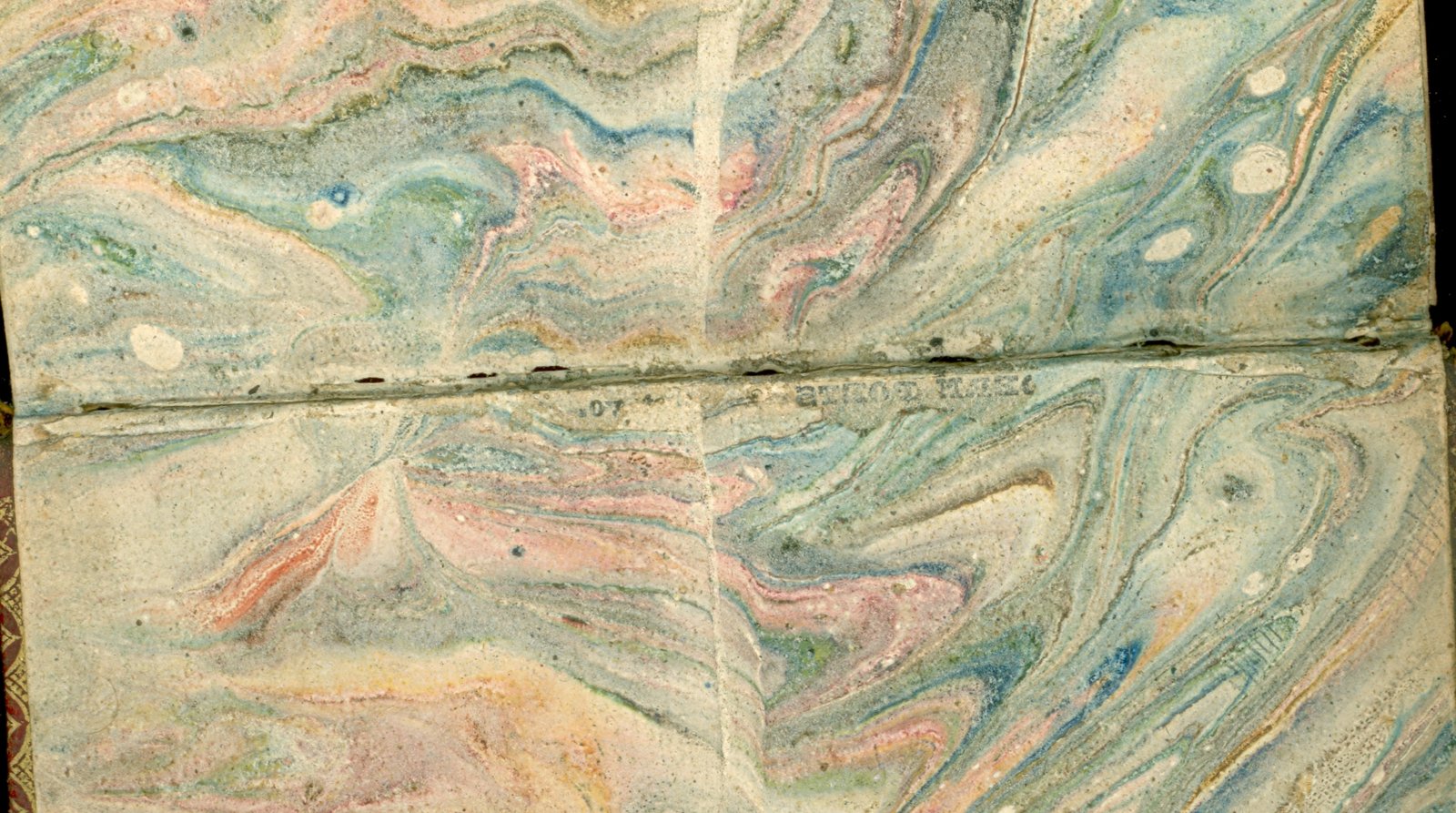
Alongside printing and binding, Venice is closely associated with carta marmorizzata, marbled paper made by floating pigments on a thickened liquid bath and carefully manipulating them into patterns before transferring the design onto paper laid across the surface. Though the technique's roots trace further east, Venetian workshops have practised and refined it for centuries, and it became closely tied to the city's bookbinding trade as endpaper and cover material — its swirling patterns instantly recognisable and still sold today, in genuine workshop-made form, alongside far more common printed imitations. Distinguishing the two requires a similar eye to spotting a handmade mask or a hand-carved forcola: real marbled paper shows organic, non-repeating variation between sheets, while printed imitation repeats identical patterns mechanically.
A trade surviving on commissions, not mass sale
Like most surviving Venetian hand crafts, print and bookbinding workshops today depend on a mix of restoration commissions from libraries and private collectors, custom stationery and artist's-book orders, and sales of smaller marbled-paper goods to visitors willing to pay for genuinely handmade material. Apprenticeship remains informal — typically learned directly in a workshop rather than through any large-scale vocational programme — which keeps the number of practitioners small but also means the craft's continuity depends heavily on individual workshops choosing, and being able, to train a successor. Some studios have found a second income stream in short workshops for visitors, offering an afternoon at the marbling trough or the sewing frame — genuine instruction rather than a packaged photo opportunity, and one of the more direct ways an outsider can grasp how much control the process actually demands, since a first attempt at marbling rarely produces anything close to a professional pattern.
Restoration work, quietly, is where the craft is busiest
Away from retail entirely, a meaningful share of the surviving trade's working hours goes into conservation rather than new production: repairing water-damaged bindings, resewing loosened signatures in centuries-old volumes, and rebuilding boards and spines for libraries, archives and private collectors managing books that have suffered from Venice's damp, saline air as much as from ordinary use. This work rarely reaches public view, but it is arguably the clearest evidence that the craft remains functionally necessary rather than nostalgic — someone has to be able to rebind a fragile seventeenth-century volume by hand, because no industrial process can substitute for it without damaging what makes the object worth preserving in the first place.
Where the history is documented
The Biblioteca Nazionale Marciana holds one of Italy's most significant manuscript and early-printed-book collections, much of it directly connected to Venice's printing golden age, while the Museo Correr's collections include material on the city's broader print and publishing trade. Neither substitutes for visiting a working atelier, but both provide the historical grounding that makes the surviving hand craft legible as a continuation of something specific, rather than a generic old-world aesthetic.
Sources
- Biblioteca Nazionale Marciana — Venice's national library, Aldine Press holdings and print history
- Fondazione Musei Civici di Venezia — Museo Correr publishing and print trade collections
- Comune di Venezia — cultural heritage documentation on Venice's historic printing trade
This article was independently researched and produced. No payment, complimentary service or editorial approval was provided by the places mentioned.