In brief
The Venice Ghetto was established by decree of the Venetian Senate on 29 March 1516, confining the city's Jewish population to a small island in Cannaregio, the site of a former foundry, or geto in Venetian dialect, which is the literal origin of the word "ghetto" used worldwide today. Five historic synagogues survive, built discreetly into ordinary tenement buildings. A small Jewish community still lives in Venice, and the Museo Ebraico di Venezia offers guided tours of the synagogues.
At a glance
- Established
- 29 March 1516, by decree of the Venetian Senate
- Location
- Cannaregio, on the site of a former foundry ("geto")
- Historic synagogues
- Five: Tedesca, Canton, Italiana, Levantina, Spagnola
- Enclosure ended
- Gates removed 1797, under Napoleon's occupying forces
- Where to visit
- Museo Ebraico di Venezia, Campo del Ghetto Nuovo
- Last checked
- August 2026
A word born on this one island
Every use of the word "ghetto," in every language it now appears in, traces back to this specific patch of Cannaregio. Before 1516 the site had been home to a foundry, a geto or ghèto in Venetian dialect, the word for the casting works once located there. On 29 March 1516, the Venetian Senate issued a decree confining the city's Jewish population to that same site, and the name of the foundry stayed attached to the neighbourhood that replaced it. From Venice, the word travelled outward with the institution it described, applied later to segregated Jewish quarters elsewhere in Europe and eventually, in the twentieth century, to any area of forced or de facto ethnic confinement. The origin is specific and traceable to this one square in a way few pieces of everyday vocabulary are.
New, old, and newest, in the wrong order
The area established in 1516 is properly called the Ghetto Nuovo, the "New Ghetto," despite being the first and oldest part of the quarter. The name follows the site's earlier identity as the location of the newer of the city's two foundries, not the sequence in which the Jewish community itself expanded into the area. In 1541 the quarter grew to include the Ghetto Vecchio, the "Old Ghetto," added to house Levantine merchants and named for the older foundry that had stood there instead. A third expansion followed in 1633, the Ghetto Nuovissimo, the "Newest Ghetto." Read as English, Old, New and Newest arriving in that order makes no sense; read as inherited foundry names, it makes perfect sense.
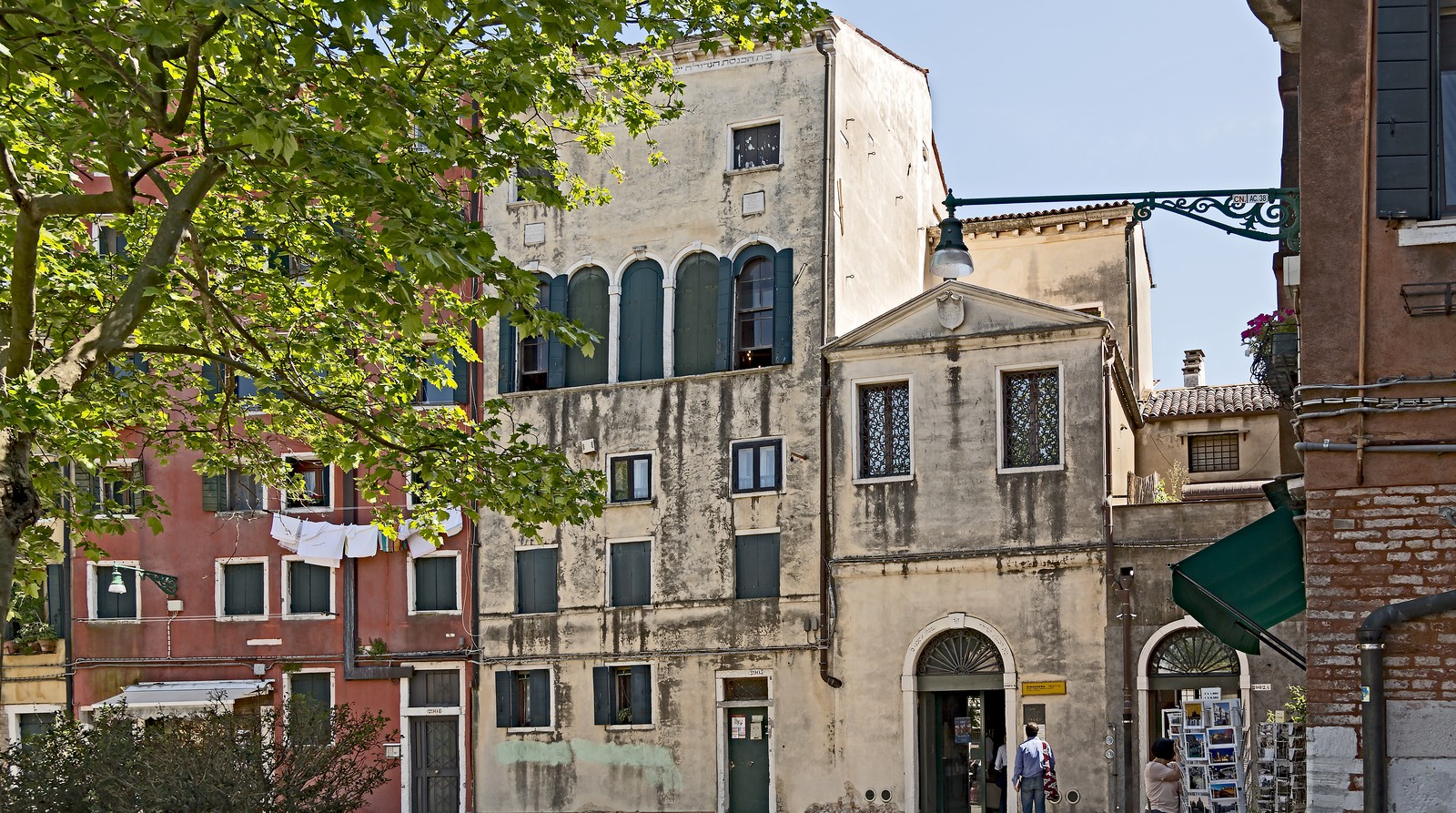
Because the site could not expand outward beyond its fixed boundaries even as the population inside it grew, the only direction left was up. Buildings in the Ghetto rose to six or seven storeys in places, tall enough that they remain among the tallest residential buildings anywhere in the historic city, a direct physical record of a community packed into a footprint that was never allowed to widen.
Gates, curfews, and three centuries behind them
The Ghetto was not simply a neighbourhood with a name; it was an enclosure. Gates at the bridges leading in were closed and guarded at night, and residents were required to be back inside before curfew. Outside the quarter, Jewish residents were required to wear identifying markers, a badge and later a yellow hat or beret for men, that made their status visible at a glance anywhere else in the city. This arrangement held, with variations, for close to three centuries, shaping daily life for generation after generation of Venetian Jews who lived, worked, prayed and raised families inside a space that was locked from the outside every night.
Five synagogues hidden inside ordinary buildings
A free-standing synagogue, visible as such from the street, was not permitted. Instead, the community built its synagogues, known as scuole, as upper floors inserted into ordinary tenement buildings, unmarked from outside and identifiable only by a scholar or a resident who knew where to look. Five of these historic synagogues survive from the period, each built by and for a different community that settled in the Ghetto over time. The Scuola Grande Tedesca, built for the German community in 1528, is the oldest. The Scuola Canton followed in the early 1530s. The Scuola Italiana was established in 1575. The Scuola Levantina and the Scuola Spagnola, serving the Levantine and Sephardic communities respectively, were built in the mid-to-late 16th century. Together they represent one of the more remarkable concentrations of historic synagogue architecture anywhere in Europe, made all the more striking by how completely ordinary each building looks from the campo below.
From Napoleon to the deportations
The physical enclosure ended in 1797, when Napoleon's occupying forces tore down the Ghetto's gates, though full civic equality for Venice's Jewish population did not arrive immediately and instead came in stages over the following century. The community's darkest chapter came under twentieth-century occupation: during 1943 and 1944, under German control and the Salò puppet regime, Venetian Jews were arrested and deported to Nazi camps, and the majority of those deported did not survive. In 1980, a bronze memorial by the Lithuanian-American sculptor Arbit Blatas was installed in Campo del Ghetto Nuovo, commemorating the more than two hundred Venetian Jews deported from this square. It remains there today, a quiet, unavoidable presence in a campo otherwise filled with the ordinary business of a living neighbourhood.
A community that still lives here
A small Jewish community remains in Venice today, commonly estimated at around 450 to 500 people, and the Ghetto is still its centre. The Museo Ebraico di Venezia, on Campo del Ghetto Nuovo, runs guided tours into the historic synagogues themselves, the only way most visitors can see their interiors. Chabad maintains an active presence in the quarter, including a kosher restaurant, Gam Gam, by the bridge at the edge of the Ghetto, and a kosher bakery nearby. The food this community still cooks, from sarde in saor to goose salami, is its own subject and the focus of a separate piece on Inside the Lagoon; what matters here is that after five centuries the Ghetto is not a historical curiosity preserved behind glass. It is a small, working, present-day Jewish quarter that happens to also be the place the word describing it was born.
Sources
- Museo Ebraico di Venezia (Jewish Museum of Venice) — Ghetto history, synagogues and guided tours
- Comune di Venezia — Ghetto heritage and civic documentation
- Comunità Ebraica di Venezia (Jewish Community of Venice) — community history and present-day life
This article was independently researched and produced. No payment, complimentary service or editorial approval was provided by the places mentioned.