
In brief
Burano lace is punto in aria, "stitch in the air," a needle lace worked entirely with a needle and thread over a paper pattern, with no woven backing fabric, unlike the bobbin lace made elsewhere in the lagoon. It was prized across 16th- and 17th-century Europe, nearly vanished after 1797, and was revived by the Scuola dei Merletti di Burano, founded in 1872. Today the Museo del Merletto documents the craft, and most lace sold on Burano's streets is machine-made, not hand-worked.
At a glance
- Technique
- Punto in aria (needle lace), worked with needle and thread only, no backing fabric
- Peak reputation
- 16th–17th century, exported and imitated across Europe
- Revival institution
- Scuola dei Merletti di Burano, founded 1872, closed 1970s
- Where to see it
- Museo del Merletto, Piazza Baldassarre Galuppi, Burano
- Run by
- Fondazione Musei Civici di Venezia (MUVE)
- Last checked
- August 2026
A technique, not a souvenir pattern
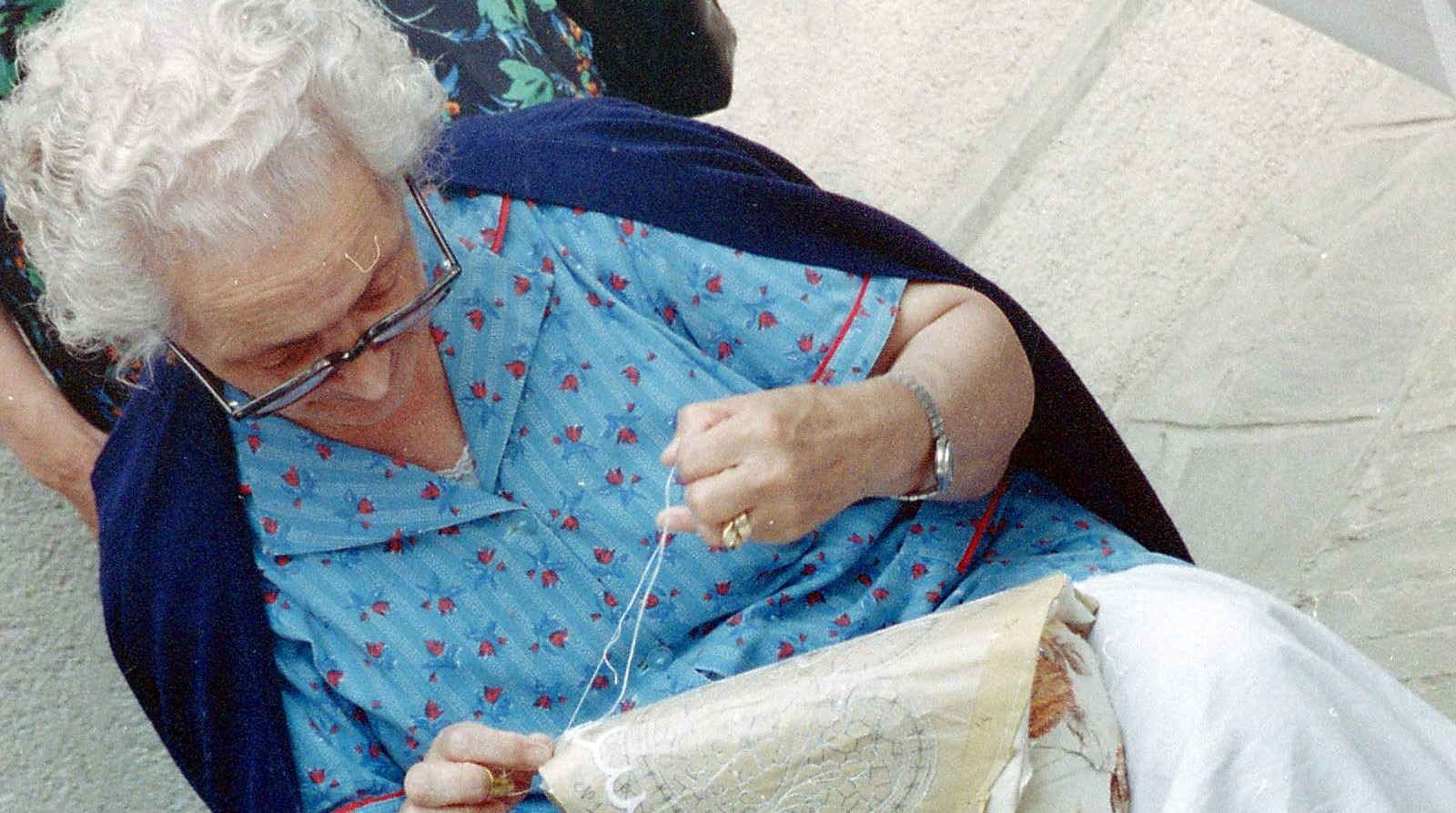
Burano is known first for its houses, painted in colours residents say once helped fishermen find their way home through fog. That is a fair place to start a visit, but it is not the island's defining craft. The craft is lace, and specifically a technique called punto in aria, literally "stitch in the air." A lacemaker works entirely with a needle and thread over a paper pattern basted onto a firm backing. Once the stitching is complete, the paper is cut away and the lace stands on its own, held together by nothing but the thread's own knots and loops. There is no woven ground fabric underneath, which is what separates true needle lace from embroidery.
This distinguishes Burano's lace from the bobbin lace, or tombolo, traditionally made elsewhere around the lagoon, notably on Pellestrina and in Chioggia, where many threads wound on wooden bobbins are twisted and crossed over a padded cushion following pins set into a pattern. Both are genuine lagoon hand-crafts and both take years to learn properly, but they are different disciplines with different tools, and conflating them, or conflating Burano's lace with Murano's glass simply because both are lagoon islands with a signature trade, misses what actually makes each one specific. Murano works with fire and molten sand. Burano works with a single needle, a length of thread, and time.
The lace France tried to copy
Venetian needle lace was, for a stretch of the 16th and 17th centuries, one of the most sought-after luxury goods in Europe. Collars, cuffs, altar cloths and diplomatic gifts made in punto in aria travelled from Venice to courts and churches across the continent, and the money that flowed back to the Republic to pay for it was substantial enough to draw the attention of at least one foreign government. In the 1660s, Jean-Baptiste Colbert, finance minister to Louis XIV, arranged for Venetian lacemakers to be brought to France to train workers there in the needle-lace technique, a deliberate effort to stop French money leaving the country for Venetian lace and to build a domestic industry instead. The result, over time, became France's own needle-lace tradition, centred on Alençon, known today as point de France or Alençon point. It is a well-documented case of a rival power moving to copy a Venetian craft outright rather than simply buying it, and it says something about how good the original was considered to be.
Decline, and a school built to save it
The Republic fell in 1797, and with it went much of the patronage and structured trade that had supported Venetian lace at scale. Fashion moved on through the 19th century, and the skills, painstaking and slow to teach, began to disappear along with the market for them. By the 1870s, genuine punto in aria was close to a lost craft on the island that had once defined it.
What reversed that was a mix of hardship and organisation. After a particularly harsh fishing season left many Burano families without income, Countess Andriana Marcello backed the founding of the Scuola dei Merletti di Burano in 1872, a lace school intended to give the island's women paid work as much as to preserve technique. The school sought out the few elderly women on Burano who still remembered the traditional stitches and set them to teach the next generation directly, passing the craft down through practice rather than written pattern books alone. The school operated for roughly a century, closing in the 1970s, by which point it had trained generations of lacemakers and kept punto in aria alive past the point it might otherwise have simply ended.
Where the craft lives now
The building the school once occupied, the Palazzo del Podestà on Burano's Piazza Baldassarre Galuppi, now houses the Museo del Merletto, run by the Fondazione Musei Civici di Venezia. Its collection traces the technique's development across centuries, from the earliest punto in aria pieces through the school-era revival work, and lacemakers sometimes demonstrate the stitches in person for visitors, needle moving over a pattern the way it has for hundreds of years. It is the clearest place on the island to see the difference between a genuine hand-worked piece and everything sold as its stand-in a few streets away.
Reading real lace from the rest
That difference matters because most of what is sold as "Burano lace" in the island's shops today was not made there, and was not made by hand. Machine lace and imported lace, much of it produced in Asia, fill the majority of the stalls along the main routes from the vaporetto stop, priced to move quickly to day-trippers who rarely have a way to tell the two apart at a glance. A genuine punto in aria piece, even a small one, can take a lacemaker weeks to complete; larger pieces take months. The price reflects that labour, which is exactly why authentic lace tends to cost far more than what fills the souvenir racks, and why a suspiciously low price on anything described as hand-made Burano lace is itself a warning sign rather than a bargain.
The deeper problem is a shrinking base of expertise. Very few lacemakers now living know the full traditional stitch vocabulary that once supported this craft, and most are elderly. Unlike Murano glass, where a number of family furnaces still train new apprentices at working scale, Burano's needle lace survives today mostly through museum demonstration and a scattering of individual practitioners rather than a functioning trade passing itself down naturally. For a personal account of what growing up on the island around this craft actually felt like, Inside the Lagoon's separate story "Growing Up on Burano" is a companion piece worth reading; this one is about the technique and the institutions built to keep it from disappearing altogether.
Sources
- Fondazione Musei Civici di Venezia — Museo del Merletto, Burano: collection and craft history
- Comune di Venezia — Burano heritage and craft trade documentation
- Historical record of the Colbert–Alençon lace-transfer episode, 1660s Franco-Venetian trade history
This article was independently researched and produced. No payment, complimentary service or editorial approval was provided by the places mentioned.