
In brief
San Francesco del Deserto is a small island of about three hectares in the northern Venetian Lagoon, close to Burano and Sant'Erasmo, home to a Franciscan friary that traces its founding to the thirteenth century. Reachable only by private boat or water taxi, it remains one of the few lagoon islands with almost no tourist infrastructure, sustained instead by the resident friars, who open the grounds to visitors for donation-based guided tours on most days of the week.
At a glance
- Location
- Northern lagoon, between Burano and Sant'Erasmo
- Best for
- Quiet, monastic history, a genuine contrast to nearby Burano
- Time needed
- About an hour for the guided grounds tour
- Getting there
- Private boat or water taxi only; no ACTV vaporetto stop
- Access note
- Donation-based visits, typically closed Mondays with limited hours; check current times before arranging a boat
- Last checked
- August 2026
An island named for its emptiness
Before it had any religious association, the small island between Burano and Sant'Erasmo was reportedly known as Isola delle Due Vigne, the Island of the Two Vineyards, a working patch of lagoon ground like many others nearby. The name it carries now, San Francesco del Deserto, points to something else entirely: "del deserto," of the desert, a description that has nothing to do with sand and everything to do with isolation. Marshy, mosquito-ridden and largely uninhabited, the island offered exactly the kind of solitude that a community of friars was looking for when it settled there, and the name stuck long after the vineyards did not.
The Francis legend
Local tradition holds that Francis of Assisi himself landed on the island in 1220, on his way back from the Fifth Crusade and the Holy Land, and stayed there briefly before continuing toward Venice. The best-known version of the story has him planting his walking staff in the marshy ground, where it took root and grew into a tree, an image later folded into the island's association with the cypresses that still line its approach. None of this is verifiable history in the way a land deed or a papal bull is; it is tradition, passed down through the Franciscan community itself and repeated in guidebooks and local accounts for centuries. The friars who show visitors around today generally tell the story as what it is: a founding legend, not a documented fact, though one that has shaped how the island understands its own origin.
A donation from the Michiel family
What is better documented is the island's transfer to the Franciscans in the thirteenth century, generally attributed to a gift from the Michiel family, one of Venice's old noble houses. The friars built a church and a small cluster of monastic buildings, and the community that took root there followed the pattern of many lagoon religious houses of the period: modest, self-sufficient, oriented toward prayer and manual work rather than the trade and politics that consumed the city across the water.
Abandoned, and abandoned again
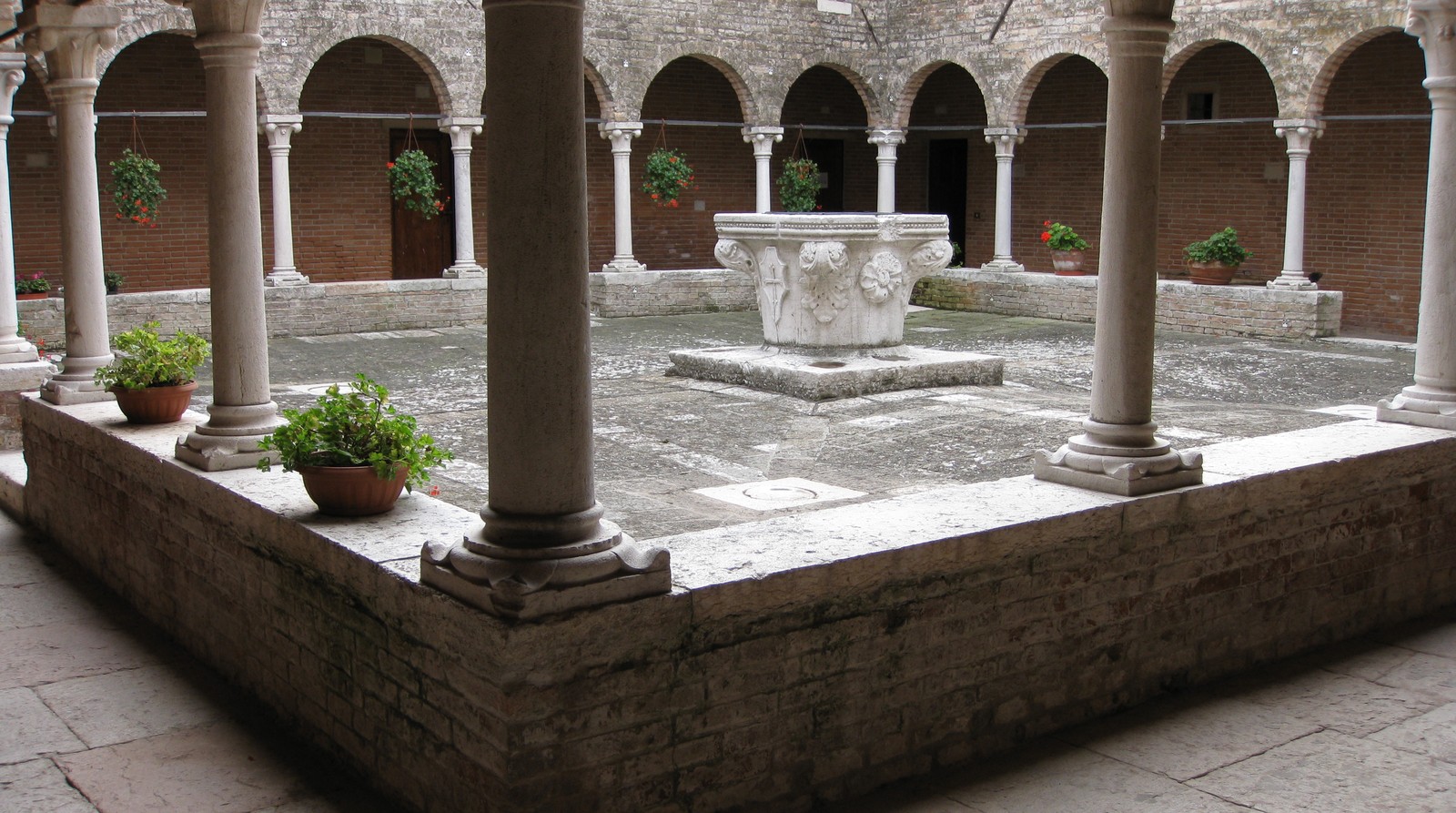
The island's religious history was not continuous. More than once over the centuries the friars left, most notably because of malaria that spread from the surrounding marshland, a disease whose mosquito-borne cause was not understood at the time and was instead blamed on the "bad air" that gave the illness its name. Each abandonment was followed, eventually, by a return, and each return required the buildings to be repaired or rebuilt rather than simply reoccupied. As a result, what stands on the island today, the church, the cloister, the friary, is substantially the product of restoration and rebuilding carried out across later centuries rather than a single unbroken medieval structure. Walking through it is less like visiting a preserved thirteenth-century site and more like reading the layered record of a community that kept choosing to come back.
The cypress avenue
The most photographed feature of San Francesco del Deserto is the avenue of tall cypress trees that runs from the boat landing to the monastery buildings, planted in close, disciplined rows that give the approach a formality unusual for the lagoon. Local tradition links some of these plantings back to the Francis legend and the staff that supposedly took root, though this connection, like the landing story itself, belongs to tradition rather than to any botanical record. What is certain is the effect: after the open water and the flat marsh grass around the island, the cypress corridor comes as a deliberate, almost theatrical change of register, announcing the friary before any building is visible.
A living community, not a museum
San Francesco del Deserto is still home to a small number of Franciscan friars who live and pray there, and the island functions as an active religious community rather than a heritage site managed for visitors. Tours of the grounds are generally donation-based rather than ticketed, led by one of the friars, and cover the church, the cloister and the gardens. Because it is a working friary, visitors are expected to keep a quieter, more respectful register than they might on a standard island itinerary: the kind of conduct appropriate to a place where people live and worship, not to a museum. The island is commonly closed to visitors on Mondays, and visiting hours are limited and can vary, so anyone arranging a boat should confirm current times with the friary or a water-taxi operator beforehand rather than assume a fixed schedule.
Getting there
There is no ACTV vaporetto stop on San Francesco del Deserto, and none is planned; the island is reached only by private boat or water taxi, typically arranged from Burano, a crossing of five to ten minutes depending on where you set off. Some water-taxi operators and boat owners on Burano offer the short hop on request, and it is worth confirming the return trip at the same time as the outbound one, since there is no scheduled service to fall back on if plans change.
Burano's noise, and the quiet just past it
The contrast with Burano is the most useful way to understand what San Francesco del Deserto actually offers. Burano, five to ten minutes away by boat, is loud with day-trippers, lined with lace shops and painted houses built for photographs, and run almost entirely on tourist income. San Francesco del Deserto has stayed outside that economy by design rather than by accident: there is no ferry stop to bring in crowds, no souvenir stand at the landing, and no pressure on the friars to expand visiting hours to meet demand. It is sustained by the community that lives there, not by the people who pass through, which makes it one of the few places in the northern lagoon that has kept something close to its original scale and pace.
Why the island still matters
San Francesco del Deserto is easy to miss on a standard northern-lagoon itinerary built around Murano, Burano and Torcello, and that is part of what makes it worth the detour. It offers a version of the lagoon's religious history that has not been converted into a hotel or a cultural foundation, still occupied by the kind of community that founded it, still reachable only on its own terms. Seen next to its more visited neighbors, it is a reminder that not every lagoon island took the same path from isolation to accessibility, and that a few, quietly, never did.
Sources
- Convento di San Francesco del Deserto: Franciscan community history and visiting information
- Comune di Venezia: lagoon island heritage records
- Patriarcato di Venezia: diocesan context for lagoon religious sites
This article was independently researched and produced. No payment, complimentary service or editorial approval was provided by the places mentioned.